
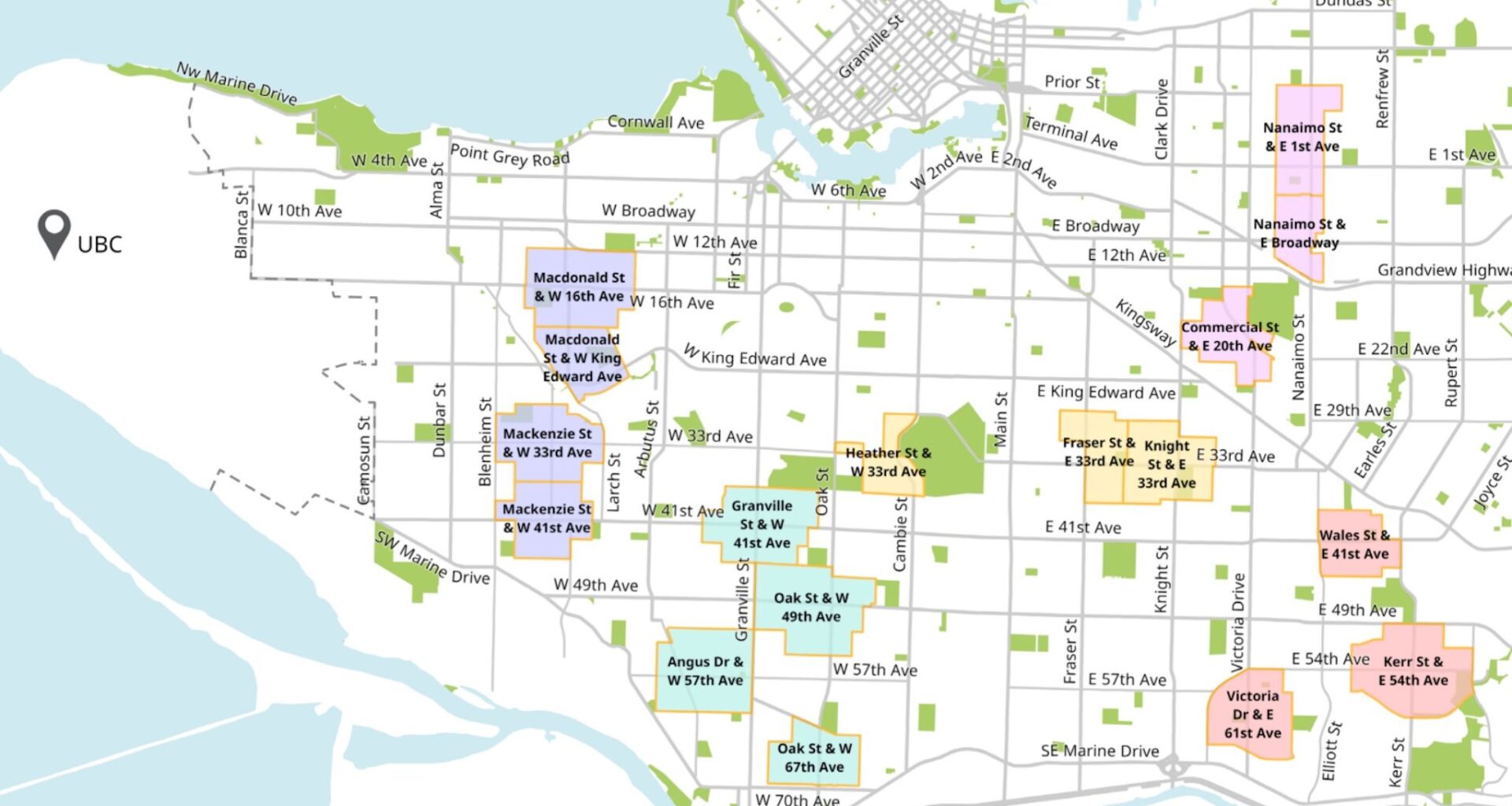
After a marathon public hearing held over several dates this month and involving a list of more than 340 registered speakers, the overwhelming majority of whom were opposed, Vancouver City Council this afternoon effectively rejected the highly controversial Villages Plan.
City Council opposed the proposed policies outlined by City of Vancouver staff to introduce low- and mid-rise residential density of up to eight storeys in 17 select areas across Vancouver, primarily within existing low-density, single-family neighbourhood areas. About 13,000 lots across the city would have been impacted.
In addition to introducing new multifamily residential density, it would have also created about one million sq. ft. of new retail/restaurant space across the commercial core areas of each of the 17 village areas.
The Villages Plan was cancelled in a 10-1 vote, with only OneCity city councillor Lucy Maloney voting in support of the strategy. Mayor Ken Sim and all six ABC city councillors — Sarah Kirby-Yung, Lisa Dominato, Brian Montague, Mike Klassen, Peter Meiszner and Lenny Zhou — voted against it, along with Vote Vancouver councillor Rebecca Bligh, Green councillor Pete Fry, and COPE councillor Sean Orr.
However, a majority of City Council endorsed an amendment to better enable small multifamily residential buildings with a single exit staircase in R3 zoning areas.
The Villages Plan was intended to create more complete, walkable neighbourhoods and bring a wider range of housing choices into areas where single-family detached houses remain the predominant form of housing.
During today’s debate and discussion, Mayor Ken Sim’s ABC Vancouver governing majority asserted that they would not support the Villages Plan in response to public feedback, including concerns relating to new restrictions over how some lots could be changed or redeveloped. They also suggested that there was a need for significantly more public consultation for the plan’s implications.
“This plan did not strike the right balance between housing growth, implementation, infrastructure and community confidence,” said Sim before voting against it.
The mayor said residents generally recognized the need for more housing, but raised legitimate concerns about the scale and pace of change, neighbourhood fit, infrastructure capacity, and how the plan would be implemented.
“I do think that no homeowner should feel that city hall is deciding the future of their property without their voice being heard,” said Sim.
“This is a plan that did not engage effectively with the public or respond to the serious concerns that were raised about these radical changes in their neighbourhoods.”
Today’s vote represents a major reversal for Sim and his ABC majority, which directed City staff in October 2023 to accelerate work on the Villages Plan, which was one of the components of the City’s July 2022-approved Vancouver Plan and the March 2026-approved overarching citywide Vancouver Official Development Plan (ODP). City Council subsequently endorsed the early planning work for the Villages Plan in October 2024, eventually narrowing the initiative from 26 potential village areas to 17.
Fry, who opposed the plan but was also critical of the process that led to its defeat, noted that City staff had spent nearly two years carrying out the work specifically requested by the mayor and the majority on City Council.
“The lesson here is not about the villages, it’s about governance and it’s about political expediency, because at the end of the day, public trust depends on Council providing clear direction and standing behind the process that initiates and being transparent when it changes course,” said Fry.
“Vancouver’s residents deserve more than two years of planning only to discover that the biggest obligation to the implementation of this plan wasn’t the technical or even the public opposition, it was the politics and the lack of political commitment from the people who initiated this process. Three years later, it seems like such a wasted, wasted amount of time and resources that could have been done so much better.”
Dominato asserted the broader economic and housing environment had changed substantially since the planning work for the Villages Plan was first initiated years ago, with much greater public concern now focused on affordability rather than housing supply alone.
“I think it’s helpful in terms of the Villages programme is to set this back in the shifting global environment that we’ve been experiencing particularly since since 2020. We went through COVID, we saw immigration restrictions, and now we’re at a place of growing economic instability, which is really driving a conversation around cost of living,” said Dominato.
“Over that time, we’ve also seen a shifting housing narrative, particularly when I was first elected, it was all about supply. Then it was about, are we getting the right housing mix? And I would say today, arguably, and I heard this in a number of the speaker’s comments was, it’s not only about those things, but it’s about affordability. And are we getting the right housing that is affordable for people regardless of the tenure?”
Meiszner also said the public consultation process may have relied too heavily on online platforms, suggesting that it may have failed to reach some older homeowners who do not regularly use the internet.
Kirby-Yung, who introduced an amendment that enabled the Villages Plan recommendations to be voted on separately from enabling small single staircase buildings, said the concept behind the plan had merit, but its execution and public consultation were deeply deficient.
“I think the idea of the villages plan was good. I think that the consultation and the execution was unfortunate at best and did not reflect the standards of the city that I believe that the residents should see,” she said.
“This was not ready for prime time. I think the intention was good. The execution was not.”
Kirby-Yung, who was first elected into City Council in 2018, said the opposition was unlike anything she had previously witnessed during a Vancouver land-use debate, describing it as a “tsunami” or “landslide.”
She was particularly critical of letters sent by the City to approximately 700 property owners whose sites could have been designated for mixed-use development, with. Some recipients interpreted the correspondence as meaning they would lose existing options to renovate, add laneway houses or build multiplexes and would instead be expected to pursue larger apartment or mixed-use projects.
Kirby-Yung said Council is not required to approve a report merely because staff had devoted substantial time to preparing it.
“That is not our job to rubber stamp things,” she said. “Our job is to look at, was it a good quality execution?”
Meiszner similarly called the proposal an overly broad, “one size fits all” approach that did not reflect the distinct conditions of individual neighbourhoods. He supported adding density and businesses to existing village areas, but argued the City should begin with one or two locations that would clearly benefit from revitalization, learn from those projects and then consider expanding the approach.
Zhou said he personally visited all 17 proposed village areas and concluded they were too different to be governed by essentially the same framework. He also questioned whether the plan would produce housing affordable to middle-income households and whether community and recreational facilities, transportation infrastructure, and utilities could keep pace with the proposed growth.
More to come…