
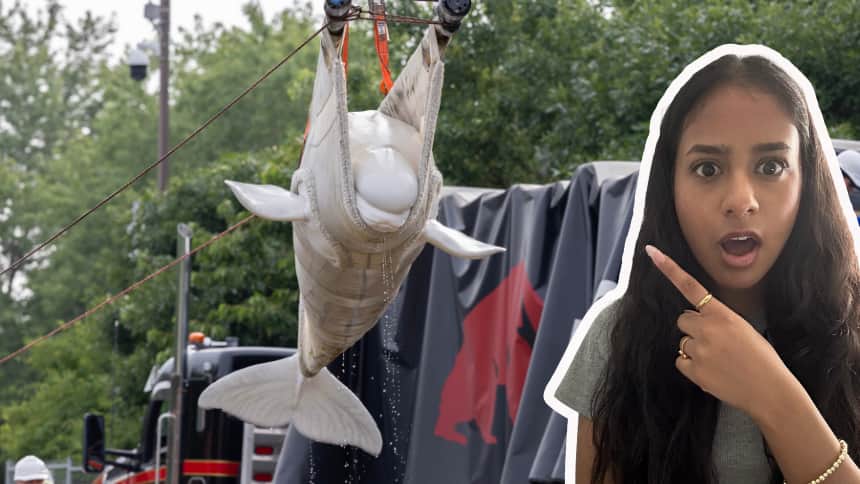
Belugas lived at Ontario park that closed in 2024
After years of their fate hanging in the balance, some of the 30 beluga whales from Ontario’s Marineland amusement park have now been successfully relocated.
On July 20, four beluga whales were moved from their long-time home at the park in Niagara Falls, Ontario, to Shedd Aquarium in Chicago, Illinois. Another two were moved to SeaWorld in San Antonio, Texas.
Earlier this year, the Department of Fisheries and Oceans Canada approved an emergency rescue plan for all 30 whales.
Watch this video to see how it all went down and then keep reading to learn more about how a team of experts were able to move such massive animals.
How to move a beluga
In a news release, the consortium of U.S. aquariums overseeing the whales said veterinarians specializing in marine mammal medicine and animal care specialists accompanied the whales on their trips to look after them.

A worker at Shedd Aquarium in Chicago, Illinois, where four of the Marineland belugas were relocated, warms up to a whale on July 20. Experts say it’s critical to make whales feel comfortable when they’re transitioning to new homes. (Image credit: Shedd Aquarium)
It said the American aquariums are also working around the clock to provide them with immediate care and get them used to their new homes.
That’s because being transported long distances can be very stressful — and potentially dangerous — for a whale, according to Andrew Trites, professor in the zoology department at the University of British Columbia.
He said that before whales are even transported, they typically go through training to get them used to the process, like swimming in and out of the transportation system.
“It’s very important to make the whales feel comfortable and safe. If they panic, they might thrash around during transport and end up hurting themselves,” he told CBC Kids News.
Trites said the transportation process typically begins by getting whales to swim into a sling, and then lifting the sling from the water using a crane.

Beluga whale Bertie Botts is transported using a special sling on July 20 by a group of experts from Marineland and several U.S. aquariums. (Image credit: Carlos Osorio/The Canadian Press)
From there, the whales are placed into cold-water containers with special padding, shock absorption and low light, which are then placed into a transport truck.
All the while, the whales are accompanied by trainers who know the animals really well, as well as veterinarians and other support staff who can feed the animal and help keep it moist and calm.
“People are able to touch the whale, talk to the whale, and tell it that it’s alright,” he said.
From there, the whales are transported to cargo planes. Once they land, they are again taken by transport trucks to their new homes and lifted into their enclosure.
Why not set them free into the ocean?
Whales that grow up in captivity cannot survive in the wild.
“It would be like asking why can’t I just put my grandmother back into the wilderness?” said Trites.
“Although humans evolved to survive in the wild, many of us no longer have those skills, and whales who grow up in captivity also never learned to survive on their own.”
He said the whales can also introduce certain viruses into the ocean that threaten wildlife.
Is this the best solution?
Although releasing the whales into the wild is off the table, some say there are better solutions than moving the whales to similar facilities.
The Whale Sanctuary Project — a Nova Scotia-based initiative that is building a natural sanctuary for whales and other captive sea creatures — said Marineland and other parks and aquariums aren’t the best homes for whales.
“These whales have survived for years confined to a barren, overcrowded environment where they simply do not thrive,” the organization told CBC Kids News in a statement.
It said captive whales should, whenever possible, be moved to sanctuaries that most closely align with their natural habitats rather than “concrete tanks.”
“In the future, we will need to do much better to have sanctuaries ready, with governments and marine parks all working together to provide these animals with a life they truly deserve.”
Have more questions? Want to tell us how we’re doing? Use the “send us feedback” link below. ⬇️⬇️⬇️
With files from Paul Forsyth/CBC and The Canadian Press