
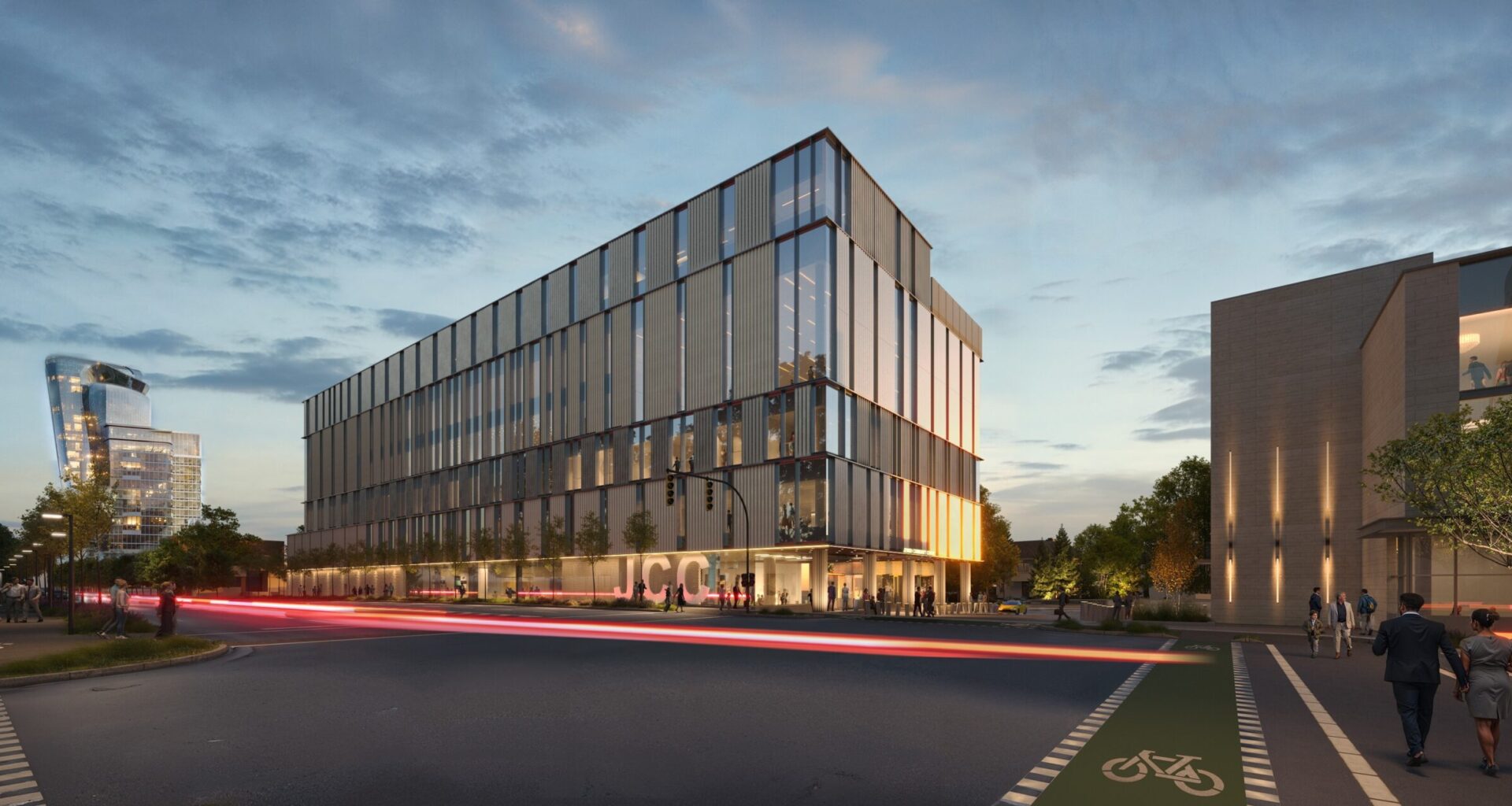
Canada’s largest public Jewish construction project, the JWest campus in Vancouver, has reached a significant milestone.
About two weeks ago, on July 16, Vancouver’s city council approved an updated rezoning proposal for the $235-million redevelopment that will build a new Jewish community centre, with a revamped Holocaust museum, daycare, theatre and space for 20 Jewish agencies, along with a larger King David High School next door. Eventually, the builders hope to erect two apartment towers offering 630 rental units, including some non-profit housing. Groundbreaking for the new JCC is expected this fall, according to Alex Cristall, the chair of the JWest Foundation, the fundraising arm.
Meanwhile, in Edmonton, work has been underway for months on a new JCC for a community that hasn’t had one since 2012. Edmonton’s construction is expected to be finished by early winter 2027, according to Stacey Leavitt-Wright, the CEO of the Jewish Federation of Edmonton. The $6-million project to refit an old Boy Scouts regional headquarters will build “a living room” for the city’s Jewish community, she said.
Unlike Vancouver’s massive undertaking, Edmonton’s will be on a much smaller scale. It won’t have a gym or a pool. But both communities share a common goal: creating new bricks-and-mortar hubs to provide a much-needed meeting place for Jews who have been seeking stronger community connections since Oct. 7, 2023.
On today’s episode of The CJN’s North Star podcast, host Ellin Bessner speaks with Alex Cristall and Stacey Leavitt-Wright about where each project stands to date, and why they are betting on the future growth of Jewish life in Western Canada.
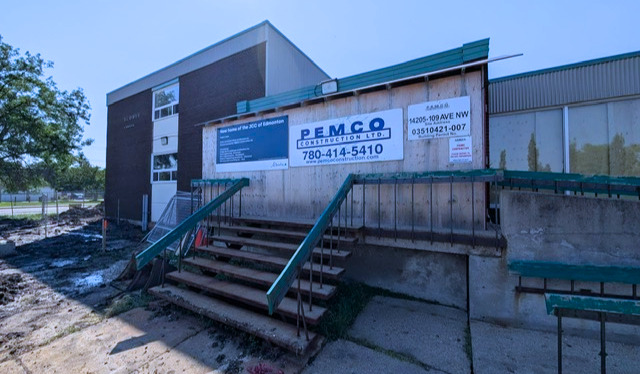 Edmonton’s Oshry | Kipnes Jewish Community Centre set to open this winter. (Photo by Bar Lavy/The CJN)
Related links
Transcript
Ellin Bessner: Twelve days ago at a meeting of Vancouver City Council, Ezra Shanken, the CEO of the Jewish Federation of British Columbia, urged councillors to approve the rezoning application for JWest, the landmark Jewish community redevelopment at Oak and 41st.
Ezra Shanken: Long after today’s debates are forgotten, families will live here. Families will learn here. Seniors will gather here. And communities will connect here. That will be the legacy of JWest. And in a time when it’s often easier to divide than to unite, we have chosen to invest in Vancouver, to strengthen Vancouver, and to help build Vancouver’s future.
Ellin Bessner: It’s Canada’s largest Jewish community building project right now. The $235 million plan calls for a new JCC of Greater Vancouver. With a daycare, a theatre, the Holocaust museum, offices for 20 major Jewish organizations, a new building: home for King David High School, and eventually, two residential towers with more than 600 apartments, including below-market housing.
City councillors said yes. The vote was unanimous.
It’s the latest milestone in the redevelopment we’ve been following here at The CJN for years. Officials say the vote clears the way for construction to start in the fall.
Meanwhile, nearly 1,200 kilometres away, construction is already underway on Edmonton’s new $6 million Oshry | Kipnis Jewish Community Centre, the first JCC in nearly 15 years since the old one closed in 2012.
Today, we’re checking in on both projects to see what’s changed, what’s next and why, in the wake of Oct. 7 and rising antisemitism, the two Jewish communities are investing millions in the future of Jewish life in Western Canada.
Alex Cristall: People were like, “We’ve got to plant a flag in the ground right in the middle of the city.”
Stacey Leavitt-Wright: What we’ve determined is the community needs a living room. It needs a central hub, a social gathering place.
Ellin Bessner: I’m Ellin Bessner, and this is North Star for Wednesday, July 29, 2026.
Welcome to North Star, the flagship news podcast of The Canadian Jewish News, made possible thanks to the generous support of the Ira Gluskin and Maxine Granovsky Gluskin Charitable Foundation.
Eight years ago, when JWest unveiled its ambitious plans to replace the 60-year-old JCC and transform the Oak Street campus into a modern Jewish community hub, construction was originally expected to begin in 2020.
But then came the COVID pandemic. Construction costs soared, the housing market changed and the project was redesigned.
The revised plan features taller residential towers, more rental housing and a standalone King David High School instead of one built onto a podium in the apartment towers.
dmonton’s project is much smaller in scale but no less significant for that community. Instead of building from scratch, leaders there purchased and renovated an existing building—the former Boy Scouts regional headquarters. Construction is underway, and they expect to open in the winter.
To bring us up to date, I’m joined from Vancouver by Alex Cristall. He’s chair of the JWest Foundation’s capital campaign. And from Edmonton by Stacey Leavitt-Wright. She’s CEO of the Jewish Federation of Edmonton.
Stacey Leavitt-Wright: Great to see you. Thank you.
Ellin Bessner: Well, it’s great to have you because it’s been a long time since you’ve been making news, and it’s time that we paid attention to what’s going on in Western Canada with these construction projects of the Jewish campuses, when many communities are downsizing in the faith world and amalgamating shuls and whatever.
So let’s get started with Alex.
JWest—when we last spoke, it was four years ago. I’d like to know: when people drive past Oak and 41st today, is there anything they can actually see that’s being built?
Alex Cristall: So not yet. We are just about to complete our fundraising. We’re just about getting permits. So I believe this fall there’ll be shovels in the ground. So it’s coming.
Ellin Bessner: And what will be the first thing?
Alex Cristall: So the first thing is the JCC needs to stay open because of all the services for seniors and kids and et cetera, and for the community. So we’re going to be building—the first phase is the new Jewish Community Centre. And once that is finished, which will be approximately three years, then the original Jewish Community Centre will be torn down, and then we will start the high school.
Ellin Bessner: Okay. I want to bring in Stacey from Edmonton.
Give us the Edmonton update. If someone drives past the site today of the former Boy Scouts building, what will they see?
Stacey Leavitt-Wright: So they will see a big sign out front announcing the Oshry | Kipnis Jewish Community Centre, no longer known as the Boy Scouts building—but that was the former Boy Scouts building.
They will see construction materials outside. They will see dumpster bins and construction fencing and PEMCO Construction signs, because construction has started on our project.
Ellin Bessner: Did you get a window in your office? Have you already figured it out?
Stacey Leavitt-Wright: I’ll have a view from the second floor, so I can see everybody coming and going.
Ellin Bessner: Okay.
Now back to Alex. The idea was to start construction earlier, and now you’re saying it’s going to be in the fall. What has changed, and what were the obstacles?
Alex Cristall: So, I mean, the schedule didn’t change too much, but one of the things—we only have one opportunity to go to the city. So we went back to maximize our zoning for the site.
Also, we’re raising approximately $235 million. I don’t think there’s a project like this in Canada, let alone just Western Canada or Vancouver.
So the key is we want to be in a really solid position with no debt. That was sort of the cautious approach we took.
But again, we’re right there. We had to do value engineering to make sure we’re building the correct building.
Ellin Bessner: But because of that, did that delay getting approvals for the changes in the project? Because we need to talk about the apartments, the size.
The City of Vancouver approved the original plans in 2018, which we talked about on air when we did the interview.
It’s going to look different now. What’s changed? Why are there more apartments, higher buildings and the school moved? Tell me what the list is.
Alex Cristall: So the key for that was we needed to… the apartments are really market-based. When the time is right, we will build them.
However, the new design gives a lot more flexibility because we owe our community—and we’re raising these funds for two things. No matter what, we need a new Jewish Community Centre, and no matter what, we need a new King David.
So if you go back to the old plan, the old plan showed King David High School being the podium of one of the towers.
I’ll credit our architects and our building committee, the JWest Development Corp. They came up with this great plan where, no matter what, King David is not attached to the apartments.
Those two potential apartment towers, which will also include some Jewish housing, will be on their own site. King David will have its own parcel. The JCC will have its own parcel.
And the beauty of that, too, is if King David grows, if we need more community space, we can actually build up. We’re not inhibited by the apartments. I mean, that could be 30 or 40 years out, but it’s just a much better plan. So that was the reason for the change.
Ellin Bessner: And you’re moving an apartment building somewhere too. It was supposed to be—
Alex Cristall: So instead of being a podium, we’re going to have two towers at the very west of the site. That’s where there’ll be room for the two towers.
Ellin Bessner: The Prime Minister was just in the news and the headlines in B.C. for the whole project of buying unsold condos. The project, from what I remember, said this was going to have a lot of social housing, and that’s less than it was going to be in this new iteration. Can you talk about that?
Alex Cristall: So yes. The economics, just like the condo developers are finding out right now, the economics to build these projects—we need a little more market housing to start with.
We’re going to have Tikva Housing Society as our partner, running those homes. Our goal will be to keep growing over the years to get as much as we can for our community. But at this point, based on that original plan, we’re looking at potentially—not quite as much as at the outset—because the bottom line is we have to make it feasible to build. That’s the most important thing. And we are lacking rentals.
Ellin Bessner: In Edmonton, housing’s not part of this, but I also learned there are no JCC pool or fitness centre. That was by design. Can you walk our listeners through why not?
Stacey Leavitt-Wright: Absolutely.
And I will say one thing that we do have in common with the Vancouver project—certainly we’re not a $235 million project—but we’re going in with no debt.
We did go through a whole value-engineering process. We did heavy consultations with the community and also built on the work of previous committees who tried to get a JCC going over time.
What we’ve determined is the community needs a living room. It needs a central hub, a social gathering place.
Taking on a pool and fitness facilities is extra capital and extra operating costs that the community doesn’t need. We also know one of the reasons the old JCC didn’t last was having to maintain that and the cost of that, as people were going to private clubs and to facilities like the Y.
So that exists in the city. What doesn’t exist is a Jewish central social gathering place.
Ellin Bessner: Whereas how many Jewish people are you hoping to serve in Edmonton—and also non-Jewish clients? Let’s talk about that first, and then Alex.
Stacey Leavitt-Wright: So I think first we had to focus on what are the resources we have to make this work.
We did not want to take on any debt, to be very clear about that.
And what is the financing capacity or the donor capacity to bring this forward? Certainly another $10 million could go to a larger building and bring in the fitness facilities, et cetera.
So we’re doing something that’s right-sized for this community, basically.
We have 5,690 Jews in Edmonton, according to the 2021 census. They are dispersed across the city, so the location was very important for us to get right and to ensure that community agencies and gatherings could take place in a very safe place.
Ellin Bessner: Coming up: how Oct. 7 changed both projects, and why creating safe, secure gathering places for Jewish communities has become more important than ever.
You mentioned that. Let’s talk about it before we go back to Alex.
How did Oct. 7 and security—when you were planning the Vancouver one, you were probably worried about seismic issues and heat domes and accessibility. Now you have Oct. 7.
Can we talk about whether that has changed things in terms of costs—added costs? Anyone can jump in.
Stacey Leavitt-Wright: I will say October 2023 is when we had found this building and wanted to bring it forward to the community for a vote to see if this is a building that we would take on to be our new home.
At the time I thought, “What am I doing? We have other things to focus on. Is this really what we should be doing right now?”
And really, it was the best thing we could be doing—giving such life and excitement to the community and really solidifying that we are here for another 125 years and counting.
I wouldn’t have thought back then that we’d be putting in the security measures that we’re having to do now.
It is a key component of this facility, that our Jewish gatherings have a place where people feel very comfortable hosting and being in this building.
And with the government funding that’s being made available, it will lessen the burden on the community of carrying that.
Ellin Bessner: Okay. And what about in B.C.?
Alex Cristall: Yeah, similar.
Even at the beginning, security was still on our minds, and when the design was happening there was consultation with security.
However, yes, that’s been upgraded in costs and costs added. It is what it is.
What I can say is, I mean, as I said, it’s a large fundraising campaign.
At the beginning we got off to a great start, but those are the easy asks, right? Those are your traditional supporters that I’m already aware of.
Ellin Bessner: And your family has skin in the game personally too.
Alex Cristall: One hundred per cent. We all do.
And what I can say, which has been so uplifting, is it’s like any fundraising campaign—you go through peaks, maybe a lull, and then you get inspired again.
Oct. 7 was such a tragedy, but the response from the community has been unbelievable.
When I say our community—I think it’s 30,000—we’re getting more and more. I think more and more people are coming out. There’s more people looking for community, actually.
And our fundraising responded in such a big way where people were like, “We’ve got to plant a flag in the ground right in the middle of the city.”
Similar to what you were saying in Edmonton, this is a generational thing.
I think people have been looking for community, and the response has been one of pride.
With that tragedy that should never have happened, it’s great to see that you have choices. You could go backwards and hide, or you could all come out as a community and be stronger and more proud and participate more.
We’re seeing way more participation.
Even from a fundraising perspective, it’s had a really inspiring impact. People feel the need for a campus.
Ellin Bessner: But are you seeing—I know there’s been some growth—what about in Edmonton? Who’s going to use this? Is it Israelis? Who’s coming that’s boosting the numbers? You’ve got about 500 extra over the last census.
Stacey Leavitt-Wright: We are seeing some growth. We’re definitely seeing new Israeli families, for sure.
I’ll tell you, as Alex was just saying about bringing out new donors and everybody having a part of it, we launched a secondary campaign called the L’Chaim Campaign, which allows anybody in the community who wants to have a part in this to make that donation and have their name on the L’Chaim board that will go up until the end of the summer.
Day one, they’ve brought this building to life.
We’ve had people come out that we haven’t heard from in this community who’ve been here for 30 or 40 years.
People who’ve been here since 1980 have said, “I want my name on that board. This is important for this community.”
So it feels wonderful.
Ellin Bessner: That’s interesting. So these are Oct. 8 Jews that are, like—they may have been there before, but now they really are coming out. So that’s very interesting. You’re seeing that in both communities, as well as immigration, is what I’m hearing.
Stacey Leavitt-Wright: So the traditional names of the generous donors who always stand up when we ask for help—and we have staff members, we have young families, new families, people who just want to be a part of this and are making significant gifts, stretching themselves to make it happen.
Alex Cristall: We just launched our final campaign—our final $18 million—and we’re six million into this last $18 million. That’s inviting the whole community.
We have more big donors than ever before on this project, and we have more donors, whether it be $18 to $3,600.
What I do know is everybody that’s been asked has increased what they’ve ever done before. So whatever that is, it’s similar to what you’re saying. Just, “I want a piece of this legacy project that is going to stand the test of time.”
I grew up in this JCC. It’s 60 years old. So it’s actually nice for my generation to be part of the next one. And it’s not just my generation—everybody’s involved—but it’s kind of rewarding to know that we’re going to leave something here.
So it’s been well received.
It’s also very nice that we’re getting corporate gifts as well, so we’re feeling that support from outside our community, which is nice for a change.
So it’s been well received by the whole city and the province, in my opinion.
Ellin Bessner: Alex, the news out of the Federation in B.C.—it’s now called the Jewish Federation of British Columbia—is an important topic to bring up because we’ve heard from Ezra Shanken and all of the people who are involved in this change that half the Jewish population of British Columbia doesn’t live in Vancouver.
So how do you have a beautiful campus if half the population is so far away?
Alex Cristall: First of all, from a federation perspective, the whole province is growing.
For us, the majority of this—we did a study—within 10 kilometres east, west, north and south is still, I’d say, 60 to 65 per cent of B.C. Jewry. We have checked that.
But it’s also sort of like—it reminds me of Israel. You’ve got the spoke in the wheel, right? Israel’s here. We need it. It’s important.
You need a strong core to have a very proud and strong periphery as well.
So it’s not necessarily just a school or just something you do every day.
This campus is here whether it’ll be a theatre event, whether it’s somebody in Victoria coming for a conference.
A strong core will make everybody stronger, whether it’s in North Vancouver, Coquitlam—they come in for the weekend. There’s the subway.
But even if it is Victoria or Kelowna, if you have a strong core—and that’s what Federation recognized, because Ezra and his board have done such a great job of making the whole province inclusive—but it’s going to be based here on this campus.
Ellin Bessner: So who’s going to come in Edmonton to yours? Is it mainly for the Jewish community, or is it also open, like all the ones here in Toronto, to anyone?
Stacey Leavitt-Wright: Yeah. So the building is mainly geared—especially in its programming—to the Jewish community, some of which we’re still starting out.
But we have large multipurpose space. We have other community rooms. We’re going to have a children’s play area, a research library, a teen lounge and a rooftop patio.
So with government funding in place, of course, we want to make many of our programs accessible to the greater community.
We’ll be providing rental space as well, so that’s also available outside of the community.
And we have the future home of the Jewish Heritage and Holocaust Centre being developed.
So with that, we can envision many school groups and other interest groups coming and learning and engaging with our community.
We hope to put on even more welcoming programs and build upon the work we’ve done over the last two years.
With a dedicated space that we don’t have to go scrambling or negotiating for, we’ll be able to strengthen all of what we’ve been doing.
Ellin Bessner: Right, because people don’t realize—but maybe you can tell them—how long has it been since there’s actually been a JCC in Edmonton?
Stacey Leavitt-Wright: Since 2012. So it’ll be 15 years by the time it opens since we’ve had one.
Ellin Bessner: Alex made eyes like, “Did you not know that?”
Alex Cristall: Yeah, no, I didn’t realize.
Stacey Leavitt-Wright: Yeah, that old building in Rio Terrace is beloved.
Many people grew up there and have fond memories of it.
When they walk into our new space, they see the ceiling, which reminds them of the ceiling that was in the old pool area. It’s a wooden ceiling. It’s got a little character to it.
But it’s been a long time.
So we’ve had a generation or two, you could say, who’ve grown up without a Jewish community centre.
The BBYO gatherings have been happening in people’s homes. They’ll happen now in the centre.
We’ll be able to host conventions.
When we have groups coming to Alberta, whether it’s school groups from Montreal, like we had Bialik last year, or robotics teams coming here from Israel annually, it seems, we’ll have a place to bring them and welcome them to the community and showcase the community.
And our fundraising is for an endowment campaign because we want to make sure this building will always have the operating funds so we’re never in the position we were with the old building.
We’ve made excellent progress in a very short period of time.
I want to make sure we get to goal—and even beyond goal—so I can sleep even better.
Ellin Bessner: Do we have a date when we’re supposed to open?
Stacey Leavitt-Wright: By winter, we should be occupying the building.
Then we’ll be able to plan a ribbon-cutting and all those wonderful, exciting things.
You know, Ellin, one of the things you had mentioned was the migration and attraction of newcomers to our cities.
I really feel that when people are looking at Alberta, if they don’t see a community centre, they don’t see that vibrancy—even though it exists without walls and in various pockets.
But having that in one space is going to make it a more attractive community to come to.
So I look forward to what this will do for our community going forward.
Ellin Bessner: Just so people might not know, where is there Jewish stuff happening? Like, where do you actually have your office now? Or do you work from home?
Stacey Leavitt-Wright: No, I’m in a rented facility. We have a very generous donor who provided us with wonderful low-cost rent in a facility that he had his offices in.
So we’re in temporary space. We’ve been in temporary space since 2012, and another space as well.
So that’s where our offices are.
Our programs are partnered with synagogues, and some with Talmud Torah. The film festival takes place in the theatre. We partner for PJ Library things.
But to be able to actually have everything at once—it’s just wonderful.
Ellin Bessner: So where are we at in terms of the fundraising? You have to raise $235 million, give or take. So where are we at?
Alex Cristall: So, $235 million. We’re down to our last $18 million. Of that, we’ve raised $6 million in this final tranche. So we’re looking for $12 million more.
Ellin Bessner: Stacey?
Stacey Leavitt-Wright: So we’ve raised all the capital that we needed beyond the proceeds of the sale of the former building.
We are close. We’re about two-thirds of the way to our goal.
We’re wanting to get to $3 million, but what would make me sleep better at night would be getting to $5 million.
I would say this is a legacy project, so anybody with any connection to Edmonton who would like to see their family recognized in this building—I would be thrilled to have a conversation.
Ellin Bessner: Now, you have naming rights already. You’ve told me already what the name is.
What’s going to happen with the naming rights for JWest?
Alex Cristall: There are.
We have the Diamond Family JCC, the Roadburg Campus, and then we have other spots—a whole slew of very generous donors who have found their own pieces that mean something to them on the campus.
You know, it’s our Bathurst now—Oak Street. Our synagogues, our Talmud Torah, our JCC, King David.
So when we’re closer, you’ll have to come and do your show from Vancouver.
Ellin Bessner: Listen, I would love to.
But also, you know, I go to the one in northern Toronto where they had CHAR—now TanenbaumCHAT. It closed because they couldn’t sustain it. They took the actual Lebovic name off. I mean, it’s gone through a lot.
What, if any, lessons did you guys take or learn from what happened to the expansion of the JCCs in Toronto up north?
Alex Cristall: We actually learned some positives from Toronto—big time—in building and fundraising.
What we did learn, though, about the satellite JCC was that it’s hard enough for a community your size.
We really figured we need a strong core campus.
Sometimes you think about needing a centre here, there, in the suburbs.
We talk about a strong core.
One of the things we learned was, you know what? Let’s not spread ourselves too thin.
Let’s put our resources into something that’s been successful for 60 years.
Stacey Leavitt-Wright: Exactly.
We didn’t want to break ground on a newly constructed facility and spread ourselves too thin and be too ambitious.
We also did an extensive search of vacant buildings that we could potentially purchase.
Yes, they were larger, but this just seemed the right size, the right fit, and as flexible as possible.
All of our community rooms will be furnished in a way that things can be moved around easily and can serve a variety of purposes.
We thought that was very important as well.
Ellin Bessner: It’s been really great to get this update.
Thank you, Alex, for being with us on The CJN’s North Star.
Thank you, Stacey, for joining us again.
Have a good summer.
Stacey Leavitt-Wright: Thank you. You too, as well. Thanks so much.
Ellin Bessner: And that’s what Jewish Canada sounded like for this episode of North Star, made possible thanks to the generous support of the Ira Gluskin and Maxine Granovsky Gluskin Charitable Foundation. If you want to see the renderings of JWest and photos from Edmonton’s construction site, or to learn more about the campaigns and the fundraising, go to the links in our show notes.
North Star is produced by Zachary Judah Kauffman and Izzie Helenchilde, who also edits our videos on YouTube. Michael Fraiman is the executive producer, and Alicia Richler is editorial director.
Thanks for listening.
Credits
Host and writer: Ellin Bessner ( @ebessner )Production team: Zachary Kauffman (senior producer), Izzie Helenchilde (producer and video editor), Michael Fraiman (executive producer), Alicia Richler (editorial director)Music: Bret Higgins
Support our show