
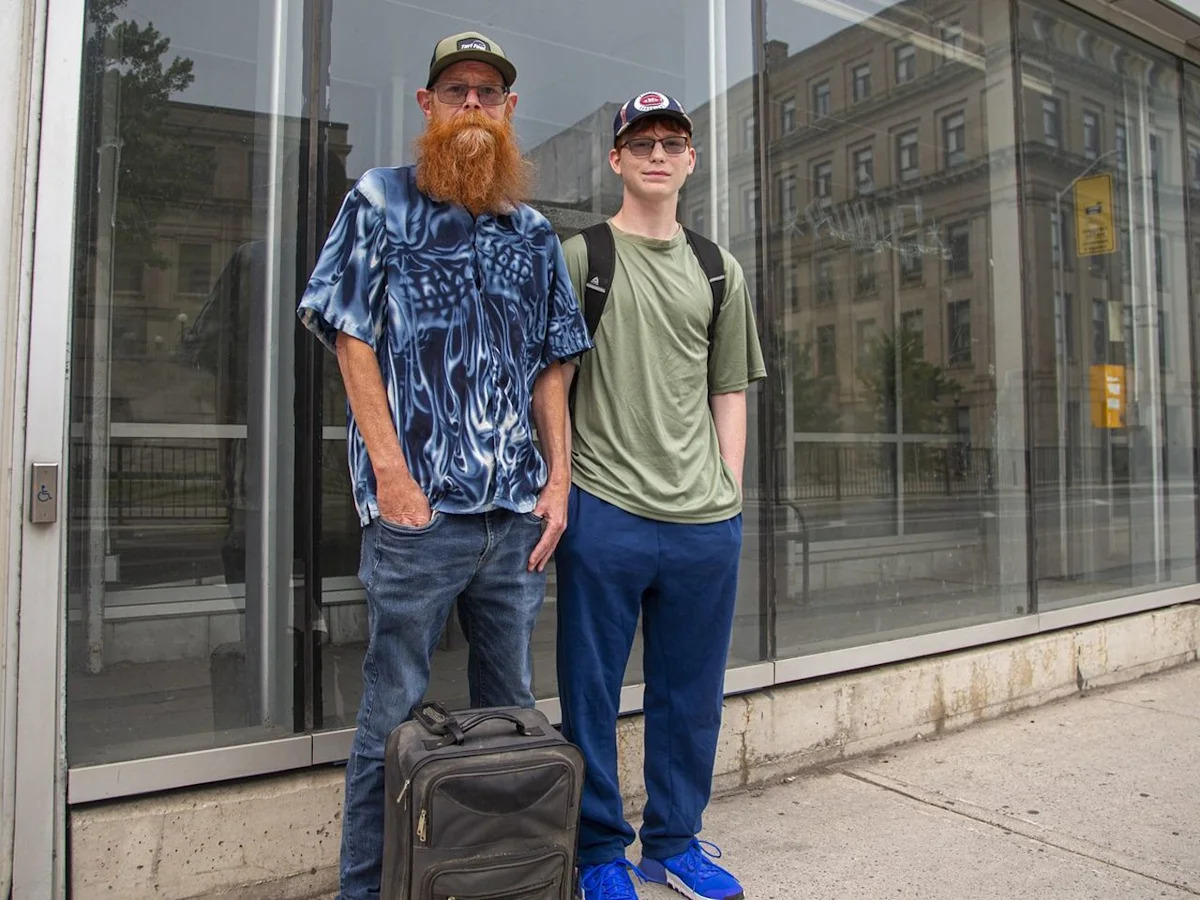
When Charles Anderson and his son Matthew decided to take the bus from Ottawa to Montreal recently, they first got a lift from their homes in Pakenham to Laurier Avenue and Waller Street, where Charles expected to find a proper bus station.
Instead, all he and his son discovered was a bus-stop pole with a sign on it for Autobus Maheux — the Quebec-based carrier they were taking — as well as signs for Orléans Express and a couple of OC Transpo routes.
There were no obvious transportation facilities: no ticket counter, no information desk, no arrivals and departures schedule. There was nowhere to stow their luggage if they wanted to go for a walk, and nowhere to get a sandwich or a coffee. Meanwhile, the doors to the two OC Transpo shelters beside the bus stop were chained shut.
There was also no designated area for someone dropping them off to pull over, nor a place for anyone picking them up to wait. It’s only because the stop is located beside uOttawa’s Desmarais building that passengers can access a washroom and a place to wait inside, away from the elements. But those amenities belong to the university, not the transportation providers.
I couldn’t help but wonder what first-time visitors arriving in Canada’s capital might think of this welcome.
One can forgive Charles his confusion. He hadn’t taken an intercity bus since the station on Catherine Street was closed, sold and demolished after Greyhound Canada ceased operating in 2021. Since then, a couple of handfuls of regional and intercity bus lines have filled the transportation gap, but with a haphazard series of pickup and drop-off points at malls, the train station and street-corners.
Most disconcerting for Charles was the fact that he couldn’t purchase a ticket in person — he doesn’t make purchases with his phone. Thankfully, Matthew does, and the pair were able to board the bus.
“It’s really on you to figure it all out,” Charles said. “I just think it’s crazy that a big city like Ottawa doesn’t have a terminal.”
Ottawa has been without a centralized bus station for five years. Has anyone decided what should replace it? Or is the patchwork network that has grown in its place the new normal?

Charles and Matthew Anderson await their bus to Montreal outside uOttawa’s Desmarais building.
The Andersons weren’t alone in wondering about that. Laura Safranek and Matt Jordan were visiting Ottawa from England, staying at a downtown Airbnb. When the time came to catch their bus to Montreal, the couple weren’t sure where to go — the uOttawa stop wasn’t listed on their Uber app, leaving them to walk through the university campus after piecing together directions themselves.
Once they arrived, Jordan went inside, expecting to find a bus terminal.
“There were just classrooms,” he said.
Neither was particularly upset, but both were surprised to learn that Canada’s capital has no identifiable intercity transportation hub.
Having one, Jordan added, would improve visitors’ experience of the city. “It could help with tourism.”
Another visitor, Tom Bailey, compared the arrangement he found in Ottawa to the system in his hometown of Maastricht, Netherlands.
“This is not very good,” he said. “The Dutch system is spectacular. It’s incredibly smooth and efficient.”
We can argue about whether Ottawa needs a dedicated bus station. The Greyhound station on Catherine Street closed in 2021, after all, and the sky hasn’t yet fallen. Intercity bus travel didn’t disappear. Travellers today can choose from numerous companies serving Montreal, Toronto, Kingston and beyond.
But no one decided that Ottawa no longer needed a bus station. We just woke up one day and the one we had was gone. Have we settled on the best arrangement, or just the one that emerged? The system works, but does it work as well as it should? Does it serve travellers who need to transfer from one carrier to another? And what does it say about Ottawa that, for many visitors, this collection of curbside stops, shopping centres and transit stations makes up the gateways to the city?
This isn’t a new debate. Long before Greyhound left, the subject of the bus station’s location was contested. In 2010, then-mayor Larry O’Brien suggested moving it to the VIA Rail terminal on Tremblay Road, where bus, rail and — eventually — light-rail transit could all be at one hub.
There were opponents to the idea, including Jim Watson, who would defeat O’Brien in the mayoralty election that year. “Most Canadian cities have the bus depot downtown,” Watson argued.
Today, many bus companies do drop-offs and pickups at the train station, effectively piggybacking on the amenities that already exist there. But it’s not the only option.
One person who has given the matter a lot of thought over the years is Janine Debanné, associate professor at the Azrieli School of Architecture and Urbanism at Carleton University.
She doesn’t argue that Ottawa should simply rebuild the old Greyhound terminal. Today’s transportation landscape, she says, bears little resemblance to the one that existed when a single carrier dominated intercity bus travel. Multiple private operators, online booking and smartphones have transformed how people travel.
“Everyone’s a bus company now,” she says.
Yet, while tickets have become digital and booking is increasingly done online, Debanné stresses the obvious: Passengers themselves haven’t become virtual.
“Our body is still there,” she says. “You still have luggage. You still need a place to wait. You still need washrooms. You still need to know where you’re going.”
That’s where a transportation hub matters. It’s not just about selling tickets, but providing a space that makes travel manageable: somewhere people can orient themselves, transfer between services, ask a question of someone in charge and arrive in a city feeling welcome.
Debanné points to Bayview as one possibility because it sits on both LRT lines and is close to downtown. The point, she adds, isn’t just the address, but creating a place where different forms of transportation, and the people using them, come together.
And not just transportation, but a civic hub that integrates buses, transit and ride-sharing with workspaces and other community functions.
“There could be facilities for co-work office space. There could be bicycle lending. It might be located in a place where there are markets,” Debanné says.
“It could be a really dynamic, live place.”
The decline of intercity bus infrastructure, she adds, disproportionately affects those who most rely on buses: students, lower-income travellers and those often elderly riders who are uncomfortable navigating an app-based system. A bus station, she says, is not a high-status building, “but to me, having one is an expression of inclusion and an interest in being connected in a broader way to the territory that expands and connects us as Canadians. I see it as a really beautiful urban symbol.”
The city appears to agree, at least in principle. Ottawa’s 2023 Transportation Master Plan says it will “collaborate with service providers to facilitate intercity bus operations and will support efforts to establish a new intercity bus terminal.” It also indicates that new passenger terminals should be located along the O-Train network, preferably within the downtown core or inner urban transects.
Whether that vision becomes a reality remains to be seen. When asked whether the city had taken any concrete steps or has a particular site or timeline in mind, an email attributed to Jennifer Armstrong, the city’s director of transportation planning, offered little more than a boilerplate response.
“The City’s Transportation Master Plan (TMP) recognizes the importance of strong regional and intercity transportation connections, including a future intercity bus terminal that would improve connections between intercity bus services and Ottawa’s rapid transit network.
“The City continues to work with transportation providers and partners to support convenient and integrated travel options. While there are no new updates to share at this time, planning for improved intercity transportation connections remains part of the City’s long-term transportation vision.”
Cities are often judged by visitors’ first impressions. For many, that isn’t the Parliament Buildings, Rideau Canal or National Gallery. Often it’s an airport, a train station or wherever they step off a bus.
At the moment, Ottawa’s message to bus passengers isn’t very inspiring. “You’re here,” it says. “Good luck.”
Take control of your search results. Make the Ottawa Citizen a preferred source on Google and see verified local reporting first.
Related