


Listen to this article
Estimated 4 minutes
The audio version of this article is generated by AI-based technology. Mispronunciations can occur. We are working with our partners to continually review and improve the results.
Three years after Peel Region declared intimate partner violence (IPV) an epidemic, frontline service providers warn an overburdened shelter system is leaving victims with nowhere to go.
While public awareness campaigns have encouraged many women to seek help, sector leaders say the resources aren’t there to meet surging demand.
Sharon Mayne, CEO of Catholic Family Services Peel-Dufferin, told CBC Toronto the crisis leaves women facing an impossible choice when crisis beds are full.
“A woman will take a beating in order to ensure that her children have a bed to sleep in,” she said. “What a dilemma to put a woman in where she has to decide between her personal safety and … shelter for her children.”
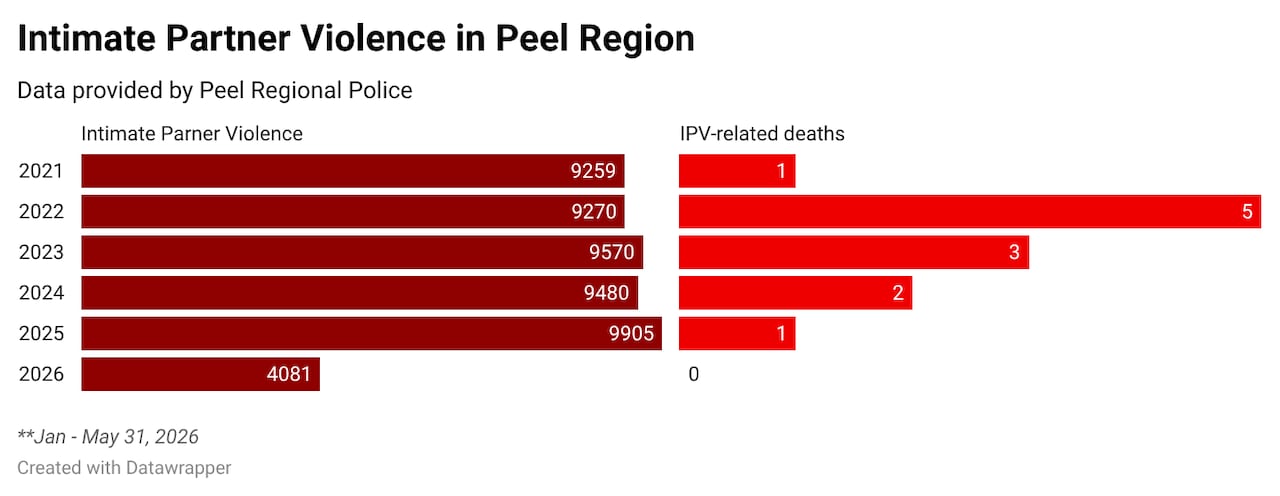 Peel Regional Police provided data showing IPV incidents have risen in recent years. (Peel Regional Police)
Since Peel declared IPV an epidemic in 2023, reported incidents have climbed steadily — reaching 9,905 in 2025, up from 9,259 in 2021 — with another 4,081 incidents logged in the first five months of 2026, according to Peel Regional Police data.
Mississauga Mayor Carolyn Parrish and Peel Regional Council recently sent letters to Premier Doug Ford urging the province to overhaul its two-decade-old shelter funding formula, end limits on shelters keeping families past four months, and fund long-term transitional housing.
The City of Toronto also declared IPV an epidemic in 2023 and these latest calls following the fatal stabbing of 29-year-old Thi Nguyen by her husband in North York on July 18.
In a statement to CBC Toronto, Ministry of Children, Community and Social Services spokesperson Anjali Frank highlighted Ontario’s $1.4-billion, four-year action plan — including $18.7 million to assist frontline providers and an additional $15.7 million annually in the 2026 provincial budget for shelter capacity.
However, frontline leaders and municipal officials argue those investments fail to address systemic flaws.
Provincial funding for shelter stays capped at 4 months
Under current rules, provincially funded shelters are capped at four months — if a shelter lets a family stay longer, it must absorb those operational costs.
Coun. Natalie Hart of Mississauga’s Ward 5 told CBC Toronto that rule creates a severe bottleneck, noting Peel’s subsidized housing waitlist exceeds 23 years.
“Over 30 per cent of women go back to their abusers because of a lack of housing,” Hart said. “We need a solution from the provincial government that recognizes that four months is not an adequate timeline to be able to seek permanent safe housing.”
Andrine Elise Johnson, CEO of Embrave Agency to End Violence in Mississauga, a gender-based violence shelter, told CBC Toronto frontline staff face a heartbreaking reality daily.
 Shelina Jeshani, executive director of the Safe Centre of Peel, left, and Andrine Elise Johnson, CEO of Embrave Agency to End Violence in Mississauga, right, say shelter staff are facing emotional burnout from having to turn people away. (Tyler Cheese/CBC)
“Not having a bed space available for folks, that could mean life or death,” Johnson said.
Shelina Jeshani, executive director of the Safe Centre of Peel — a network of 31 IPV providers operating across Mississauga and Brampton — agreed, adding shelter staff are facing emotional burnout.
“Our frontline staff carry that burden of wanting to be able to respond quickly and to be able to help support a victim through this. And sometimes the bandwidth is just not there,” Jeshani said.
Johnson also stressed that IPV cannot be treated in isolation.
“It’s in fact a community thing that often becomes very pressing within our healthcare system,” she said. “Everything that we do in life intersects … the funding must match our service provision.”
Integrated network key to protecting Peel survivors
That interconnected approach is the exact model the Safe Centre of Peel and its partners, including police, have spent years perfecting.
Rather than forcing survivors to navigate a fragmented web of agencies, Jeshani explained Peel’s collaborative model lets women access wraparound care in one location without constantly retelling their trauma. But she warned even a seamless system cannot function without long-term provincial backing.
Without stable, annualized base funding — rather than short-term grants — and affordable housing, the region’s integrated system risks falling apart, Jeshani said.
Mayne, with Catholic Family Services Peel-Dufferin, agreed, noting Peel doesn’t need to reinvent the wheel to protect families.
“We actually know exactly what to do in order to ensure that women and children are safe,” she said. “We just need the resources to do what it is that we need to do.”