
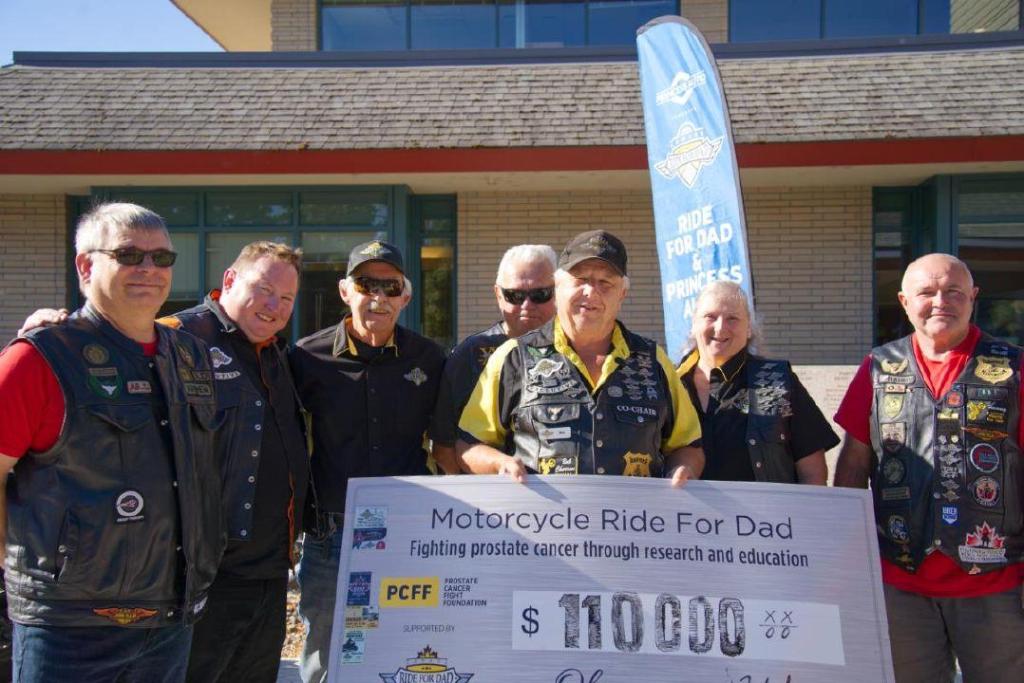
$110K donated towards prostate cancer research in Kelowna
Published 9:51 am Wednesday, July 29, 2026
Research and treatment against prostate cancer in the Central Okanagan is getting a healthy boost as a sizeable amount of money was donated to the BC Cancer Foundation on Wednesday, July 29.
Through a year of fundraising efforts, the Motorcycle Ride for Dad Okanagan Chapter was able to gather $110,000 to donate towards cutting-edge research into prostate cancer and brachytherapy, as well as an awareness campaign.
Since 2009, the Ride for Dad campaign has raised over $1.4 million for the fight against prostate cancer.
Around 60 to 70 per cent of the money will go into prostate cancer research and treatment conducted by Dr. Juanita Crook, a professor of radiation oncology at UBC and a research chair in prostate brachytherapy at the Kelowna Cancer Centre.
Crook said the funds have been used supported her research, purchase equipment and get staff such as statisticians and pathology assistants.
“More recently we’re using it to do genetic profiling on the more aggressive and advanced cancers to be able to determine who the bad actors are at the beginning, and then intensify the systemic treatment as well as getting rid of the local prostate cancer because the ones that have a bad genetic profile are the ones that are destined to fail distantly (cancer spreads to distant sites), rather than you have having to get rid of the local tumour and you solve the problem,” Crook said.
She said she has been testing genetic profiling retroactively, using a pool of 200 patients who’ve had advanced or aggressive prostate cancer. They’ve used around 10 years of data from the patients, meaning the researchers know who had cancer spread to distant parts of their body and who had cancer recurrence locally.
“What we want to do is figure out who are the ones that are destined to fail at distant sites right at the beginning, and then if you intensify their general systemic treatment, their chemotherapy or whatever they’re going to get at the beginning, that could potentially eradicate these micrometastases that are there that we don’t know about otherwise.”
The funding has also helped Crook run the high-dose rate prostate brachytherapy program.
The program differs from common brachytherapy by delivering the radiation treatment in one sitting while the patient is under anesthetic, meaning they don’t take radiation home after the procedure.
“We insert a scaffolding of needles into the prostate, and then a single radioactive source will step through each needle in turn, pausing long enough to give the required radiation to that site, and then it moves into the next needle… It takes about 20 to 30 minutes while the patient’s asleep, then we can remove the needles, wake them up, and the treatment’s done,” Crook explained.
Bob Charron, a spokesperson for the Ride for Dad Okanagan Chapter, talked about the importance of prostate cancer treatment.
Charron said he lost both his father and brother to prostate cancer.
“A year later (after losing his brother), I was diagnosed with prostate cancer. Now, I’ve been getting checked regularly since I was 40-years-old, so when I got the call, I eventually got hooked up with the cancer clinic here (in Kelowna), and I got the therapy and I’m cancer free,” Charron said. “My mission in life right now is to make sure that men aged 40-annd-up insist on getting PSA blood tests, because now we’ve got some excellent treatments available for early detection, we want to make sure that people get treated.”
When asked what his message was to men who haven’t been tested, Charron told them to not be afraid.
“Why would you gamble not knowing? The blood test takes almost an hour out of your day, and you may not have to do it for another.”
He thanked people in B.C. and the Yukon for donating to raise the $110,000.
Crook said people should be getting their first PSA tests while they’re around 40 to 50 years old. After age 50, she said people should get another.
She thanked the Ride for Dad campaign, saying they’ve made a lot of important research possible.