
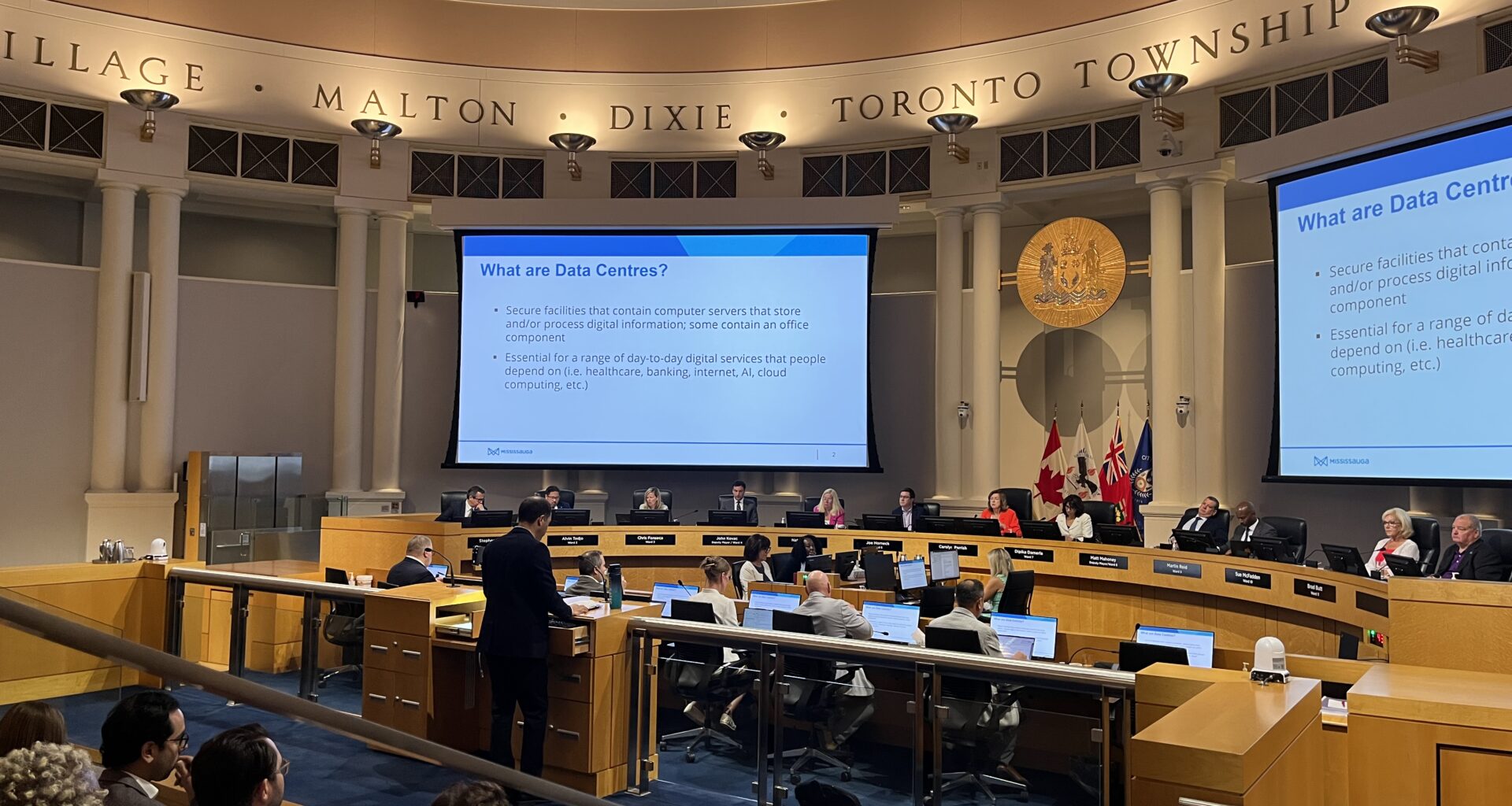
A one-year pause on data centre developments moved one step closer to passage after a unanimous vote by Mississauga’s city council on Wednesday, just weeks after a similar bylaw was voted down in nearby Hamilton, Ont.
If the bylaw passes when it returns to council in September, it could set a precedent in Canada — but questions about its legality remain.
The motion, brought forward by Coun. Martin Reid and seconded by Coun. Sue McFadden, asked staff to study Mississauga’s planning policies and processes for approving data centres. City staff will prepare an “interim control bylaw,” which prohibits the establishment of data centres for at least one year — with a possible extension of up to two years — while a review is underway.
Although the bylaw would enact a city-wide freeze, at the heart of Wednesday’s debate was a rezoning application filed by industrial real estate company Prologis. It wants to build a 229,000-square-foot data centre in Meadowvale Business Park. Residents have been vocal about their disapproval for the facility, citing concerns about energy use, water contamination, environmental and health impacts.
 Mississauga residents Chris Tulip, left, and Max Sebesta, right, attended the meeting to voice their support for a pause on data centres. Photo by: Emmerson Jull / Canada’s National Observer
Over the course of five hours, councillors heard from more than 20 residents and business representatives on the motion.
One of the first came from Alireza Harandi, a senior vice president at Prologis. He said the facility’s peak demand energy draw would be 40 MW, and Prologis is in negotiations with an unnamed Canadian firm as a potential tenant for the site.
Harandi also suggested that Prologis would refrain from filing any appeals with the Ontario Land Tribunal if council waited longer and took more steps before passing the interim control bylaw. Such a delay would push the final vote past the municipal elections in October, meaning an entirely new council could be voting on the bylaw.
After the motion passed, Canada’s National Observer asked Prologis to confirm whether they would be appealing the bylaw at the Ontario Land Tribunal. In an email response, a company spokesperson said, “We are reviewing Council’s action and its implications for our application. We have not made a decision about an appeal and will consider next steps once Council completes its process.”
Whether an interim control bylaw is necessary to create guardrails for data centre developments — and if it would be defensible in court — sparked debate among councillors, city staff and speakers.
Staff said they would carry out a comprehensive study to determine the community impacts and potential benefits from data centres, even without an interim control bylaw.
“What we’re actually debating is … going to the dramatic level of doing an [interim control bylaw] which will immediately generate an appeal,” said Mayor Carolyn Parrish, who abstained from voting on the motion.
Parrish explained that the city wouldn’t rush into building data centres before studies had been done, but acting too fast against the development could discourage investment. “We can’t do something hastily, because the word will go out: ‘Don’t build in Mississauga,’” she said.
Without the moratorium, Mississauga staff would still follow regular planning processes. Any data centre proposals would be reviewed. Approvals would be subject to the city’s own criteria and future guidelines from the province. But data centres could still be built, and few of them would require public consultation or a vote from council.
Councillors decided in a unanimous vote to move the moratorium forward. Their decision was met with a round of applause — and likely some relief for the residents who had been seated for hours, awaiting the vote.
Staff are expected to prepare the bylaw and return to council for final approval on Sept. 16. There’s a chance that the bylaw could be struck down at the last minute, as it was in Hamilton.
“We want to make sure that doesn’t happen here,” said Max Sebesta, who lives in Mississauga. “If the federal government and the provincial government aren’t doing anything, it’s up to the municipal government … to start making change.”
The Sept. 16 vote coincides with council’s last sessions before the municipal elections, and data centres are shaping up to be a key issue for voters. Multiple councillors are hoping to keep their seats, and others are in the mayoral race alongside Parrish, who’s running for re-election.
If Mississauga’s data centre moratorium passes, it’s likely to be the first of its kind in Canada. It could prompt a wave of similar bylaws, but would likely also be subject to appeals.