
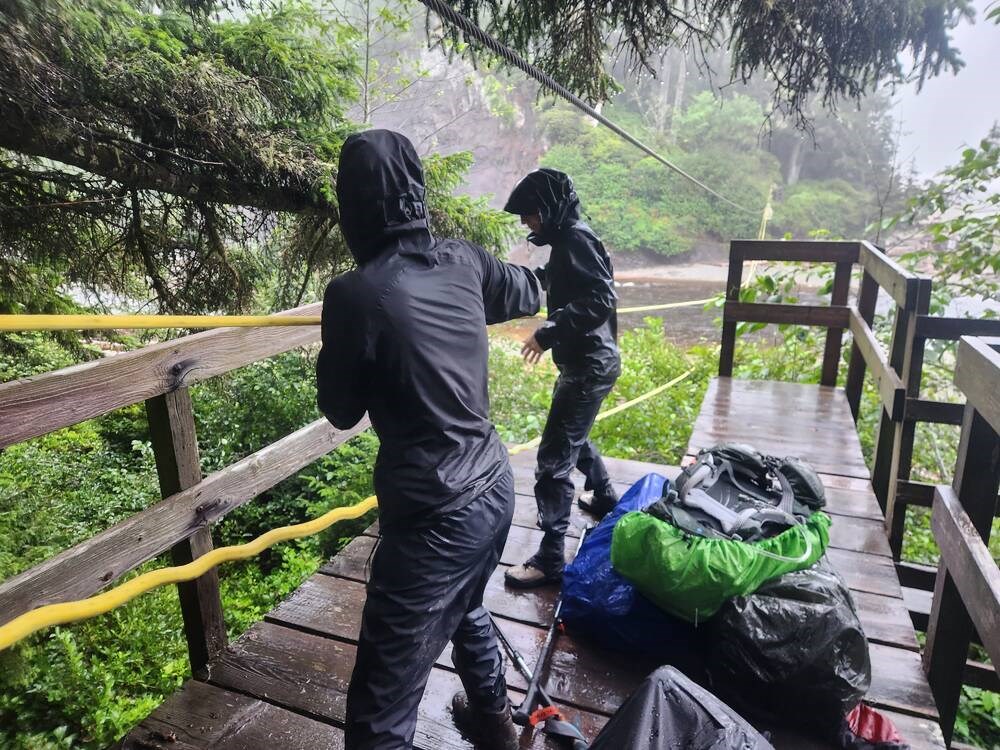
The group ended up crossing a creek that was swollen to almost waist height.
Hiker Benjamin Currie says he was warned during a Parks Canada orientation about problems with a cable car over a creek on the West Coast Trail, but was told that if anything went wrong, or if there were updates, they would let people know right away.
“Any immediate news, you were on the assumption that Parks Canada or one of the First Nations guardians would alert you,” said Currie, who is from Kamloops and was doing the hike with his father, Jeremy, along with two others from Vancouver.
But after conditions deteriorated, he said he and the rest of his group of four saw nobody on the trail at all.
“And we were in that section where most of the people were evacuated from.”
Jeremy Currie suspects Parks Canada staff were at the north end of the trail helping to get people out, saying when they were later drying out at the Crabshack, a floating restaurant at Nitinaht Narrows, they could hear Parks Canada staff on the radio saying they were near Darling River.
“People were stuck between Darling River and Michigan, the two rivers, and there was no way out for them,” he said. “They were working at getting people out of there.”
Parks Canada representatives were not immediately available for comment.
Jeremy, an experienced hiker, said it was his fourth time doing the West Coast Trail, but when the group got to Carmanah Creek on Sunday after setting out on Saturday from the Gordon River trailhead in Port Renfrew, he realized they might be in trouble.
When he had done the hike before, the creek was navigable by foot, but after a day and a half of torrential rain, the creek was swollen higher than he had ever seen it.
The group had already trudged through several creeks that were fast-flowing and knee-deep. Conditions were miserable, and their boots were full of water, said Benjamin.
There was a cable car at Carmanah Creek for use if the water was too high to cross by foot, but its pull rope was damaged and frayed.
“It was coming apart, so it was really, really hard to move,” said Jeremy. “So we tried going across the river, and it was too deep. I got almost to my waist, and it was fast-flowing, so we decided not to do that.”
By that point, two other hikers had shown up, and between the six of them, they were able to get the cable car moving.
Essentially, the car is suspended on a cable across the creek, and there is a rope attached, with pulleys on either side, to move the car across. People can stand on either end to help the person in the car get across.
In this case, they were able to get everyone over to the other side safely, but given how damaged the rope was, Benjamin said he wonders what might have happened if they didn’t have such a large group.
“A solo person would not be able to get across. Some people turned around, that’s what we think,” he said.
“We’d actually heard from people on the trail that somebody waited at the cable car for over two hours because they couldn’t cross the creek and had to wait for another group to arrive to aid them in order to get across.”
Benjamin said that night they camped in the Carmanah campground, huddling in the outhouse for shelter.
Jeremy woke up in the middle of the night Sunday and checked the West Coast Trail app and saw Cribs Creek was “swollen and impassable.” They decided to leave early Monday and try to cross it anyway, Jeremy said.
“It wasn’t quite waist deep when we went through there, it was just under, so we were able to make it through,” he said.
The group pushed on and managed to get to the Crabshack, where they stayed at a covered tent pad before evacuating on Tuesday.
Wayne Aitken, who has hiked the trail since 1985 and co-wrote the guidebook Blisters and Bliss: A Trekker’s Guide to the West Coast Trail, said no amount of preparation can prevent the chaos that comes with that kind of extreme weather.
“I considered myself a very experienced backpacker, even back in the ’90s. And there’s just nothing that you can do to dry out when it’s that bad.”
It can rain for a couple of days and be miserable, and that’s not a problem, he said.
But when it’s day after day, even if hikers have brought backup dry clothing, it doesn’t take long before that is saturated as well, “and then you’re in trouble,” he said.
Weather in that area can be bad at times, and it’s not unusual to recommend a shutdown of the trail, but this was different, Aitken said. “This is real, serious flooding of creeks and streams,” he said. “Sometimes they’re just a wet spot in the sand, and now they’re impassable.”
The only other time Aitken can recall a weather event this extreme was in the late 1990s when he was hiking the trail with five friends. After three days of heavy rain, with water over their boots and running down the trails “like a funnel,” they ended up heading back to the Crabshack.
Both Aitken and the Curries emphasized the importance of the Crabshack and its staff in helping stranded hikers dry off and get out of the area.
It’s unclear how many hikers have been evacuated so far, but the bus drivers at West Coast Trail Express, which operates out of Victoria, estimate they’ve taken eight to 12 extra hikers per day out of the area, manager Orrin Anderson said Wednesday.
“There is more coming out today. Most people have gotten out the last couple of days.”
The company is also seeing more cancellations, Anderson said — “people who’ve turned around and just walked back to their car, or people who chose not to go on the trail, so it’s starting to slow down.”
Conditions on the trail are expected to improve by Friday.