
Article content
Researchers who discovered the world’s first known transmissible cancer in freshwater fish in Lake Memphremagog, a lake shared by Quebec and Vermont, are now looking into reports the same affliction might be hitting the same species in New Brunswick.
Article content
Brown bullhead catfish in Quebec were discovered with unusual black skin lesions, prompting testing that uncovered the lesions were melanoma, according to the study that was published this month in the science journal Nature. The study found the cancer cells appeared to move between fish of the same species and grow new tumours.
Scientists from the University of Vermont, working with researchers in the University of Cambridge’s Transmissible Cancer Group in England, have since collected brown bullhead from the St. John River in Queens and Sunbury counties.
“We are looking into New Brunswick because we have received feedback that fish that look similar to those that we found in Lake Memphremagog have been seen in this province,” said Dr. Zoe Clarke, a postdoctoral researcher at the University of Cambridge who is helming this second phase of the study..
Lead researcher of the original study, Dr. Julie Dragron, associate professor of microbiology and molecular genetics at the University of Vermontand, said in an email the New Brunswick research “will determine how widespread the condition is and estimate the age and origin.”
Article content
Clarke said researchers have not yet determined whether the fish collected in New Brunswick have the same disease.
“We have only sampled brown bullhead from New Brunswick, and we have zero confirmation that what we are looking at in New Brunswick is related to what we have found in Vermont,” she said. “To figure this out, we have to do further analysis of the fish we collected.”
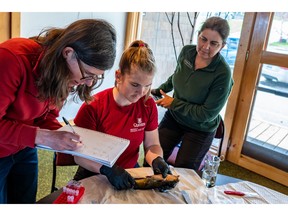 University of Vermont researcher Dr. Julie Dragon (right) oversees a fish dissection as part of the study that identified the first known transmissible cancer in a freshwater fish species. Researchers are now expanding their work to determine how widespread the condition may be. VERMONT FISH AND WILDLIFE PHOTO Photo by Josh Brown /VERMONT FISH & WILDLIFE
She said the team collected samples in May and June.
Researchers are asking anglers who catch brown bullhead with raised black skin lesions to keep and freeze the fish, take photographs and contact Clarke by email at zc456@cam.ac.uk so the specimens can be evaluated for further study.
Despite the unusual discovery, Clarke said there is no evidence the disease poses a risk to people.
“We do not believe that there is any concern related to brown bullhead handling or consumption,” she said.
Laura Bourque, a wildlife pathologist with the Atlantic Veterinary College at the University of Prince Edward Island, who works with the Canadian Wildlife Health Co-operative but who is not directly involved in the New Brunswick sampling, said she is investigating a similar case in Nova Scotia and described the work as “pretty new and emerging.”
She said the Canadian Wildlife Health Co-operative’s Atlantic office is also available to receive fish with suspicious lesions for examination.
Share this article in your social network