
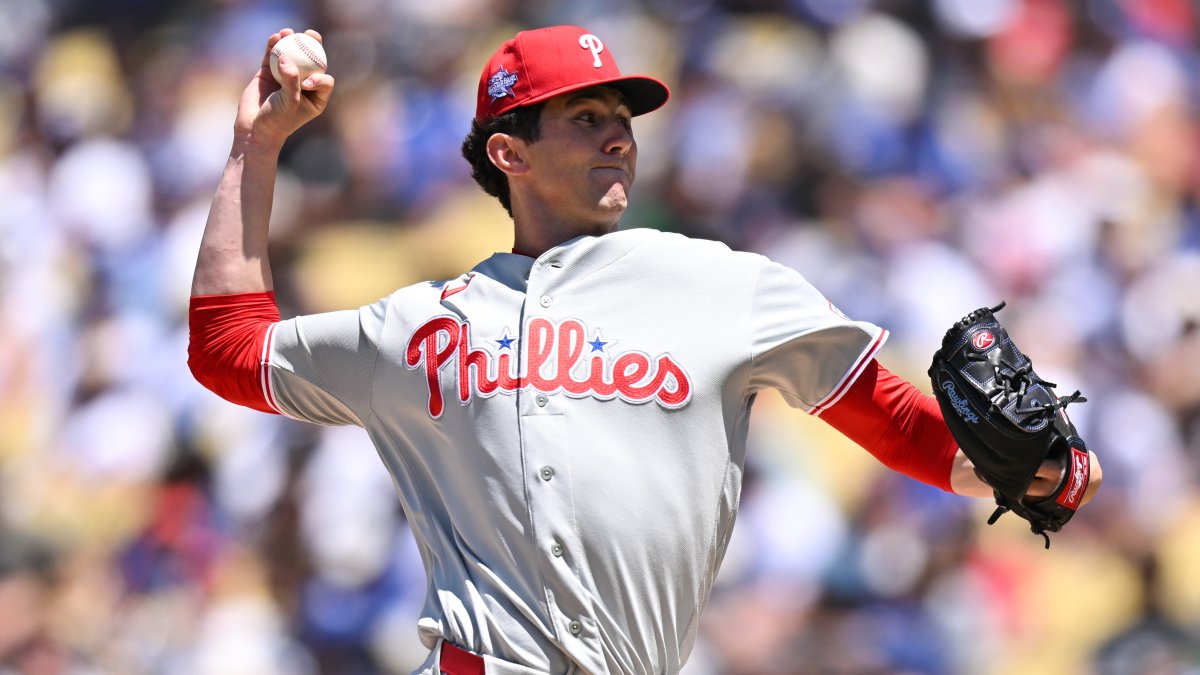
Forty-four days ago, Andrew Painter, the Phillies’ most-coveted pitching prospect in two decades, was sent down to Triple-A.
On Friday, he’ll take the mound for Philadelphia against the Baltimore Orioles at Camden Yards, a source said, either starting or following an opener.
The tall 23-year-old right-hander had posted a 7.06 ERA in his first 14 outings. He had allowed 14 homers in 65 innings.
Batters were hitting .316 against him. His high-90s fastball, the pitch that made him such an intriguing farmhand, was ineffective — a .404 opponent’s average and a .660 slugging percentage against it.
It was time for a reset. The Phillies weren’t giving themselves a good chance to win when he took the ball, and his development and confidence needed a reset at Triple-A Lehigh Valley.
A month and a half later, the club is still struggling out of the No. 5 spot in the rotation. The Phillies are winless in their last six turns since Painter’s demotion, producing a 5.17 ERA with starts from Alan Rangel and openers from lefty Tim Mayza.
That skid actually stretches back further. The last time the Phillies won a game from that spot was May 18 — a 5-4 home win over the Reds, behind a six-inning, two-earned-run outing from Painter.
That start was part of a three-start stretch where the 6-foot-7 Florida native looked the part. Five or more innings in each outing, two or fewer runs, and allowed just one homer across starts against Boston, Cincinnati and Cleveland.
It was Painter’s next start, against the ever-challenging Dodgers in Chavez Ravine, when the issues re-emerged. His Achilles heel — the long ball — came back. Two homers were part of seven hits surrendered in a 3 1/3-inning outing. He’d allow five more over his next 11 2/3 innings before finding himself back in Lehigh Valley.
With the Iron Pigs, Painter has made five starts, and he’s coming off one of his best on Sunday. Four of his five starts have gone at least four innings — three of those at least five — with two or fewer earned runs. He’s allowed only two homers in 23 2/3 innings across those five starts.
That’s progress.
A large part of Painter’s struggles in his first big-league stint was not being able to throw his four-seam fastball and control at-bats against left-handed hitters. The shape of his fastball didn’t have the late ride teams look for, and it became a predictable offering in hitters’ counts.
Some of his secondaries in the majors, though, showed promise, namely his split-finger, sweeper and curveball. In his most recent minor league start, the velocity on his splitter was up and the shape tightened — notably less vertical break. It generated a ton of swing-and-miss and will be a pitch to watch going forward, working as a stronger tunnel off his fastball, which touched 99 mph during his time in the minors.
So, why is Painter back in the bigs?
There could be a laundry list of reasons.
He’s shown improvement. It could be an audition outing for other teams ahead of the August 3rd deadline.
Or, ultimately, it could be that the Phillies would prefer to answer their own back-end rotation issue from within, with their former first-rounder and once-prized prospect.
How will he stack up against the Orioles?
The biggest focus will be how he matches up against their lefties. Baltimore’s left-handed hitters rank 24th in the majors in OPS against right-handed pitching. They’re batting .235. They have not done a great deal of damage against four-seamers, either.
Arguably, this outing is as crucial as his debut back in March. It’s been a rocky couple of years for Painter — Tommy John surgery, a rough return season at Triple-A last year, and now a shaky start to his major league career this season after a strong spring training.
The Phillies’ rookie will look to get off on the right foot.