
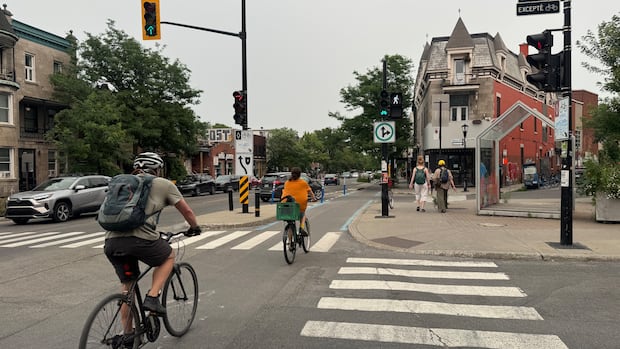
Montreal is often touted as North America’s top cycling city. But anyone who regularly cycles in Montreal has likely seen, if not experienced, some close calls.
With the future of the city’s cycling infrastructure under consideration, CBC wanted to know where the most dangerous areas are for cyclists — and why.
We obtained data from Quebec’s auto insurance board (SAAQ), which shows the intersections that had the most collisions involving cyclists between 2023 and 2025.
You can find the top 10 locations on the interactive map below:
4 intersections with most collisionsGilford, St-Denis & Villeneuve streets – 14 collisions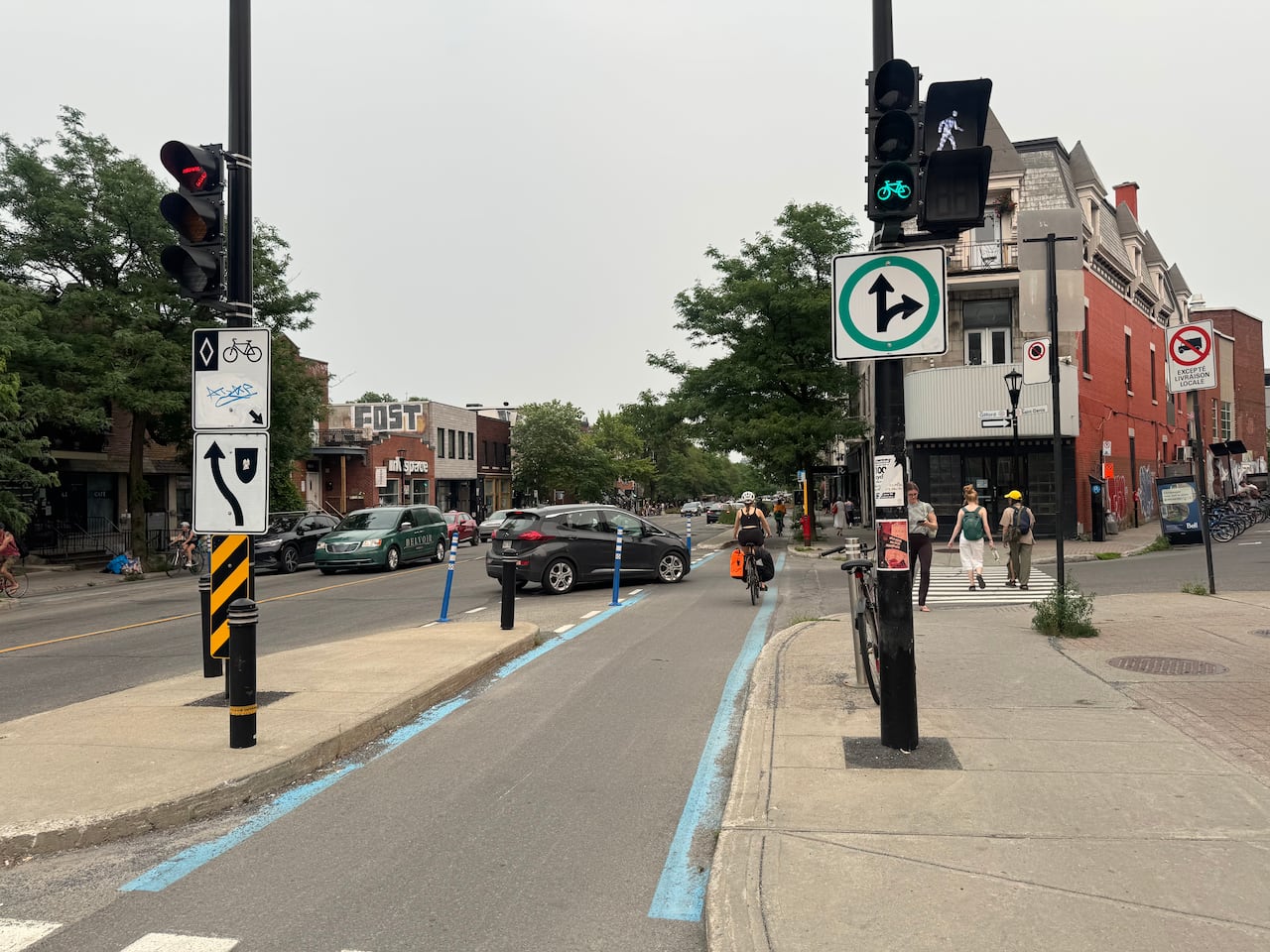 A car turns right across the bi-directional bike path on St-Denis Street onto Gilford Street. (Patricia Kozicka/CBC)
Between 2023 and 2025, this Plateau-Mont-Royal intersection recorded 14 collisions — the highest total of any intersection in Montreal.
It also had the most collisions in 2025 and has ranked in the top two every year since 2018.
The problem spot is on the west side of St-Denis Street, where there are two intersections very close together. The one at Villeneuve Street is controlled by a light, then a few metres further, cars turn right across St-Denis — home to the city’s busiest bike path — onto Gilford Street.
“That’s where collisions can happen,” said Magali Bebronne, Vélo Québec spokesperson and director of programs. “Even though motorists are supposed to yield to whatever user is going straight, that does not always happen.”
WATCH | Breaking down the most dangerous intersections: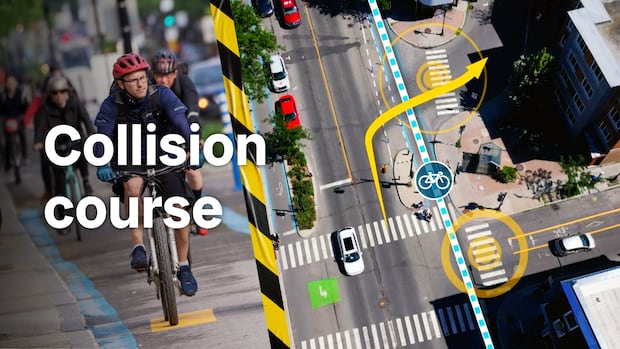
Montreal’s most dangerous intersections for cyclists — and what’s being done about them
The intersections with the most collisions involving cyclists reveal a complex story of pain points and major traffic conflicts between cyclists and motorists. They also don’t come close to telling the whole story of roads or intersections in the city that cyclists don’t feel safe using.
A failure to yield is the one of the most common causes of collisions involving cyclists, according to Montreal police.
The borough says new bollards were installed on both sides of the intersection last year to better guide motorists and discourage sharp turns.
Côte-Sainte-Catherine Road & Beloeil Avenue – 10 collisions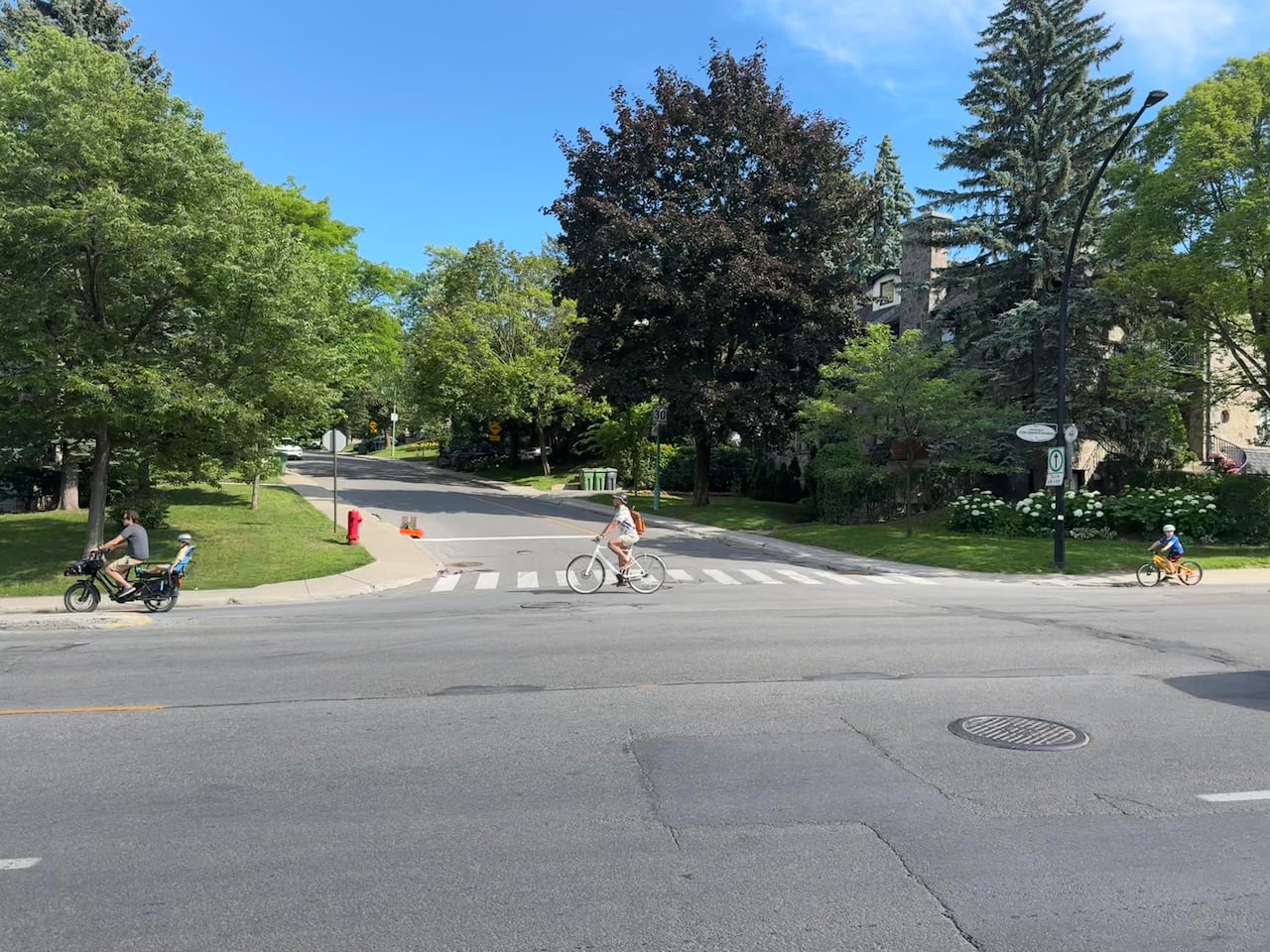 With a number of schools in the area, children are often seen on the bi-directional bike path on Côte-Sainte-Catherine Road. (Patricia Kozicka/CBC)
There’s a bi-directional bike path here in the Outremont borough, and the safety issue arises whenever cars try to turn left or right across it onto Beloeil Avenue.
“Plus the fact that there’s a slope, cyclists may be going a little faster, that is a perfect mix for incidents to be happening,” said Bebronne.
SAAQ spokesperson Simon-Pierre Poulin said left turns by drivers are “one of the most dangerous” for cyclists with oncoming traffic, and in this case, bike traffic coming from both directions.
A nearby intersection, at Côte-Sainte-Catherine Road and McCulloch Avenue, was another top collision site for cyclists in the SAAQ’s 2025 data.
Outremont borough mayor Caroline Braun said an in-depth analysis of this bike path was recently completed as part of the city’s audit and it’s working to improve safety along the path, which Braun says 3,000 cyclists use daily.
St-Urbain Street, President Kennedy Avenue & De Maisonneuve Boulevard – 9 collisions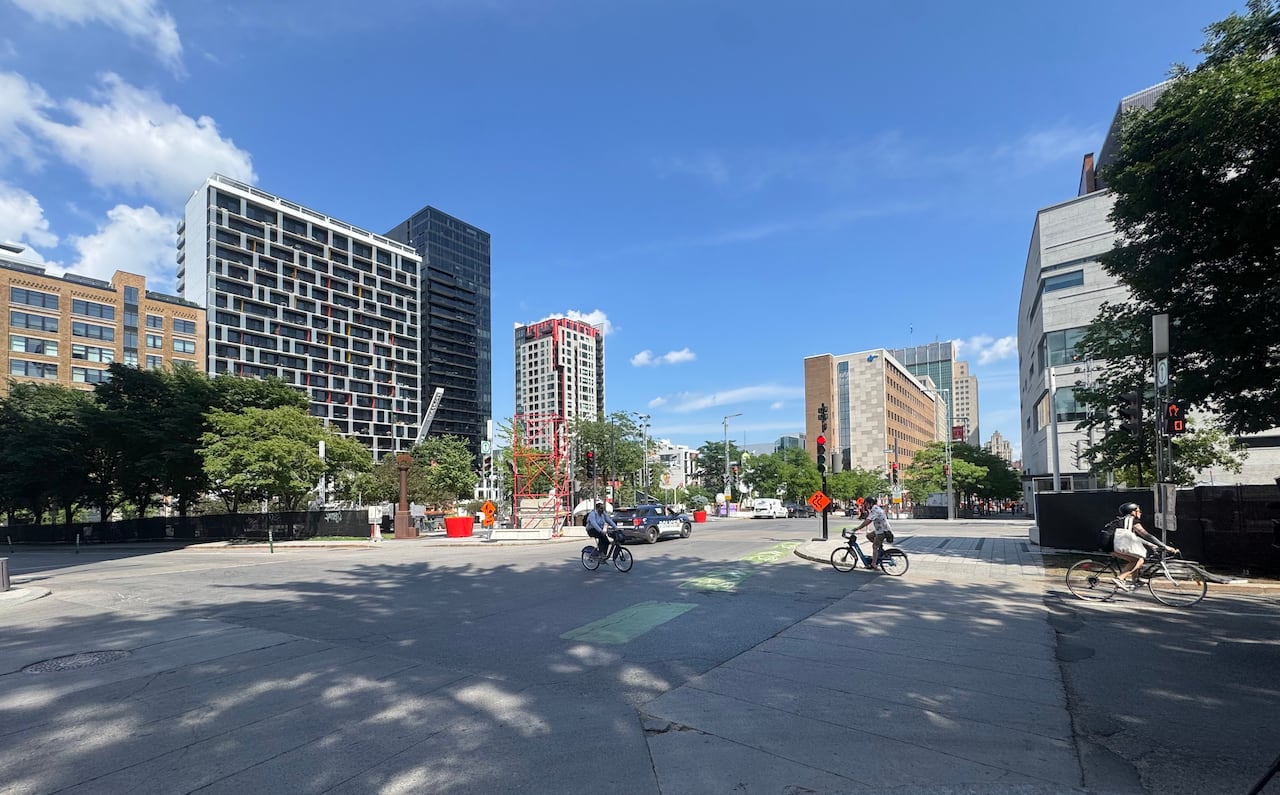 This intersection in the Ville-Marie borough has a number of factors that may contribute to cyclist collisions. (Patricia Kozicka/CBC)
Cars from three different directions and three cycling routes, including the unprotected St-Urbain Street path, converge here in downtown Montreal.
“Cyclists are literally thrown in traffic going downhill [on St-Urbain] at pretty high speeds, and then crossing Maisonneuve and President Kennedy, closely one after another while motorists are trying to turn right,” said Bebronne.
Despite Vélo Québec raising issues about this intersection for years, city spokesperson Hugo Bourgoin told CBC in an emailed statement that “the current layout is considered safe.”
He said the intersection is currently in a temporary configuration due to construction, and that all road users should be more careful when travelling through a construction zone.
St-Jacques, St-Antoine West and De Courcelle streets – 7 collisions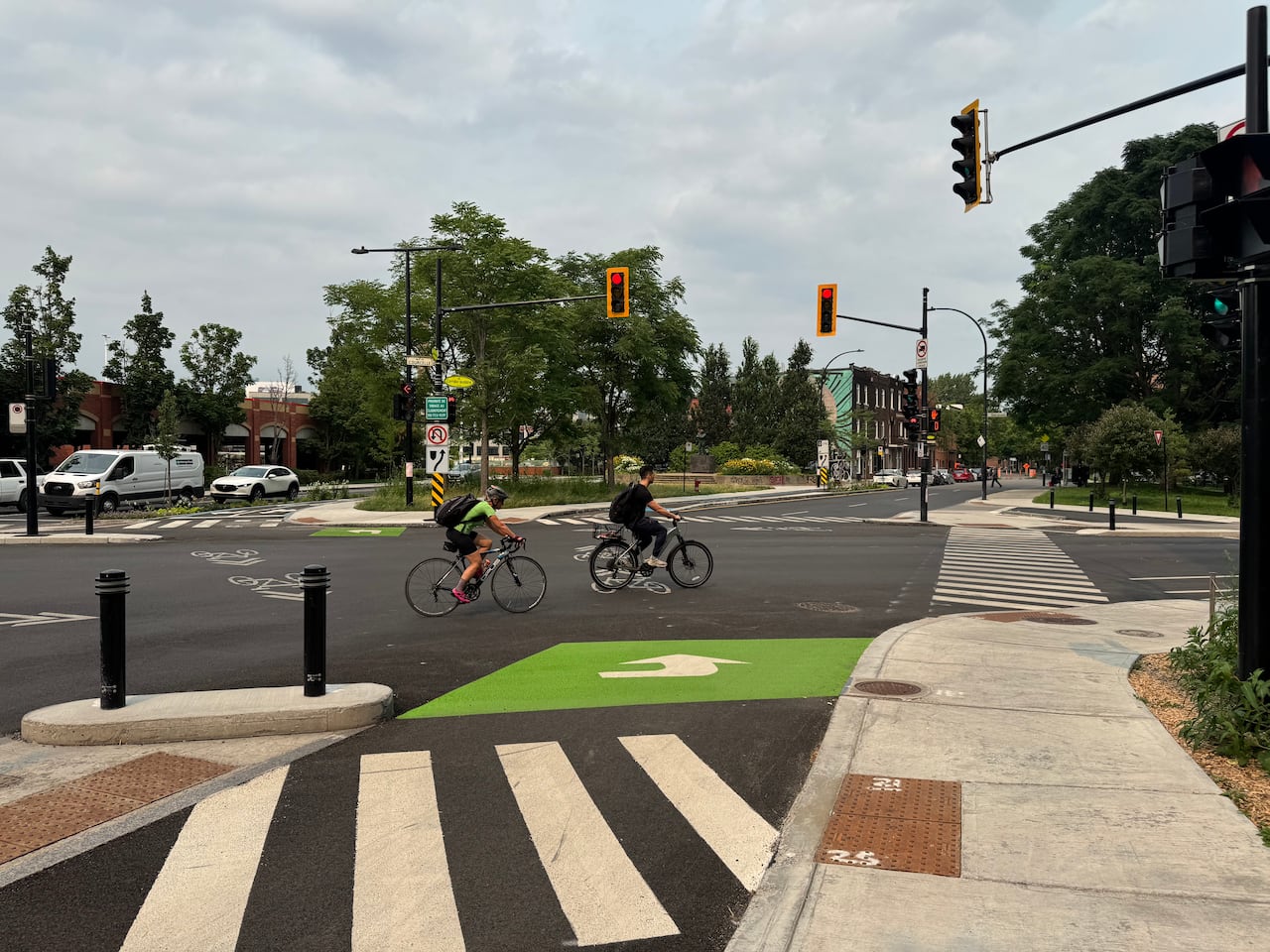 Cyclists cross the newly upgraded bike path at this intersection in Montreal’s Saint-Henri borough. (Patricia Kozicka/CBC)
Three major roads and bike paths meet at this multi-leg intersection, which is a link between the City of Westmount, the Sud-Ouest borough and downtown.
Two years of road work just wrapped up here this spring. Some of the upgrades included adding a link to the city’s Réseau express vélo (REV) as well as closing a passage that westbound vehicles could previously use to make U-turns onto St-Jacques.
“[That] kind of configuration was pretty dangerous,” Sud-Ouest borough mayor Véronique Fournier said, adding that the re-design makes it “safer to everyone.”
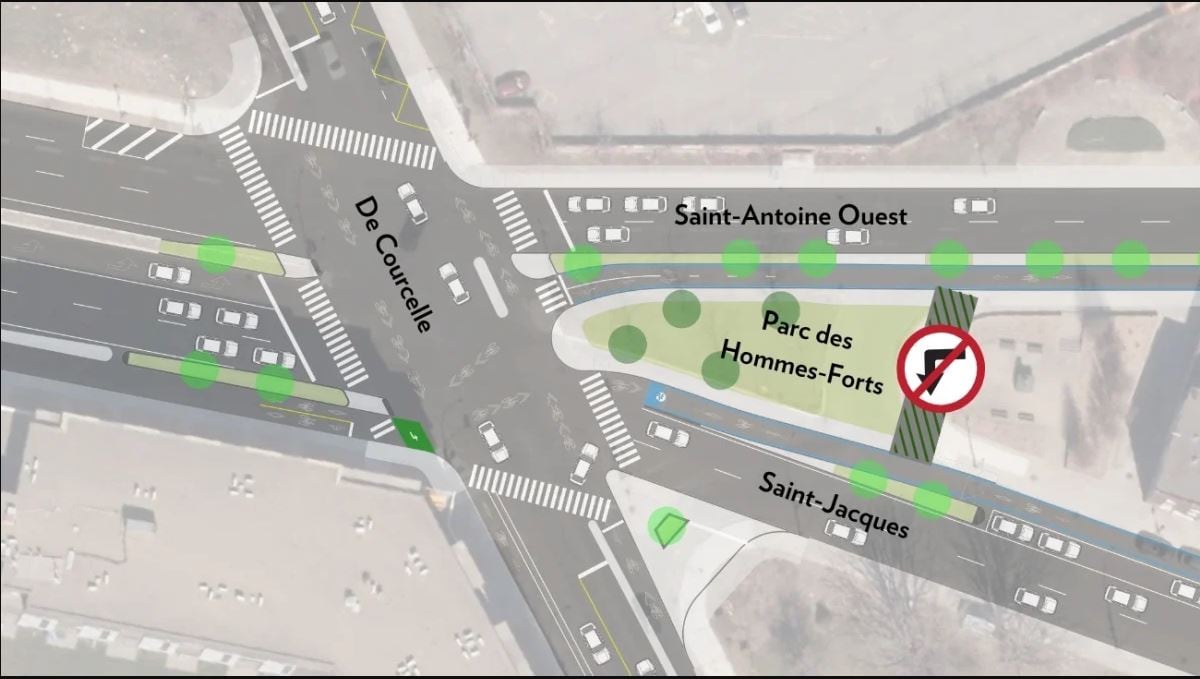 An overhead of the newly redesigned intersection, which shows where vehicles used to be able to make U-turns before the intersection. That path has since been closed off in an effort to improve safety. (City of Montreal)Other dangerous intersections
These five intersections each saw six cycling collisions between 2023 and 2025, according to the SAAQ’s data.
Dorion Street and De Maisonneuve Boulevard East in the Ville-Marie borough. Notre-Dame Street and Alphonse D Roy Street in the Mercier–Hochelaga-Maisonneuve borough. Papineau Avenue and Bellechasse Street in the Rosemont–La Petite-Patrie borough. Rachel Street East and Midway Avenue in the Rosemont–La Petite-Patrie borough. Rachel Street East and Henri-Julien Avenue in the Plateau-Mont-Royal borough. 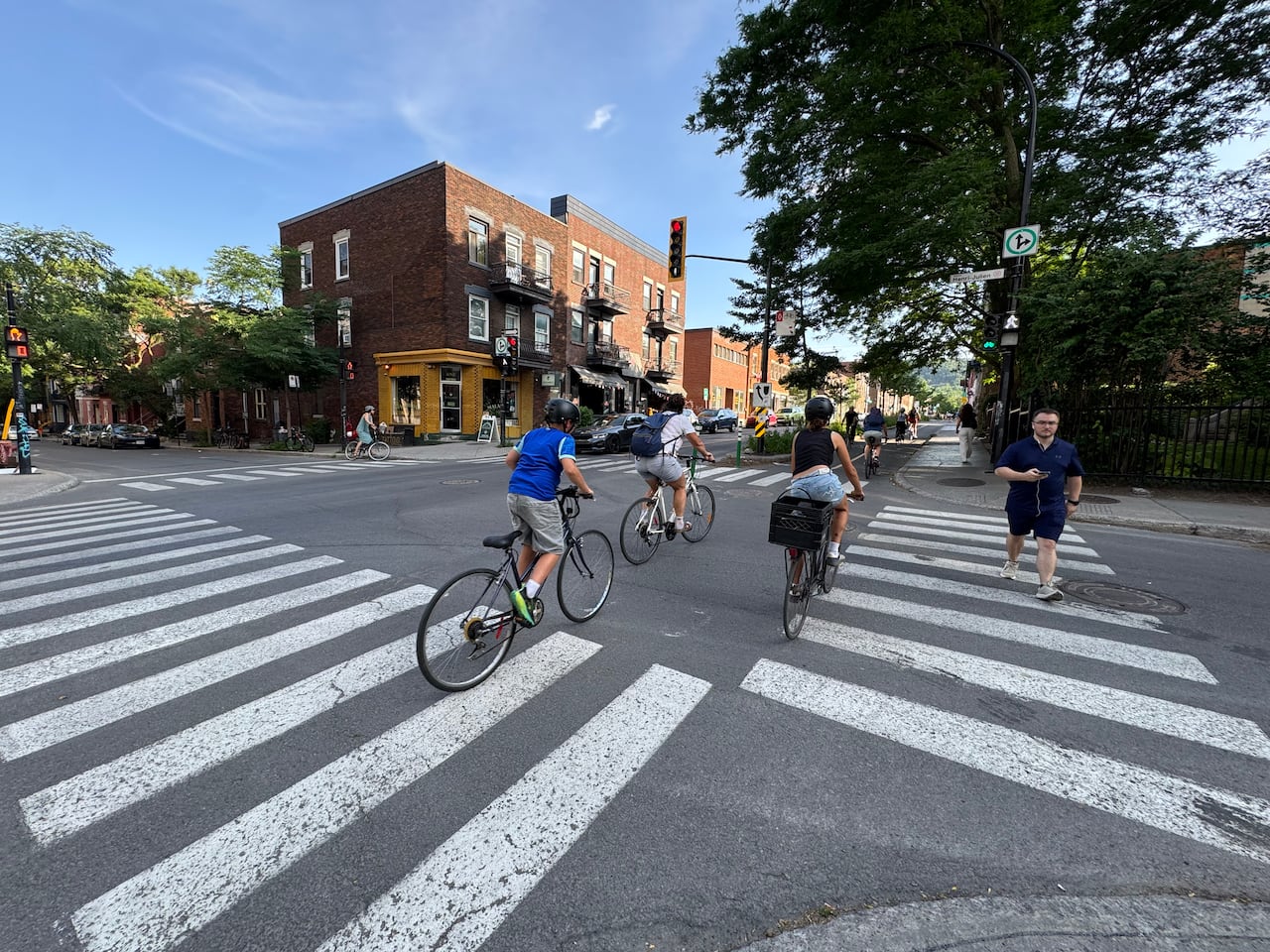 The bike path on Rachel Street E. and Henri-Julien Avenue is narrow with a very high volume of cyclists. (Patricia Kozicka/CBC)
Nicolas Marcotte, a Montreal resident involved in improving safety for cyclists, takes the bike path on Rachel all the time to take his kids to school.
“It’s a bike path that when way more people use it, it’s less safe,” he said. “You want bike paths that when there is more volume of cyclists, it’s safer for everybody.”
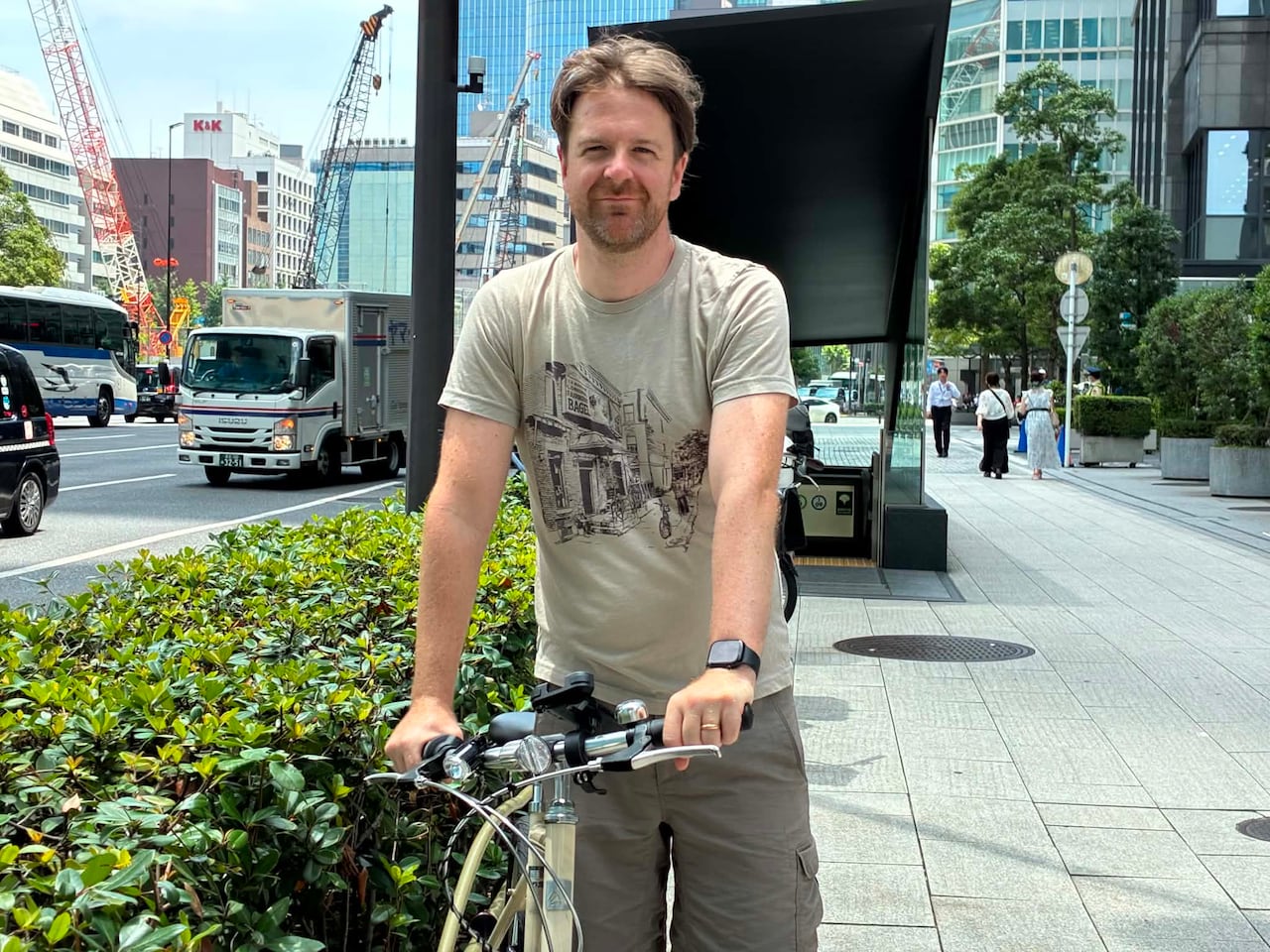 Nicolas Marcotte is a Montreal resident who advocates for safer cycling. He uses the bike path on Rachel Street regularly, and would like to see it transformed into two uni-directional bike paths. (Supplied by Nicolas Marcotte)
Marcotte also finds the current configuration stressful to navigate as a driver.
He’d like to see the Rachel bike path transformed into two uni-directional bike paths on each side of the street. Because, as he explains, “when it’s a uni-directional path, you know from where the bikes are coming.”
Bebronne has heard motorists say they try to avoid Rachel “at all cost.”
“Sometimes they have to find a gap between oncoming vehicles, two directions of cyclists plus the pedestrians. And that’s really tricky to do,” Bebronne said.
LISTEN | Montreal cyclists share where they feel are the city’s biggest trouble spots:
This is Montreal26:29Montreal’s most dangerous intersections for cyclists
July is peak season for biking in Montreal. It’s also one of the months when the most cyclists are hit by cars. The numbers show that a handful of intersections account for a large number of collisions involving bikes. CBC reporter Patricia Kozicka breaks down what makes these intersections so dangerous and what can be done to fix them.4,000 intersections ‘very hazardous,’ group says
SafeMobility, a Montreal-based research organization, uses predictive analytics to determine where collisions are most likely to occur in an effort to help prevent them.
Founder Owen Waygood, who’s also a professor of sustainable transport at Polytechnique Montréal, explained there are 4,000 Montreal intersections that are considered “very hazardous” due to factors like speed as well as the volume of traffic and heavy vehicles.
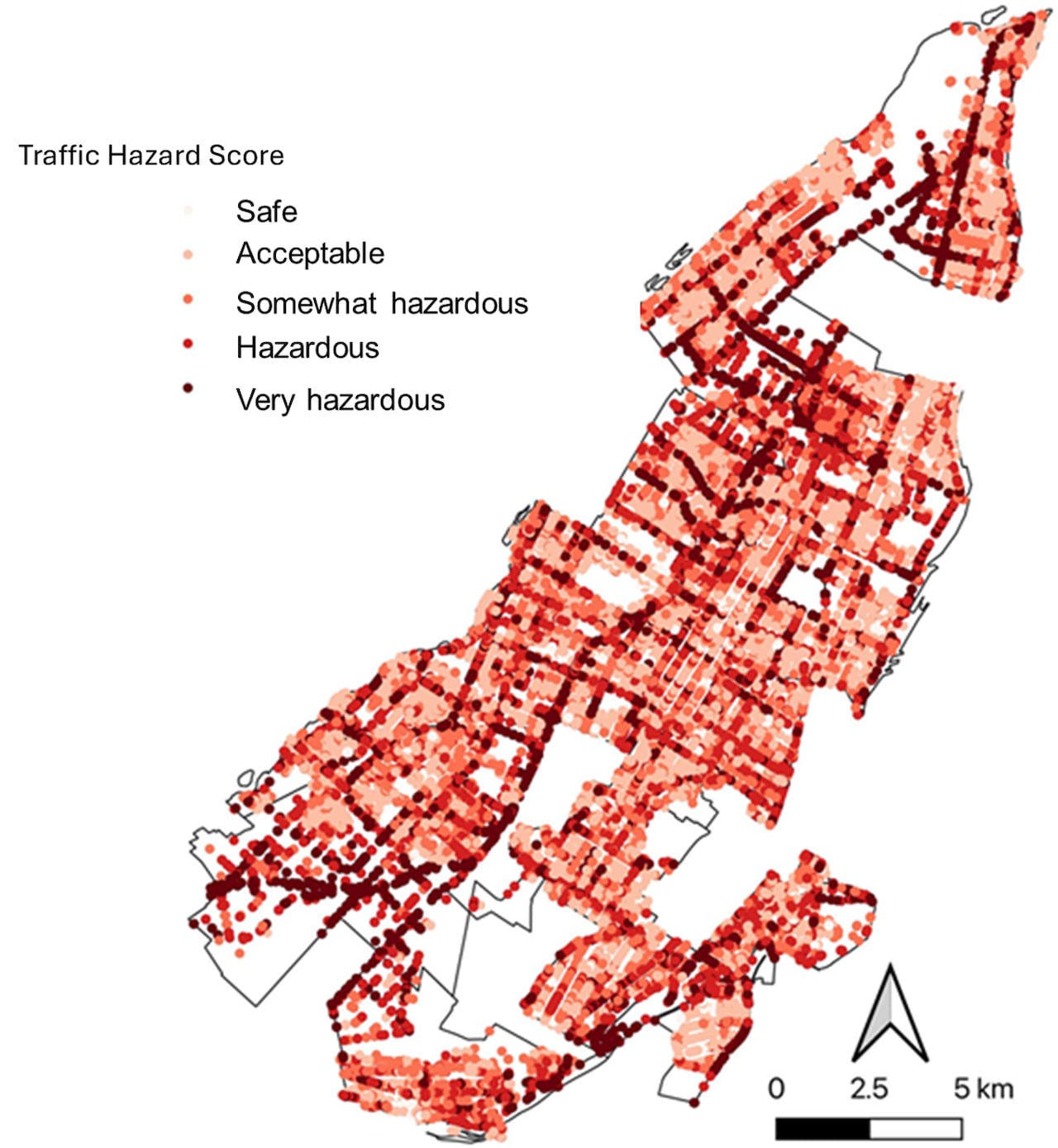 According to SafeMobility, 20 per cent of Montreal’s collisions are considered ‘very hazardous,’ signified by the dark red markings on this map. (Submitted by SafeMobility)
There are also 6,100 “hazardous” intersections, which means “there’s a good chance somebody would be killed” if there is a collision, said Waygood. Another 7,100 “somewhat hazardous” intersections are where someone could be killed.
“The current approach in traffic engineering,” Waygood said, “is often that we wait for the horrible event, like a death, to occur before you really say: ‘OK, let’s change that intersection.’”
His team has shared their data with the City of Montreal and City of Westmount to encourage planners to make necessary changes “before these horrible outcomes occur.”
A statistical portrait of cyclist collisions
Based on Montreal police data from the past five years, some 665 collisions involving cyclists — two fatal — occur annually in the city.
There were two cyclist deaths in 2025, one of which happened on Park Avenue, where Mayor Soraya Martinez Ferrada said 13 cyclists and pedestrians have lost their lives over the past 13 years.
This year, two cyclists have already been killed: a 38-year-old man in June in the Mercier–Hochelaga-Maisonneuve borough and a 65-year-old man in July in Ville-Marie.
Poulin, the SAAQ spokesperson, says the trend is still “relatively positive.”
“There are more people on the street, there are more cars,” Poulin said, “and yet the death toll is globally stable.”
Of the hundreds of cyclist collisions in Montreal every year, police say most occur off designated bike paths. They also mostly happen between May and October and on weekdays between 3 p.m. and 7 p.m.
The city is developing a new bike plan that’s set to be released next fall. The process has included asking road users for their input via an online survey that ended last week, auditing four existing bike paths, and reviewing planned bike path projects.
In the meantime, Poulin says many collisions can be prevented through changes in behaviour.
“One of the first articles of the driving code, there’s a principle of precaution. If you are bigger, you take care of the smaller,” he said.
“It’s true for the trucks regarding the cars, and it’s especially true for the cars regarding the cyclists.”