
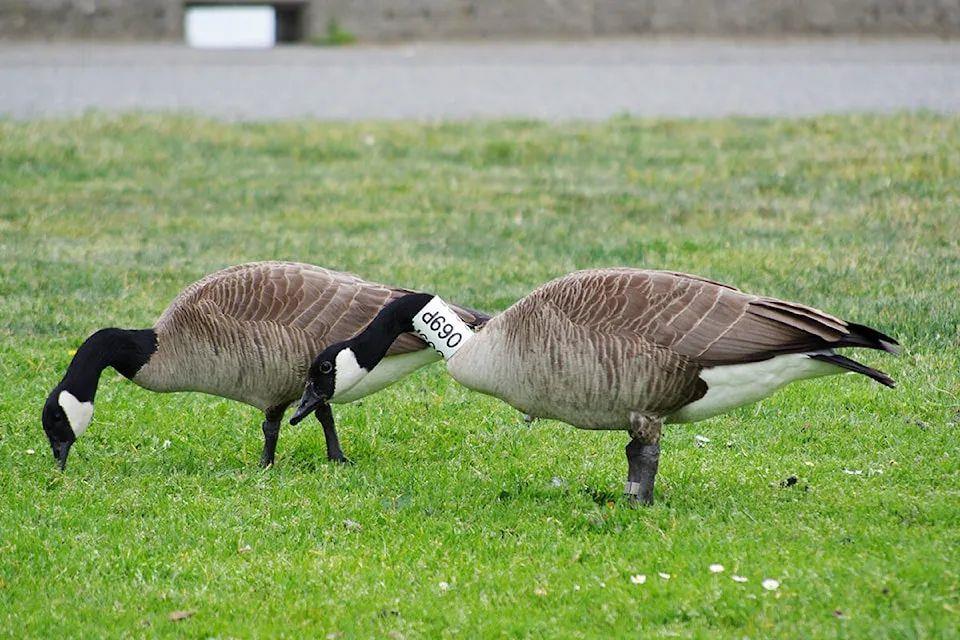
Over a thousand invasive Canada geese eggs addled last year in RDN
Published 5:30 am Saturday, August 1, 2026
Over a thousand eggs containing invasive Canada geese have been addled throughout the Regional District of Nanaimo last year.
The numbers come from a September 2025 report created by Guardians of our Salish Estuaries, a science-based, non-profit conservation organization dedicated to healthy, productive estuaries.
The group told the regional district during a meeting on July 21, that from the Greater Victoria area north to Fanny Bay, a total of 1,221 eggs had been addled from 222 nests found during 2025.
These eggs come from a sub-species of Canada geese introduced to Vancouver Island from Ontario 60 years ago, under the intent of increasing hunting opportunities for wildlife viewing.
However, these introduced geese don’t migrate, leaving damage to local ecosystems over time, whereas the ecosystems have time to regrow from foraging from native migrating sub-species.
As a result, initiatives are currently underway to curb the population. Namely addling.
Addling is the act of causing fertilized eggs to lose any viability. In the case of this initiative, Guardians of our Salish Estuaries perform vigorous shaking to detach membranes within the eggs, which terminated embryonic development.
The most eggs that were addled in 2025 were from Oak Bay, which saw 425 eggs being addled from 77 nests. Industrial sites meanwhile, had around 127 eggs addled from 27 nests, and Winchelseas had around 113 eggs addled from 18 nests.
The report also gave results of a moult count of Canada geese throughout the mid-Island region. The count revealed that 384 moulting Canada Geese had been observed along the region overall, with the three largest concentrations of malting Canada Geese on shorelines of Snaw-naw-as lands along the Nanoose Bay, Englishman River Nature Trust lands, and at the mouth of the Little Qualicum River. Lantzville had 68 Canada Geese, Nanoose Bay had 81, and Little Qualicum River Estuary had 87.
Within the Esquimalt Lagoon, the moult population was reduced to 100 Canada geese, down from over 500 in previous years.
Additionally, due to the efforts of the Wei Wai Kum First Nation, 61 Canada Geese inhabit the Campbell River Estuary, a 96 per cent drop from its population of 1442 Canada Geese before the first nation conducted its harvests. The report added that First Nations led harvests of adult Canada Geese within their traditional territories have been key in reducing nesting in targeted areas. The example it also gives, the Baynes Sound area, had a 93 per cent reduction in Canada Geese nest numbers between 2021 and 2025. Two successful harvests by the K’omoks First Nation had been conducted in 2021 and 2022.
The report adds that ongoing egg addling and harvests are required to reduce Canada goose populations and to mitigate damage to ecosystems, stating that cooperation between First Nations, NGOs and governing bodies remain a cornerstone of the program’s success.
– Files from Jessica Durling, News Bulletin
misha.mustaqeem@nanaimobulletin.com