
PROMISING PROSPECTS:
Full-year economic growth could surpass 10 percent if the current momentum persists, buoyed by exports and domestic demand, the DGBAS said
By Crystal Hsu / Staff reporter
Taiwan’s economy expanded at the fastest pace in nearly four decades in the second quarter, propelled by a surge in artificial intelligence (AI)-related demand that lifted exports, business investment and domestic activity, underscoring the nation’s growing role in the global technology supply chain.
GDP rose 12.92 percent in the April-to-June period from a year earlier, the strongest quarterly expansion since 1988, data released by the Directorate-General of Budget, Accounting and Statistics yesterday showed.
The economy has now recorded double-digit percentage growth for three consecutive quarters.
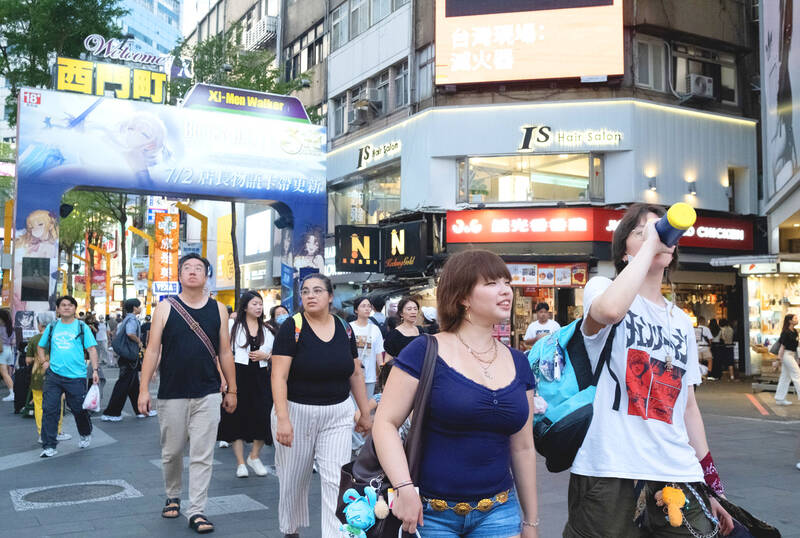
Photo: CNA
Growth reached 13.72 percent in the first half, the best performance in five decades. If the momentum persists, full-year economic growth could exceed 10 percent, the statistics agency said.
The acceleration was initially driven by robust external demand, but the expansion is increasingly spreading beyond exports into corporate investment, production and consumer spending.
“Exports, a key driver of economic growth, surged in the second quarter, as accelerating demand for AI applications boosted shipments,” DGBAS senior official Chiang Hsin-yi (江心怡) told a news conference in Taipei.
The rapid adoption of AI, high-performance computing and cloud services has fueled demand for Taiwan’s semiconductor and information-technology products, lifting shipments across the broader technology supply chain.
Exports of goods and services jumped more than 40 percent from a year earlier during the quarter, led by electronic components and information and communication technology products.
After adjusting for price changes, real exports also outperformed the agency’s previous forecast, reflecting stronger-than-expected demand for AI-related technology products.
Imports accelerated alongside exports as companies expanded production capacity and increased purchases of raw materials, semiconductor equipment and other capital goods to meet AI-driven demand. Higher global commodity prices also contributed to the increase, Chiang said.
Net exports added 5.93 percentage points to second-quarter growth, highlighting the continued strength of overseas demand for Taiwan’s AI-related semiconductor and technology products.
However, domestic demand was the largest contributor to growth in the quarter, signaling that the benefits of the AI boom are beginning to extend beyond exporters and technology manufacturers.
Domestic demand expanded 8.47 percent in the second quarter, contributing 7 percentage points to economic growth and surpassing the contribution from net exports. The shift reflected stronger business investment as companies accelerated capacity expansion to capture AI-related opportunities.
Capital formation increased more than previously expected, driven by higher spending on machinery, technology and infrastructure.
Private consumption also improved as gains in the stock market boosted household sentiment and concerns over auto import tariffs eased. Retailers stepped up promotional campaigns to stimulate spending, the agency said.
The broadening of growth momentum suggests Taiwan’s AI-driven expansion is moving beyond a technology export cycle into a wider economic upswing, supported by investment and domestic demand.