
Just over a year after the Carney Liberals held up their promise to drop federal barriers to internal trade, provinces still need to make strides to increase labour mobility and the trade of services, say economists and interprovincial trade experts.
“There’s still a lot left to do,” said Trevor Tombe, a professor of economics at the University of Calgary.
Bill C-5, the One Canadian Economy Act, dropped 53 federal carveouts in the Canadian Free Trade Agreement (CFTA), on Canada Day 2025. Following that, provinces scrambled to strike trade deals with neighbouring provinces, with Ontario notably inking agreements with seven provinces and all three territories.
“I don’t want to take away from the actions we’ve seen since last year,” said Tombe. “The past year-and-a-half has seen more progress on internal trade—though it’s hard to measure explicitly—than ever before.”
 Trevor Tombe, a professor in the department of economics at the University of Calgary, says there’s ‘still lots left to do’ in encouraging interprovincial trade. Handout photograph
But, he added, there’s still work for the provinces, particularly in encouraging the internal trade of services by mutually recognizing credentials. For example, a health-care worker in Ontario can’t work in another province without also going through that province’s credentialing process. That means an industry like telehealth will face significant trade barriers between provinces, Tombe said.
“There’s been almost no movement there, in terms of mutual recognition or other approaches that makes it easier for someone to sell a service across a provincial border without going through multiple registrations,” he said. “Every province is different in terms of those [licences], and that’s a barrier to our ability to trade, in this case, health-care services.”
Don Drummond, formerly TD Bank’s chief economist and also a past assistant deputy minister at the Finance Department, was blunt in his analysis of how much progress has been made over the past year.
“Not very much,” he told The Hill Times.
“First, the federal government committed to do what it could do, and it did that. But the federal government wasn’t the main problem, so that didn’t accomplish very much.”
There have been “minor agreements” between provinces to encourage trade, he said, but “we still have restrictions on labour mobility and certification across provinces, so the major obstacles remain unchanged.”
The tariff war with the United States and the uncertain future of a North American free trade pact should light a fire under provincial leaders, he added.
“If that’s not a wake-up call, I don’t know what is,” Drummond said.
 Don Drummond, former TD Bank chief economist and a past assistant deputy minister at the Finance Department, says trade tensions with the U.S. should be a ‘wake-up call.’ Handout photograph
“Still, in Ontario, Quebec construction workers can work here, but Ontario workers can’t work in Quebec, and that’s terribly unfair to the Ontario workers. But [Premier] Doug Ford and everybody else in Ontario has never been able to convince Quebec otherwise.”
On June 29, Internal Trade Minister Dominic LeBlanc (Beauséjour, N.B.) issued a statement on the heels of a meeting with provincial and territorial ministers responsible for internal trade, urging his counterparts to “move faster” and “meet established timelines.”
The statement said trade and labour mobility barriers hinder economic growth, and add unnecessary costs and delays.
“We need to make it easier for businesses to sell goods and services across the country, and for skilled workers to apply their expertise where it is needed in Canada,” LeBlanc’s statement reads.
“The Committee on Internal Trade can play a leadership role in driving change across the country—but for that to happen, we must move faster on our priorities, and meet established timelines.”
That starts with meeting promises to which provincial and territorial leaders committed earlier this year, LeBlanc’s statement said, including expanding mutual recognition to the services sector by the end of the year, harmonizing health and safety training requirements in the construction sector by this fall, and implementing digital public registries to speed up credential verification for skilled trades workers by next spring, among other commitments.
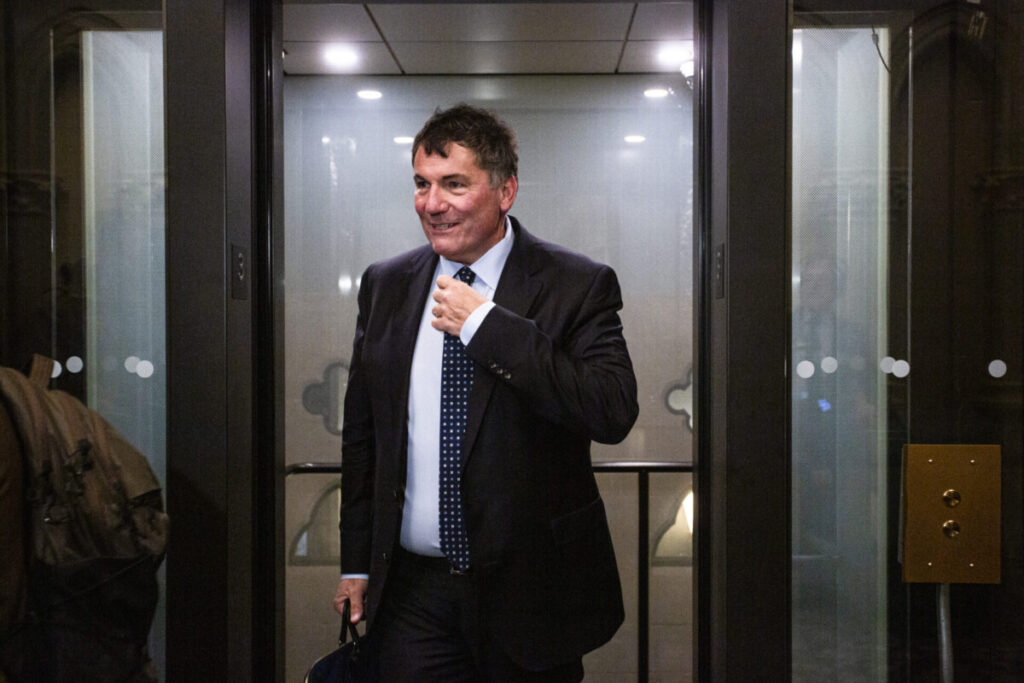 Dominic LeBlanc, minister responsible for Intergovernmental Affairs and One Canadian Economy, has urged provincial counterparts to honour previous commitments to lower internal trade barriers. The Hill Times photograph by Andrew Meade
“We’ve only been talking about this since 1867,” said Drummond, a fellow-in-residence at the C.D. Howe Institute. “I mean, let’s not rush into anything rashly here.”
Conversely, SeoRhin Yoo, a senior policy analyst of interprovincial affairs with the Canadian Federation of Independent Businesses, described the progress made on internal trade as “monumental,” with all the provinces “making commitments towards a freer internal trade market.”
 SeoRhin Yoo, a senior policy analyst of interprovincial affairs for the Canadian Federation of Independent Business, described the progress made on internal trade as ‘monumental.’ Handout photograph
She cited the Canadian Mutual Recognition Agreement on the Sale of Goods—signed in November 2025 by federal, provincial, and territorial members of the Committee on Internal Trade—as one of the year’s success stories since the agreement allows products that are legal in one province to be sold across the country.
“A lot of this work was almost unimaginable two years ago,” she said, but added LeBlanc should get “kudos” for rallying provincial leaders.
“We did see moments where it felt like motivation was almost faltering,” she said.
In one instance, a deal for direct-to-consumer alcohol shipments was supposed to be finalized between all 10 provinces and the Yukon by the end of May. That deal eventually was signed during the Council of the Federation summer meeting in Charlottetown, P.E.I., in late July. Quebec and Yukon did not sign on, though a joint statement says both aim to do so “in the near future.”
Get Today’s Headlines Newsletter
Wake up to the day’s top political and policy headlines. Weekday Mornings.
By entering your email address you consent to receive email from The Hill Times containing news, analysis, updates and offers. You may unsubscribe at any time. See our privacy policy
The provinces breached the “very public” self-imposed deadline for the direct-to-consumer alcohol deal, said Ryan Manucha, an internal trade expert and a research fellow at the C.D. Howe Institute.
 Internal trade expert Ryan Manucha says labour mobility is a top priority. Handout photograph
“What does that mean for literally anything else of ambition?” he said.
But, he added, individual provinces like Ontario are “stepping up” in signalling that mutual recognition of credentials will soon be expanded. Labour mobility is a top priority, Manucha said, adding he expected the mutual recognition agreement to expand before the year’s end.
Tombe, though, said he’s not sure how to overcome the “difficult politics” of mutual recognition and credentials, with provincial licensing bodies potentially viewing the move as a threat to their independence and authority.
“But economically speaking, mutual recognition and professional credentials is perhaps the biggest source of potential economic growth,” Tombe said. “If it were easy, I suppose we would have done it already.”
The Hill Times

Marlo Glass is a news reporter covering the federal public service and everything newsworthy on Parliament Hill. She is also The Hill Times’ deputy digital editor. Glass hails from Winnipeg. With a background in breaking news, her career spans over several cities including Ottawa, Saint John, and Halifax where she covered crime, local government, and the occasional cat up a tree. Glass holds a degree in rhetoric, writing, and communication from the University of Winnipeg. Send tips to mglass@hilltimes.com. See all stories BY MARLO GLASS