
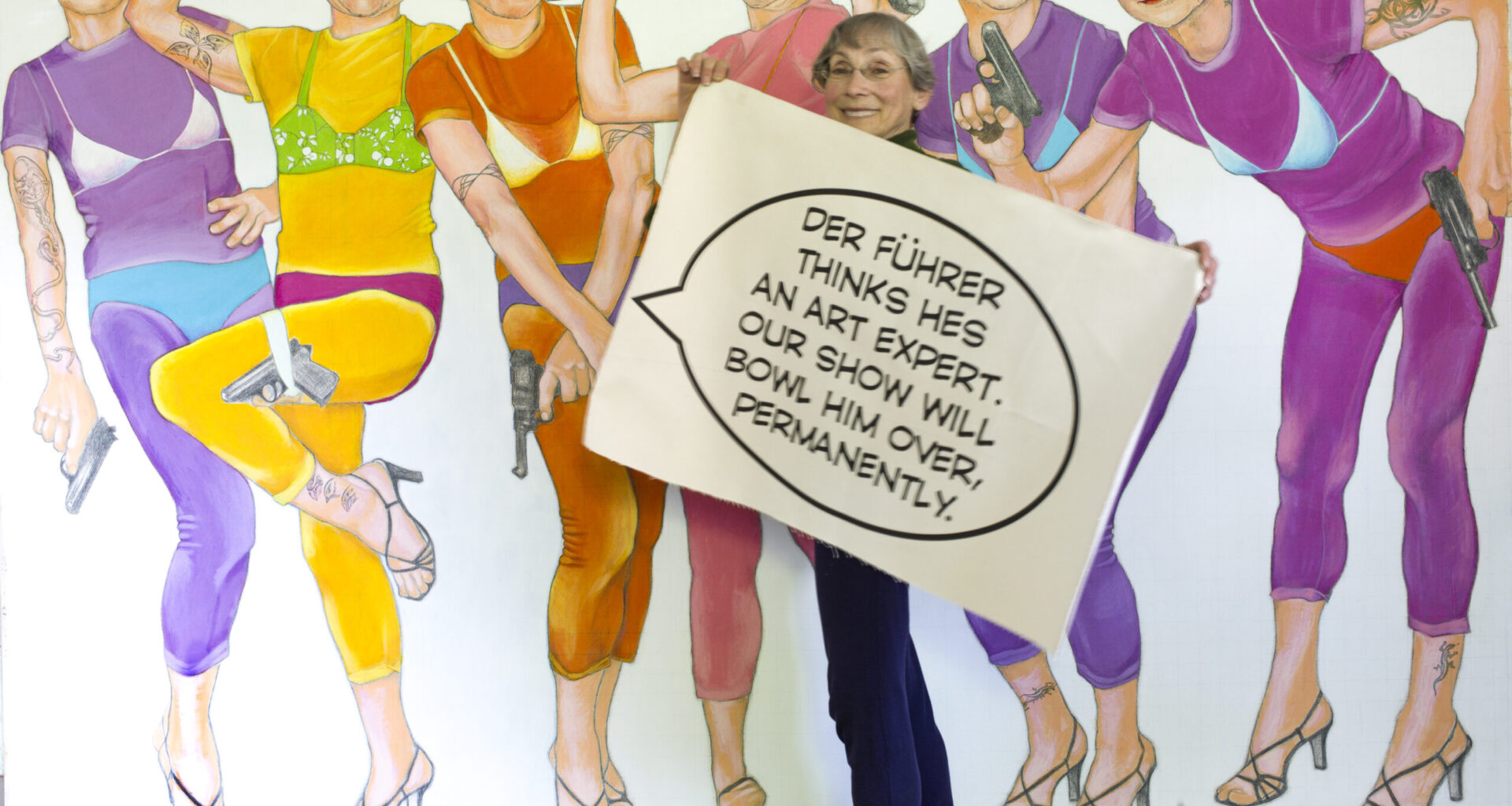
The women are impossible to ignore—except that few people have ever actually seen them.
Rolled into more than a dozen giant cylinders in Vancouver artist Hinda Avery’s basement studio are nine-foot-by-six-foot paintings of grinning, elderly Jewish women in garish dresses and bikinis, toting automatic rifles through scenes inspired by the Holocaust, casually and crudely plotting Hitler’s demise.
Avery calls them the Rosen Sisterrrz. For more than two decades, they have kept her company.
Petite and self-deprecating, Avery speaks thoughtfully about art, feminism, history and social justice, her understated style belying a wicked sense of humour. Now, at 86 and living with her latest bout of cancer, she no longer has the strength to unroll the giant canvases herself. Even so, she is matter-of-fact about what is now her life’s goal.
“I’d love to have a show before I die.”
A lifetime of challenging assumptions
Long before she began imagining the Rosen Sisterrrz, Avery had spent her life questioning accepted ways of seeing the world.
A self-described lifelong feminist, she helped launch Vancouver’s Women’s Centre in the late 1960s, when women’s bookstores, galleries and political organizing were reshaping the city’s cultural landscape.
“It was a time of euphoria and excitement,” she recalls. “It was a reawakening for all of us.”
Avery studied Fine Art at the University of Victoria and UBC before becoming one of the region’s early instructors in Women’s Studies. In her 50s, she earned a doctorate, with research on architecture and urban planning. Her work examined how the built environment reflected, and often ignored, the needs and experiences of women.
Looking back, Avery sees many of the ideas that were once dismissed as radical—safer public spaces, more green space, more thoughtful urban design—have since entered the mainstream.
“What is good for women,” she says, “is good for everyone.”
That instinct—to challenge conventional thinking and imagine alternatives—would later shape her art as profoundly as it had her academic career. Rather than painting Jewish women as history remembered them, Avery painted them as she wished they could have been: fearless, funny and gloriously impossible to intimidate.
The women she never knew
Avery never met two of the women she was painting.
Her mother left Poland before the Second World War. Two of her brothers, who had immigrated to Canada, agreed to sponsor her because they believed she could attract a husband. But they refused to sponsor their younger sister, Avery’s aunt.
“They believed she wasn’t pretty and wouldn’t find a husband, and she’d be a financial burden,” Avery says.
Her aunt remained in Poland, where she married and had twins. She, her husband and the children were all murdered by the Nazis, along with Avery’s grandparents and other relatives.
After retiring in 1993, Avery travelled to her mother’s hometown of Staszów, near Krakow, hoping to learn more about the family she hadn’t known. She visited museums, concentration camps and memorials throughout Poland but found almost nothing about her own relatives.
“I never knew my grandmother, my aunt or the other women in my family who had been murdered,” she says. “I decided I needed a connection with them.”
She had only a couple of faded photographs.
“I thought one way we could be connected would be to paint them.”
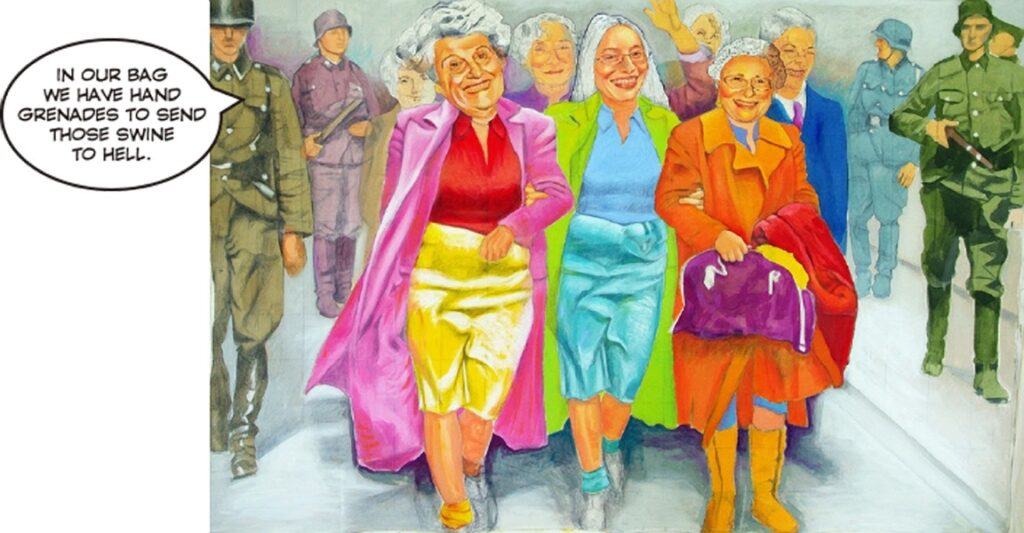 Painting of The Rosen Sisterrz by Hinda Avery
Reimagining the Rosen Women
Beginning in 2005, Avery painted her grandmother, aunt, mother and herself, first as vulnerable, naked prisoners in Nazi concentration camps. But the paintings refused to stay there.
“I got tired of the women being victims,” she says. “I wanted them to have some fun.”
They escaped to the forests and became partisan fighters inspired by the Zionist youth movement Hashomer Hatzair, which resisted the Nazis and helped lead the Warsaw Ghetto Uprising. The drab uniforms and bleak surroundings gradually gave way to dazzling colours. The women acquired automatic weapons. Friends joined the group. The grim expressions broadened to wide smiles.
Eventually, the women became the Rosen Sisterrrz—joyful, wisecracking feminist avengers whose speech balloons gleefully detailed their plans for Hitler’s downfall. Avery patterned several of the compositions after historic Holocaust photographs, replacing terrified victims with her grinning Sisterrrz. She depicted them as medics rescuing a wounded comrade, as burlesque queens, as sci-fi fighters aiming laser guns.
The canvases grew with the women’s confidence—from three-foot squares to monumental nine-by-six-foot paintings. By this point, the women—now known as “The Resisterzzz”—had traded battlefields for outer space, where they were victorious astronauts, intercepting Hitler’s imagined quest to conquer the heavens.
The contradictions in Avery’s paintings are jarring. These kindly looking grandmothers aren’t baking cookies or reading bedtime stories. Instead, they’re forces of nature in chartreuse and fuchsia, hurling expletives at the Nazis. The Sisterrrz exude such confidence, joy and mischievous delight that the paintings invite viewers to be inspired and to thrive in the face of adversity—and to have a hell of a time, while at it.
“I’ve never known the Rosen Sisterrrz to be depressed,” she says. “I wanted the women to be this caricature—crazy, sweet, smiling, feminist Wonder Women having the time of their lives.”
Women with guns
The paintings have never fit comfortably into any category, and Avery understands why they make some viewers uneasy. Still, she can’t help noting that if her painting subjects had been male, the weapons would have gone unmentioned.
“I was told guns are not ‘nice,’” Avery recalls. “My argument was that the women needed weapons to deal with Hitler.”
Others accused Avery of trivializing the Holocaust through dark humour, a criticism she rejects.
“There is still that hesitation—that my work is too far out, that it’s too big a leap from the seriousness of the Holocaust to the absurd humour.”
But to Avery, the paintings gave her agency, allowing her to reclaim a history that otherwise might well have crushed her.
“It was really art therapy to create these women,” she says. “As I painted them, I felt that I, too, was a resister. I, too, was confident. I, too, wasn’t afraid.”
“For me, it was sort of a saving grace,” she says. “To live with the Holocaust as it happened can turn a person crazy.”
Hinda and her Sisterrrz
Documentary filmmaker Michael Kissinger first met Avery while he was working as an editor at the now-defunct Vancouver Courier. Avery repeatedly contacted him, hoping someone would help tell the story behind her unusual work. When he first saw her paintings, he remembers stopping in surprise.
“I was staring at these elderly women holding machine guns,” he recalls. “I thought, ‘Wow—this isn’t your typical pictures of seagulls.’”
The encounter led first to a short video and an article for the Courier. A year or two later, with the help of a grant Avery received from the Canadian Arts Council, Kissinger made 2017’s Hinda and Her Sisterrrz. The documentary first screened at the Vancouver Jewish Film Festival and went on to be an official selection at the Jewish film festivals of Toronto, San Francisco, Boston and Victoria.
He believes the paintings transformed alongside Avery herself.
“She got sick and tired of feeling like a victim,” he says. “She wanted herself and her family to become the heroic avengers of the story, and they’re having fun while they’re doing it.”
Saying goodbye to the Sisterrrz
The Rosen Women’s journey was now complete, with the astronauts.
What surprised Avery was how deeply she mourned their departure. After spending more than a decade painting the women, they had become the family she had spent years creating.
“I had been hanging out with these Rosen women for so many years. They were real characters in my mind that I was having this relationship with,” she says. “It was a real loss for me.”
Avery sank into a depression for a time afterward. Then, the end to the Sisterrrz eventually gave birth to another character.
Enter Bayla
Since retiring the Sisterrrz, Avery has turned to Bayla, an aging Jewish artist whose wrinkles make her a unique comic book character. Bayla explores ageism, sexism and antisemitism. She frets constantly about friendships, technology, romance and artistic recognition, often while sparring with an unflappable inner therapist.
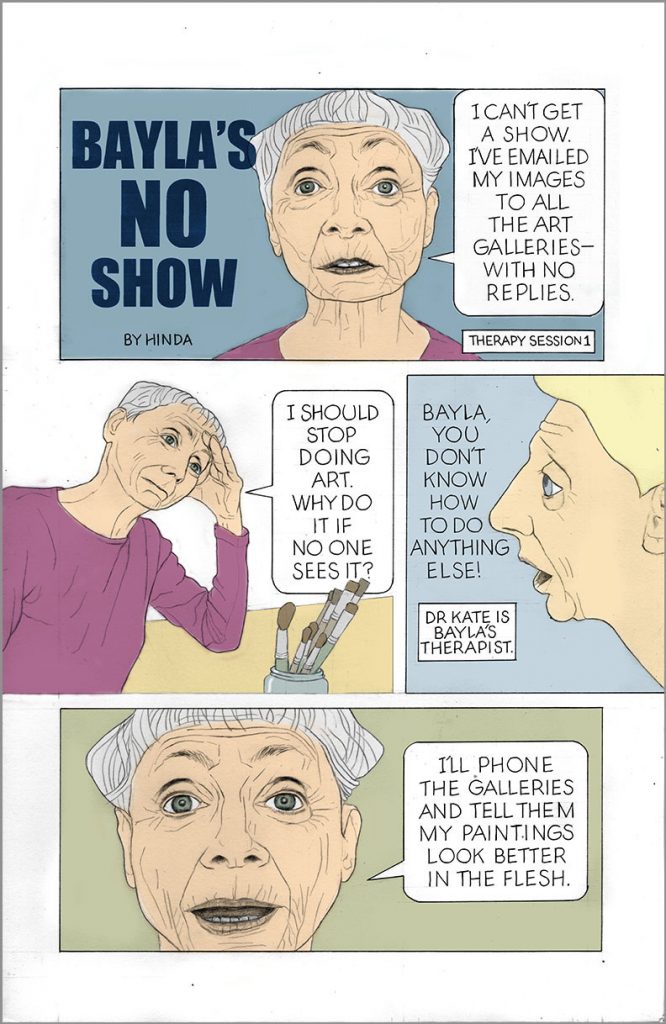 Comic by Hinda Avery
Although Avery describes Bayla as fictional, the two clearly wrestle with many of the same questions older women typically do, including changing appearance, the loss of friendships, and invisibility.
“I couldn’t think of anything else to paint at the time other than an old woman fighting ageism and anxiety, and needing recognition in the art world.”
Kissinger marvels at Avery’s artistic output, given her advanced years—she has completed 14 Bayla comic booklets and adapted two of them into 3-D sculptures. He has since animated several of the comics and is now working on her two newest issues.
The search for a venue
Finding a gallery willing to exhibit the Rosen Sisterrrz remains difficult. The paintings are physically enormous, commercially unconventional and emotionally challenging.
For now, the giant canvases remain rolled in the corner of her studio. Avery still hopes there is time for the rest of the world to meet the companions who have kept her company for nearly two decades.
“I do have a need to share it,” she says. “This is work by a Jewish woman whose family was murdered in the Holocaust, and this is how she deals with it. It’s as simple as that.
“For me, it’s a medicine. It helps me, being here on earth.”
The paintings are still waiting.