
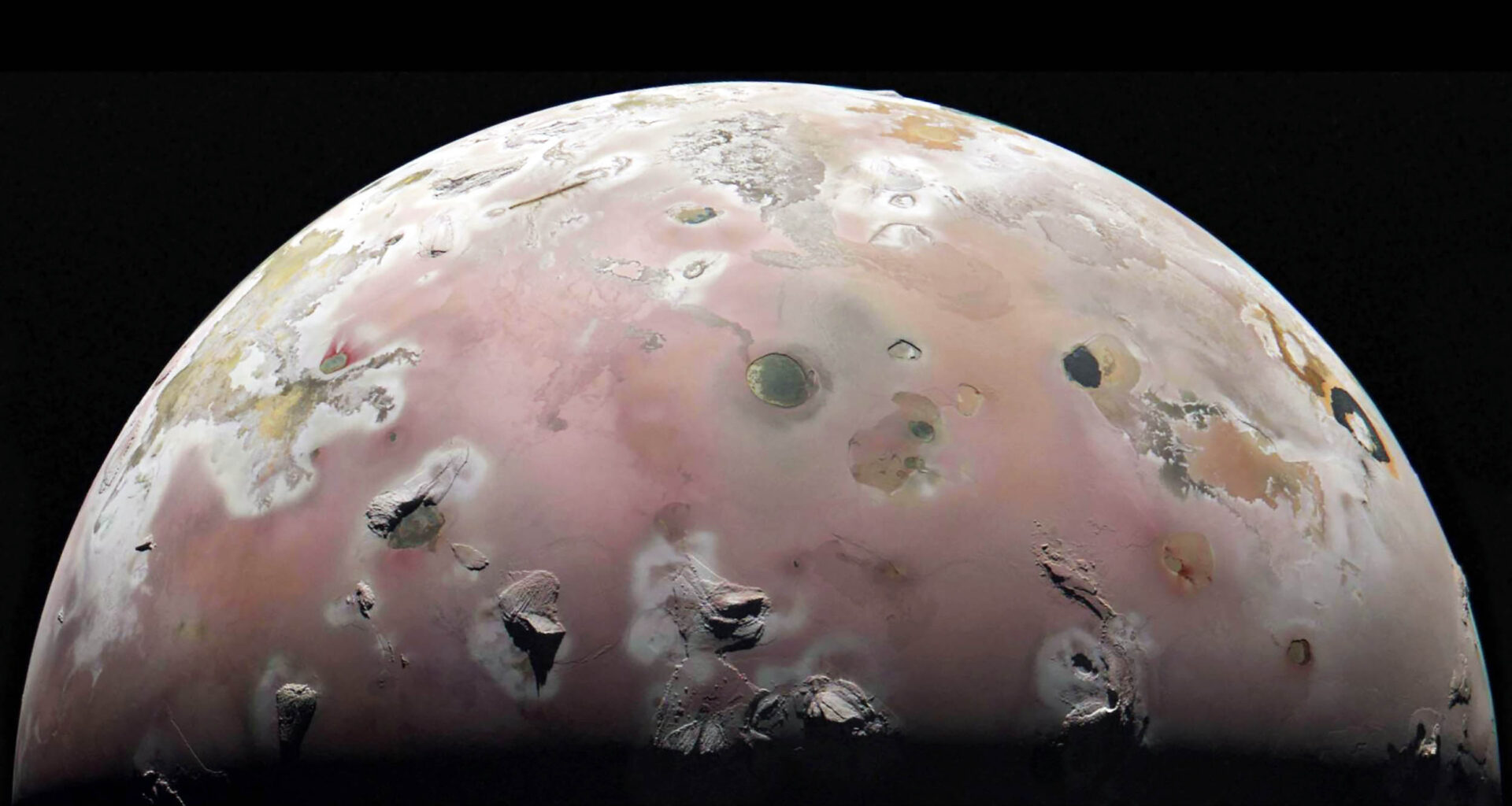
Jupiter’s moon Io has never been a quiet place. Its surface is covered with active volcanoes that constantly reshape the landscape.
For decades, scientists could only measure the heat escaping from the moon’s surface. That left one big question unanswered: What is happening below it?

New observations have finally started to answer that question. For the first time, scientists have measured temperatures beneath Io’s surface instead of only observing the heat radiating from above.
The results show that heat is rising from below across much of the moon, offering fresh clues about what powers the most volcanic world in our solar system.
Looking below the surface
Unlike infrared instruments, which measure surface temperatures, microwave observations can reach different depths underground.
Juno’s Microwave Radiometer uses six antennas that detect microwaves across wavelengths ranging from about half an inch to 20 inches.
“The Juno Microwave Radiometer directly observed Io’s heat output by looking below the surface,” said Scott Bolton, study coauthor and Juno’s principal investigator at Southwest Research Institute.
“The surprising discovery that we could see below a rocky moon’s surface has important implications for studying Earth’s volcanoes.”
According to Bolton, the same type of microwave instrument could one day be used to study volcanoes on Earth. By detecting subsurface temperature gradients, it could reveal processes that surface measurements cannot.
The same technique has already been used to study Jupiter’s icy moons Europa and Ganymede, where scientists explored ice extending tens of miles below the surface.
“The technique is novel in that each wavelength explores different depths, providing a new way to characterize the deep atmosphere of giant planets and the subsurface crusts of icy and rocky moons,” said Bolton.
“At Ganymede and Europa, we explored tens of miles below the surface, assuming their ice shells were mostly pure water. But the ability to probe into the volcanic rock at Io was an unexpected discovery.”
What powers Io’s volcanoes
Io’s intense volcanic activity comes from tidal heating. As the moon travels around Jupiter in a slightly stretched orbit, the giant planet’s gravity constantly pulls and squeezes it. That endless flexing generates enormous amounts of internal heat.
Juno flew within about 930 miles of Io’s surface during passes on December 30, 2023, and February 3, 2024. Those close encounters allowed scientists to make the first direct measurements of underground temperatures.
“The instrument measured Io’s thermal emission at depths ranging from a few inches down to tens of feet,” said Shannon Brown, the paper’s lead author at NASA’s Jet Propulsion Laboratory.
Brown said the team found temperatures rising by more than 40°F just a few feet below the surface. The temperature gradient was far steeper than solar heating alone could explain.
What’s heating Io from below?
Researchers believe the heat could be moving upward through Io’s crust in two different ways. One possibility is a steady flow through solid rock. That background heat flow measures between 1 and 3 watts per square meter.
While that amount is modest in one location, across the entire moon it adds up to an energy release as much as 30 times greater than Earth’s average.
The other possibility is that buried lava flows are slowly cooling beneath about 30 to 35 feet of hardened crust. Those underground lava fields may cover about 10% of Io’s surface at any given time.
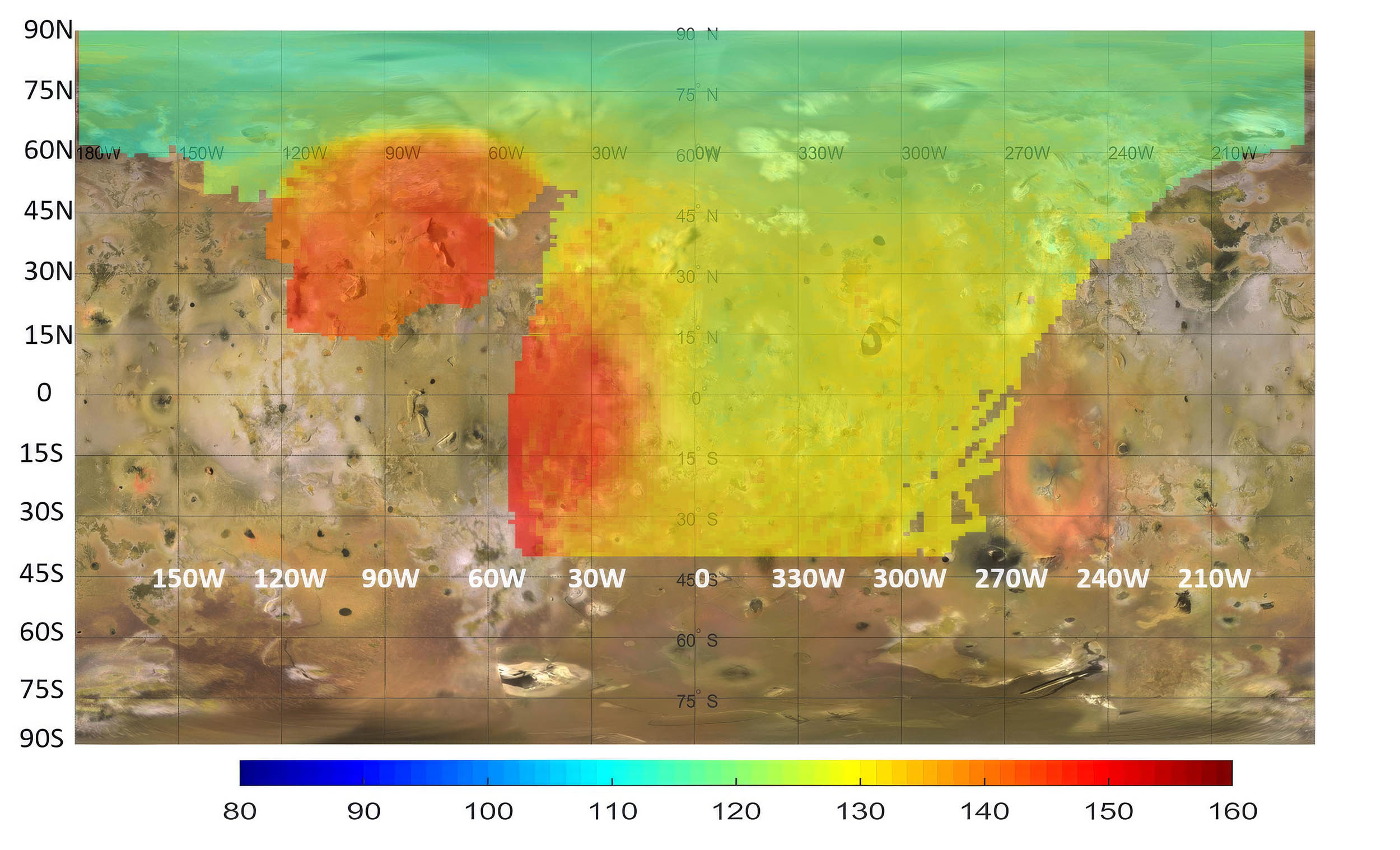 This map represents data captured by the Microwave Radiometer instrument aboard NASA’s Juno, indicating heat rising from just beneath the surface of Jupiter’s moon Io. The colors illustrate a distinct temperature gradient across the moon, with the most extreme, localized heat output in red. Credit: NASA/JPL-Caltech/SwRI/USGS. Click image to enlarge.Beyond Jupiter’s volcanic moon
Scientists are interested in Io because tidal heating is not unique to this moon. The same process affects other worlds throughout the solar system and could shape planets and moons orbiting distant stars.
“Io provides a unique window into learning how tidal heating works throughout the cosmos, a fundamental process that provides energy and heat to worlds that are far from their parent star,” said Bolton.
“This process can not only create the most volcanic body in the solar system, in the case of Io, but also fuels the subsurface oceans on the moons of giant planets, such as Europa and Ganymede.”
Until now, scientists could only observe heat escaping from Io at the surface or during volcanic eruptions. The new measurements reveal how that heat moves from the moon’s interior toward the surface.
Understanding how heat travels underground may also help scientists better understand volcanic systems closer to home.
While Earth’s volcanoes are powered by different processes than Io’s, measuring temperatures below the surface could reveal details that are impossible to detect from surface observations alone.
A surprisingly smooth world
Io is famous for towering mountains and constant eruptions, but Juno uncovered another surprise. Large parts of the moon appear much smoother than expected.
Because the spacecraft observed overlapping regions from different viewing angles, scientists could study how the surface reflected microwave signals. The measurements revealed broad, smooth areas stretching for more than 60 miles.
“Away from its mountains, the surface is more like the Great Plains of North America, and even though Io is a rocky body, the surface material has a very low density – more like pumice or fluffy volcanic ash than solid rock,” said Brown.
That low-density surface may help explain how heat moves through the moon’s upper layers.
Together with the new underground temperature measurements, the findings provide the clearest picture yet of what is happening beneath the surface of the solar system’s most active volcanic world.
—–
Like what you read? Subscribe to our newsletter for engaging articles, exclusive content, and the latest updates.
Check us out on EarthSnap, a free app brought to you by Eric Ralls and Earth.com.
—–