

Listen to this article
Estimated 2 minutes
The audio version of this article is generated by AI-based technology. Mispronunciations can occur. We are working with our partners to continually review and improve the results.
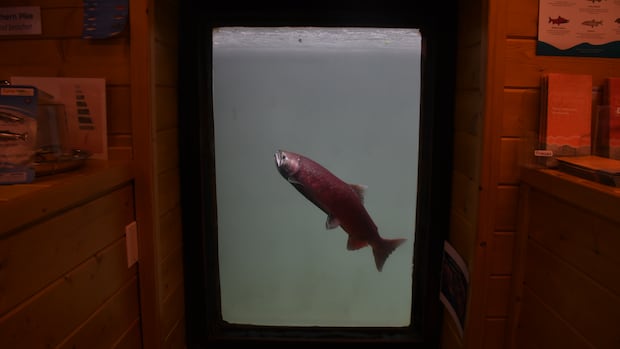
As the first chinook salmon pass through the Whitehorse fish ladder on the last leg of their migration to their spawning grounds, early numbers are indicative of one of the strongest runs in recent years.
As of Wednesday evening, 19 salmon have passed through the fish ladder, according to Liam Milford, the manager of the Whitehorse fish ladder.
“So far, we are ahead of what we had last year,” he said.
Milford and his colleagues count the salmon that pass through the ladder by reviewing footage from an underwater camera. Workers used to count the fish manually, and fish passage through the ladder was blocked overnight.
Now, the new camera means fish can pass through the ladder any time of day, Milford said.
 Manager of the Whitehorse fish ladder, Liam Milford, says the number of Chinook salmon that have arrived so far is ahead of last year’s number. (Peter Paul Pineda)
Each year, chinook salmon migrate up the Yukon River from the Bering Sea off Alaska to their spawning grounds in the Yukon and B.C.
“It’s the longest salmon migration in the world and it spans, at its longest, about 3,200 kilometres,” Milford said.
This year, Yukon River chinook salmon are entering Canada in numbers that haven’t been seen since 2019, but the run is still falling short of its historical average and conservation targets.
So far this season, approximately 27,000 chinook salmon have passed through the sonar station in Eagle, Alaska — about 30 kilometres from the Yukon border — according to an announcement from the Alaska Department of Fish and Game.
It said about three-quarters of the run has passed through the station so far.
Despite reaching a seven-year high to date, this year’s run is still below the historical average of approximately 40,000 salmon observed at the sonar station.
It’s also well below the rebuilding target of 71,000 set in the 2024 agreement between Fisheries and Oceans Canada and the Alaska Department of Fish and Game to address the decline of Yukon River chinook salmon.
That agreement also set out a seven-year fishing moratorium on Yukon River chinook until 2030.
Milford says Chinook salmon numbers have been climbing in recent years under the moratorium and he’s hopeful that trend will continue.