
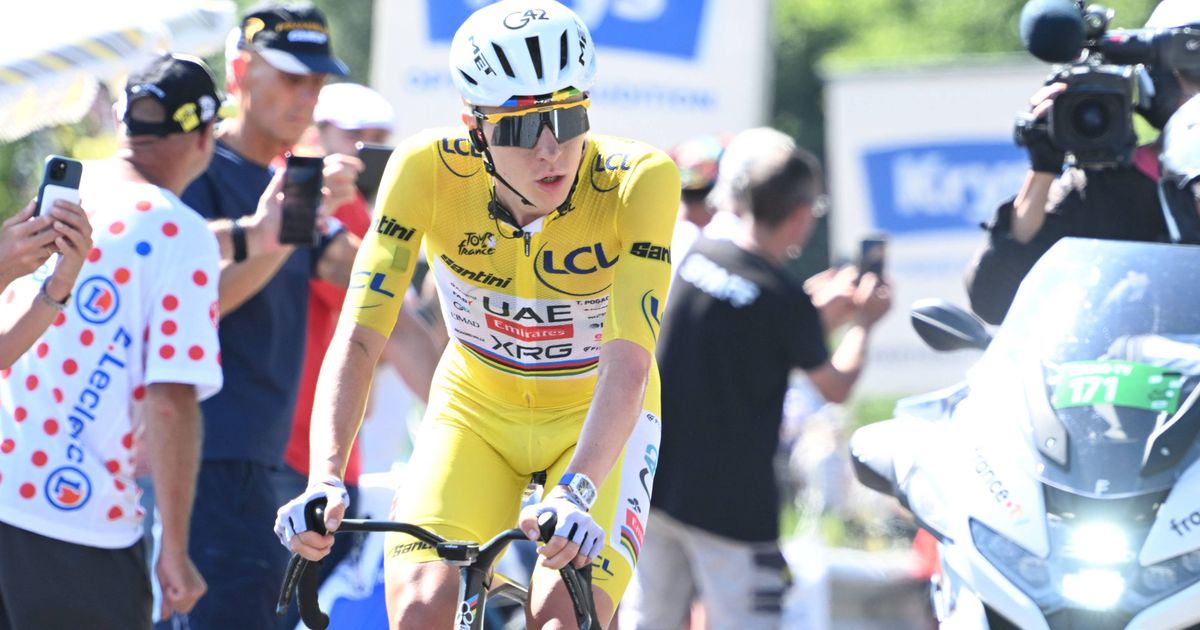
Their calculations placed Pogacar between 94 and 98 ml/kg/min, with an average estimate of 96. Anything above 90 is considered exceptional even among elite endurance athletes.
The figure remains an estimate rather than a confirmed laboratory measurement, but it offers another possible explanation for the sustained climbing performances that have separated Pogacar from the rest of the peloton.
Four performances used to calculate Pogacar’s rangeThe researchers selected Plateau de Beille and Isola 2000 from the 2024 Tour de France, Peyragudes from the 2025 Tour and the Passo di Ganda from that year’s Il Lombardia.
Their estimates for the four efforts were 96, 97, 94 and 98 ml/kg/min respectively. The climbs lasted between approximately 17 and 40 minutes and covered different competitive demands, from high-altitude Grand Tour stages to a mountain time trial and a one-day Monument.
Peyragudes provided a largely uninterrupted individual effort against the clock. Plateau de Beille and Isola 2000 came after hours of racing during the Tour, while Passo di Ganda extended the analysis beyond July and into Il Lombardia.
Factors including the estimated combined mass of Pogacar and his bike, aerodynamic drag, rolling resistance and the characteristics of each climb were included in the mathematical model.
His exact weight and power data on those days were not available, leaving an unavoidable margin of uncertainty. Pogacar’s physiological figures remain tightly protected, with only occasional fragments reaching the public.
He previously revealed that his Zone 2 output was approximately 340 watts, itself an extraordinary figure for a controlled endurance intensity. Rather than relying on a laboratory test, the study used performances produced after the fatigue, positioning battles and repeated changes of pace found in professional racing.
 Pogacar quiz for cycling experts
10 questions · ≈ 5 min · 100 players
Log in to compete in the ranking.
StartChris Froome comparison gives model a reference pointValenzuela, Sitko and Berg checked their method against Chris Froome, whose physiological data have previously been made public. Froome recorded a VO2 max of 84.4 ml/kg/min in laboratory testing. The researchers’ model estimated him at 85.3, a close result that supported the range calculated for Pogacar.The comparison is particularly relevant after Froome offered his own assessment of the Slovenian’s climbing during an appearance with Adam Blythe. “What I was doing for 10 minutes, Tadej is doing for more than 40 minutes now,” Froome said.
Pogacar’s most damaging performances have repeatedly come across long climbs rather than through one short acceleration. He has sustained that level after several hours of racing, both deep into Grand Tours and in the closing stages of Monuments.
Plateau de Beille became one of the defining performances of his 2024 Tour victory. Isola 2000 followed during the same race, while Peyragudes showed the same level in a mountain time trial. Passo di Ganda added another reference point at Il Lombardia, under the sharper tactical demands of a one-day race.
Pogacar’s coach questions the estimates
A VO2 max close to 96 would not, on its own, account for Pogacar’s success. Norwegian rider Oskar Svendsen recorded 96.7 ml/kg/min in a laboratory test before becoming junior world time trial champion, yet never established himself among cycling’s elite.
Aerobic capacity does not account for recovery, efficiency, tactics or the ability to repeat major efforts across three weeks. Pogacar combines his apparent physiological ceiling with acceleration, durability and the capacity to produce decisive power late in races.
There is also disagreement over whether performance-based models may overstate his figures. Pogacar’s coach Javier Sola has argued that such estimates can exaggerate power because they cannot perfectly account for aerodynamics, equipment and the precise conditions of each climb. Sola has also said Pogacar has not undergone a formal VO2 max test under his supervision and rejected the suggestion that the figure is around 100.
Without private testing data from Pogacar or UAE Team Emirates – XRG, the 94-98 range cannot be confirmed. For now, it remains a calculated estimate built from four performances that already sit among the strongest climbing displays of Pogacar’s career.