
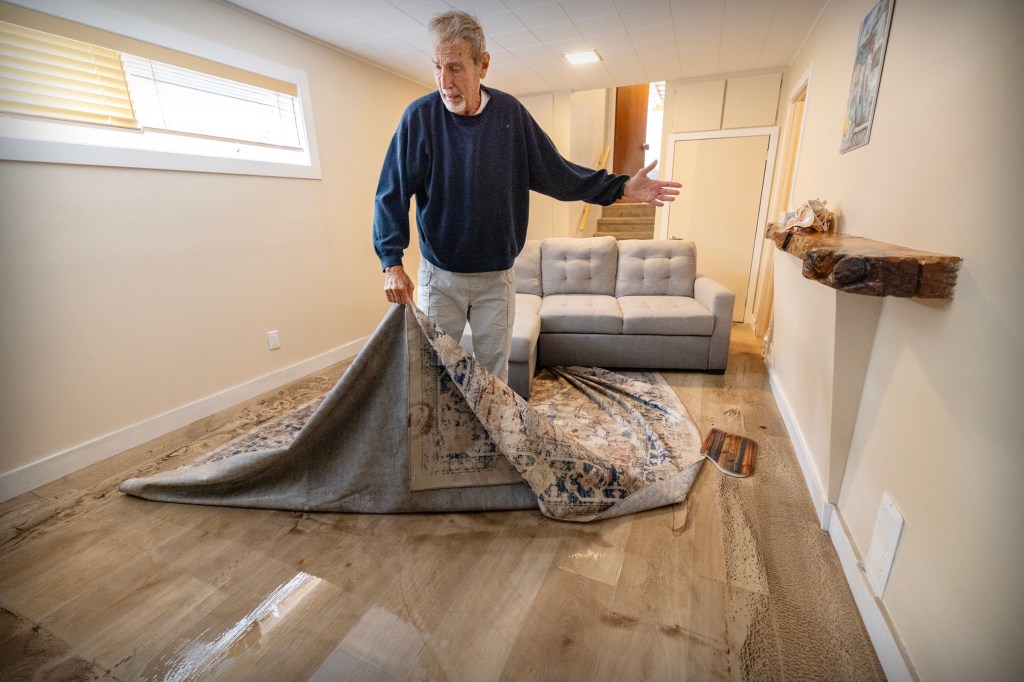
When Erol Araf’s basement filled with water in 2024, the Pierrefonds resident spent tens of thousands of dollars above and beyond his insurance payout to do everything the city suggested to prevent flooding in the future.
So when deluvian rains inundated his home for a second time in June — and he was nearly pinned under his tipping dryer as he attempted to stop it from floating away — Araf knew what was at fault this time.
“The problem is not what I’m doing inside the house,” he said in an interview. “The problem is inadequate infrastructure and the fact that they have known for almost 20 years that the climate change would cause this problem.”
Araf is among the West Island residents who have had it up to here with repeated flooding and are now pressing all levels of government to act.
They’re seeking authorization for not one but two class-action lawsuits against Dollard-des-Ormeaux and the city of Montreal.
They showed up at the Pierrefonds-Roxboro borough council meeting Monday to demand accountability from borough mayor Jim Beis, who is also responsible for public security and prevention on Montreal’s executive committee.
And Araf has drafted a manifesto that calls on the city, Quebec and federal governments to come together to support affected residents with emergency relief funds, develop a comprehensive water infrastructure plan, and be more transparent with the public about risks, among other measures.
As the climate crisis takes a devastating toll year after year, Araf said elected officials can no longer pretend each episode of extreme weather or fresh disaster is an “act of God.”
“It’s an act of incompetence,” he said.
Yet with governments already failing to keep pace with adaptation measures, two more recent studies suggest global warming is accelerating.
One analysis of multiple climate indicators published in Earth System Science Data in June found temperatures rose 35 per cent faster than previously detected between 2015 and 2025.
Another in Geophysical Research Letters that came out in March noted the same trend over the last decade but indicated warming took place 95 per cent more quickly than earlier measurements.
While the scientific community uses intricate data sets, conducts extremely rigorous calculations and speaks in degrees of certainty (98 per cent in the latter study), real-time evidence is all around us.
It’s sweltering temperatures suffocating Europe. It’s tinder dry forests igniting in northern Ontario or burning across British Columbia. It’s smoke blanketing far off places, be it New York City or Montreal. It’s tornadoes churning through Harrington in the Laurentians. It’s heavy rainfall washing out roads in L’Ascension, another Laurentian village.
This catastrophe has long been foretold. But since nobody knows who, where or what will bear the brunt next — or how — a sense of inertia, or even paralysis, sets in.
Just like our efforts are stalling to reduce the greenhouse gas emissions that cause climate change, the work to adapt to more volatile meteorological conditions and plan for emergencies is falling behind.
It’s like we’re defeated by the immensity of the task before we begin to tackle it.
Montreal undertook emergency repairs this summer to shore up the crumbling Atwater aqueduct that delivers water to 1.3 million, prompting restrictions on consumption.
A recent report revealed 10,000 kilometres of water mains, representing 10 per cent of Quebec’s water and sewer infrastructure, are deteriorating — never mind bringing what it would take to bring them up to standards that would withstand torrential rainfalls that caused the most recent flooding in the West Island in June.
If the scale of the work wasn’t daunting enough, the cost is staggering.
The Union des municipalités du Québec recently warned that despite sound financial management, cities and towns are running out of funds to address their growing infrastructure needs, including $19 billion needed for sewers, water mains and water treatment plants.
In a recent report, the UMQ estimated municipalities could face collective operating shortfalls of at least $9 billion by 2035 trying to keep up.
Four years ago, during Quebec’s last provincial election campaign, mayors asked for $2 billion a year in funds to adapt infrastructure to climate change. They were immediately rebuffed. Municipalities eventually got a fraction of that amount to put toward resilience. But every year we wait, the problem just gets more expensive, dire and urgent.
Citizens are often left to their own devices when calamity arrives on their doorsteps.
Leaders of remote Indigenous communities in northern Ontario had to decide on their own when to flee and escape without assistance before wildfires consumed their homes.
Cut off by washed-out roads, dozens were still stranded in L’Ascension Wednesday as Quebec’s ministry of public security and police pondered how to reach them.
And homeowners like Araf are left to cope with the physical, mental, and financial anguish of seeing their homes flooded for the second or third time.
Cities, boroughs, towns and villages, along with the Quebec and federal governments, can no longer shirk their responsibilities or defer necessary preparations. As climate change accelerates, the fallout will only intensify and more people will find themselves in harm’s way.
“Enough is enough. I’m not going to drown in my basement,” said Araf. “No way.”
Editor’s Picks
I started at The Montreal Gazette in 2000 as an intern. Since then I have covered the National Assembly and courts, worked on the assignment desk and written editorials, before debuting as city columnist in 2017.
ahanes@postmedia.com