
Football is cyclical. Trends can arise just as quickly as they fall. But sometimes, the game simply evolves.
After the Seattle Seahawks’ Legion of Boom-led era of single-high safety defenses paired with aggressive, attacking fronts, we saw an explosion in the passing game, punctuated by Kansas City Chiefs quarterback Patrick Mahomes throwing 50 touchdown passes in 2018. To combat the spike in passing production, defenses started playing more two-high coverages, meaning they kept two safeties deep before the snap to discourage deep passing. This top-down approach helped reduce explosive pass plays and forced offenses to drive the length of the field with more plays, making it harder to get into the end zone.
Offenses have loaded up on bigger bodies this offseason and seem to be gearing up to focus more on the running game, but can they force defenses to cycle back into putting a safety in the box? After speaking with defensive coaches, the collective answer was, surprisingly, no. Two-high defenses are here to stay. Quarterbacks and receivers are simply too good. Finding ways to slow the run, while making it hard to create explosive pass plays, is the key to modern defenses. Even if one or two teams become so explosive on the ground they force defenses to put the extra safety in the box, those offenses won’t be enough to change the defensive meta.
Quarterback Tiers defined
Mike Sando and Lauren Morales-Jones
There can be confusion about exactly what the term two-high refers to. It can refer to an umbrella term for coverages with two deep safeties, such as Cover 2 or Cover 4, or it can simply mean that both safeties align deep before the snap. After the snap, the safeties can rotate or drop down, and the coverage can shift into one-high. For this article, two-high will refer to presnap alignment. Modern defenses are lining up in two-high and rotating into many types of coverages. For example, Cover 3 is still being played at a high rate from a two-high alignment, but it’s important to note that it’s being played differently.
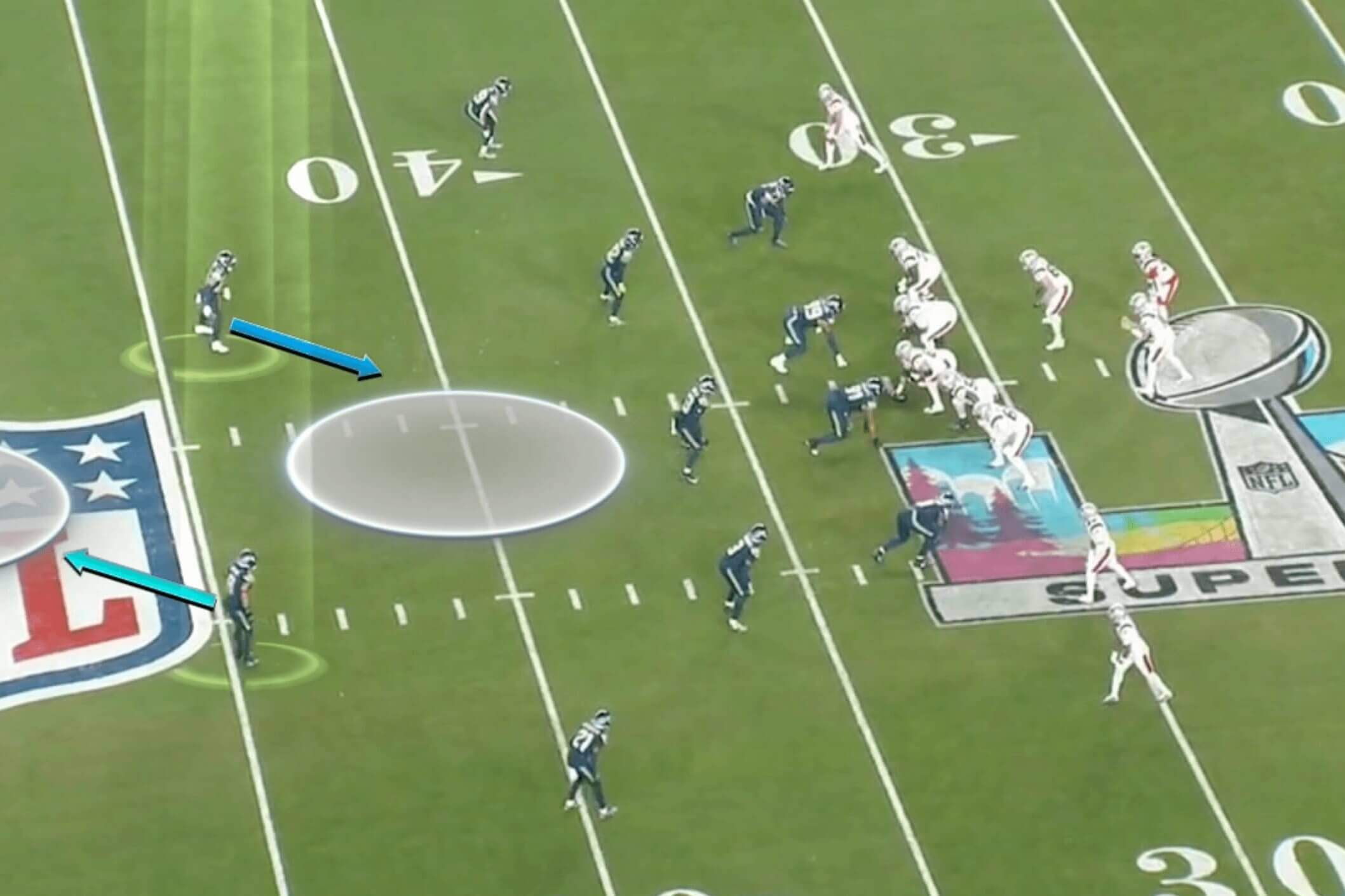
Here, the Seahawks lined up in two-high before the snap but rotated into a Cover 3 after the snap with safety Julian Love dropping down to play an underneath zone.
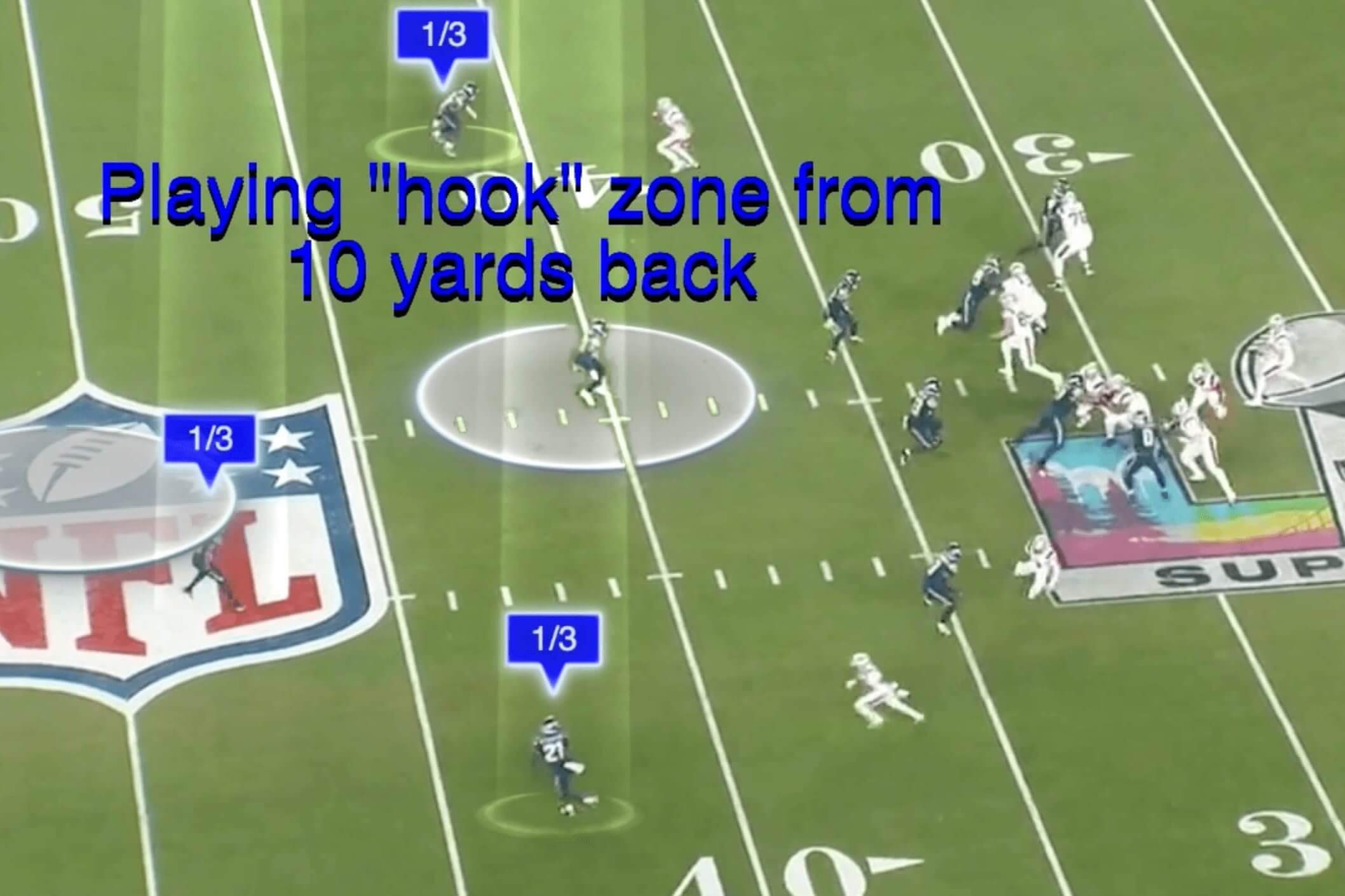
After his rotation, Love played his “hook” zone from 10 yards deep.
It’s being played from depth to take away some of the deep crossers, which can be a weakness when playing it with a safety lining up in the box. Even though Cover 3 will be categorized the same on charts, there are different flavors of it. The Cover 3 being played today is focused on taking away explosives.
Philadelphia Eagles defensive coordinator Vic Fangio, who is responsible for starting this trend, called a lot of man coverage from two-high last season. An advantage to this is that you don’t give a quarterback a presnap indicator to go to his deep route. Back then, without disguise, a quarterback would be licking his chops as soon as he saw press coverage on the outside with one deep safety in the middle of the field.
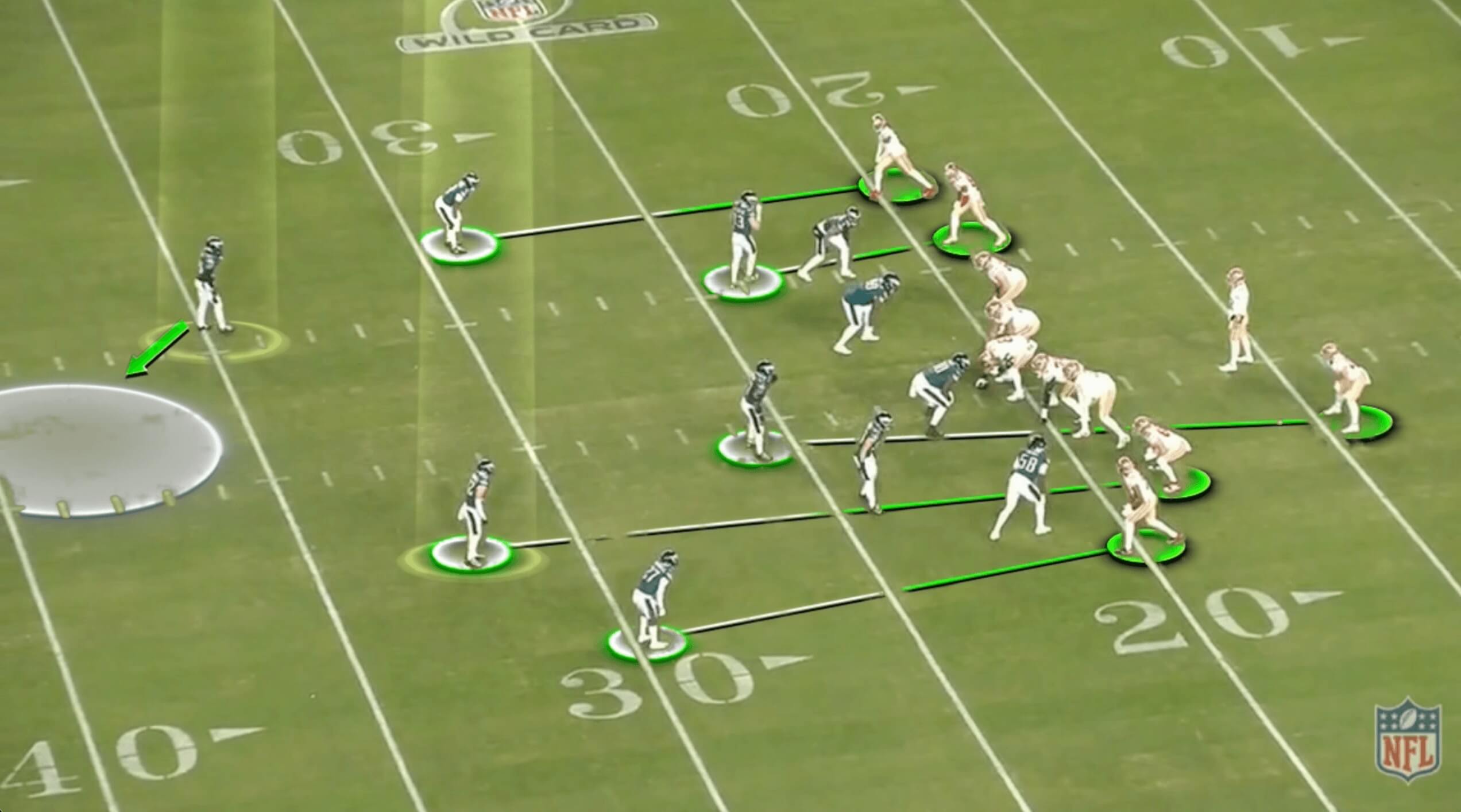
In this image, the Eagles showed two-high, but safety Reed Blankenship rotated down to cover the tight end in man-to-man coverage.
Two-high coverages aren’t immune to deep passes. There are still weaknesses in any coverage, but it makes them harder to find. The top quarterbacks can decipher these coverages after the snap, find the weaknesses and hit deep passes with anticipation, but two-high makes it much more difficult to execute.
Committing to this style of defense means you have to be comfortable playing with a light box. Even though a defense can rotate into a single-high coverage, the safety is coming from depth and he’s not an immediate part of the run fit. Defenses have to be OK giving up efficient runs on the ground. The theory is that it is very difficult to keep stringing together efficient runs, and offensive coordinators will eventually get impatient.
“If you’re giving up a bunch of explosive runs, obviously you’re going to have to do something, but if they’re getting four or five yards of pop because you’re in split safety and they’re patient enough to do it, I can live with that sometimes,” an AFC defensive play caller said. “I know that it’s not sexy, but the second you go single-high, the explosive passing rate goes ridiculously high.”
What constitutes an explosive play can differ depending on who is charting or the coaching staff setting the parameters. Generally, an explosive play is a pass play of 20 or more yards or a run play of more than 10. Some coaches define any play, whether it’s a run or pass, as an explosive if it gains 15 or more yards.
“If you look at an explosive play as a 15-plus-yard play, whether it’s a run or pass, the percentage of the offense scoring a touchdown if they get an explosive versus the percentage if you don’t give up an explosive is much higher. The likeliness of the offense scoring a touchdown without an explosive is very low,” an NFC defensive coordinator said. “Ninety percent of explosives come from passes. So as long as you don’t give up an explosive, they’re likely not gonna give up a touchdown.”
From 2022 to 2025, offenses scored touchdowns on 42.7 percent of drives in which they had at least one play of 15 yards or more. On drives when they didn’t have an explosive, that percentage dropped to 21.8 percent.
It’s much easier to create an explosive through the passing game than on the ground. Though it’s easier to get efficient runs against two-high, the scheme actually does a better job of containing explosive runs. Big runs happen when defenses crowd the line of scrimmage and the ball carrier gets through the second level. By putting a safety back, the defense strengthens its second-level line of defense, and defensive backs are becoming better at fitting the run and tackling from depth.
“The pace of our fits from depth has gotten better,” an NFC defensive coach said.
The combination of more repetitions defending the run and an emphasis from scouts on finding good tacklers has improved open-field tackling. In this style of defense, coaches talked about the need to remain disciplined even when teams are having success running the ball. You can’t abandon your defensive philosophy, and if a team is really dominating on the ground, there are schematic levers to pull to try to disrupt the run game.
“When you’re in nickel (five defensive backs) and split-safety coverages versus 12 and 13 personnel (multiple tight ends), you’re gonna give us some 7- and 8-yard runs, and that’s where you got to be comfortable doing that and have the discipline to stay with it,” an AFC head coach said. “Then you have got to have the ability to call a run blitz or do something to kind of get them off schedule. And now, you don’t have the deck in your favor.”
A defense can give up several efficient runs in a row, but if a defensive play caller can create a negative through blitzing or changing the front to confuse the blocking scheme, the defense can get the offense into second-and-long, and then it is right back on track. By scouting and looking at the analytics, defensive coaches can help their light fronts gain an advantage with their calls.
“By understanding what runs we can expect to get out of certain looks, looking at this personnel grouping paired with this formation or core structure with this backfield set, we can have a good idea about what run might come,” an NFC defensive coach said. “So what can we do from a line movement or a game or even sending a pressure from the second or third level where they might not be accounting for that guy in the count?”
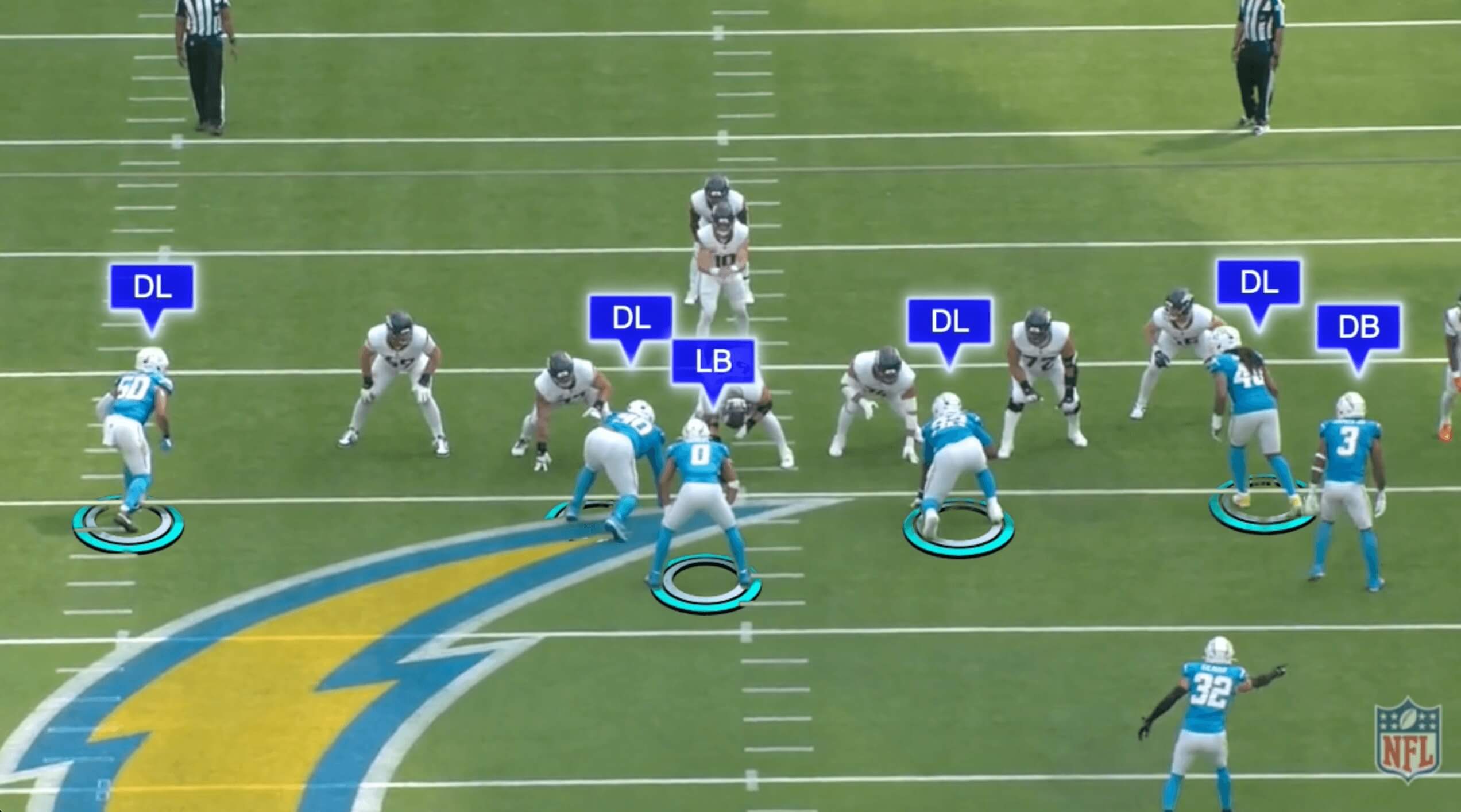
On second-and-long, the Los Angeles Chargers had dime personnel (six defensive backs) on the field. They had four defensive linemen, one linebacker and safety Derwin James in the box.
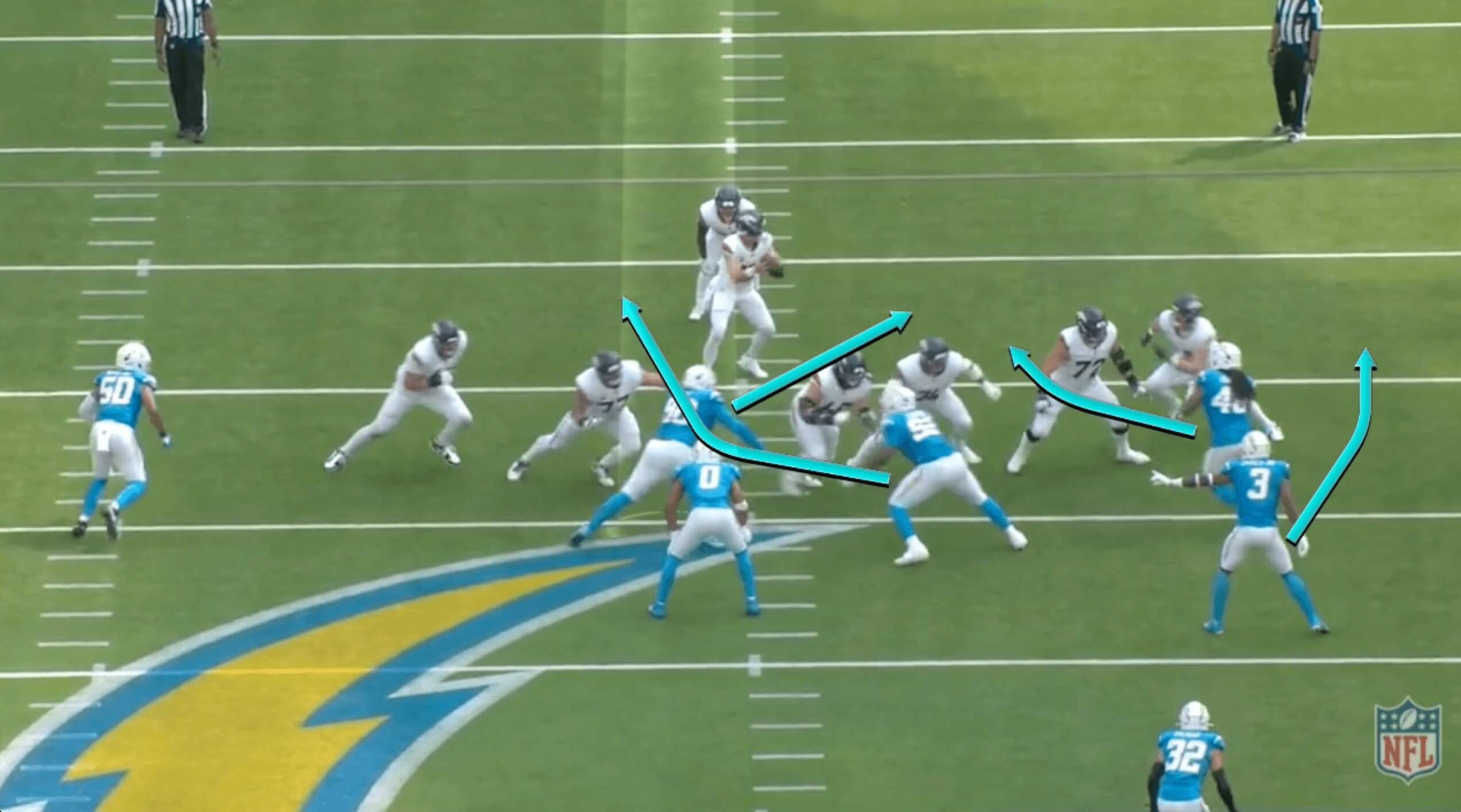
The defense had a stunt called with nose tackle Teair Tart spiking inside the A gap. This was a perfect call against a zone concept going toward the defensive right because the guard had a highly difficult block to make.
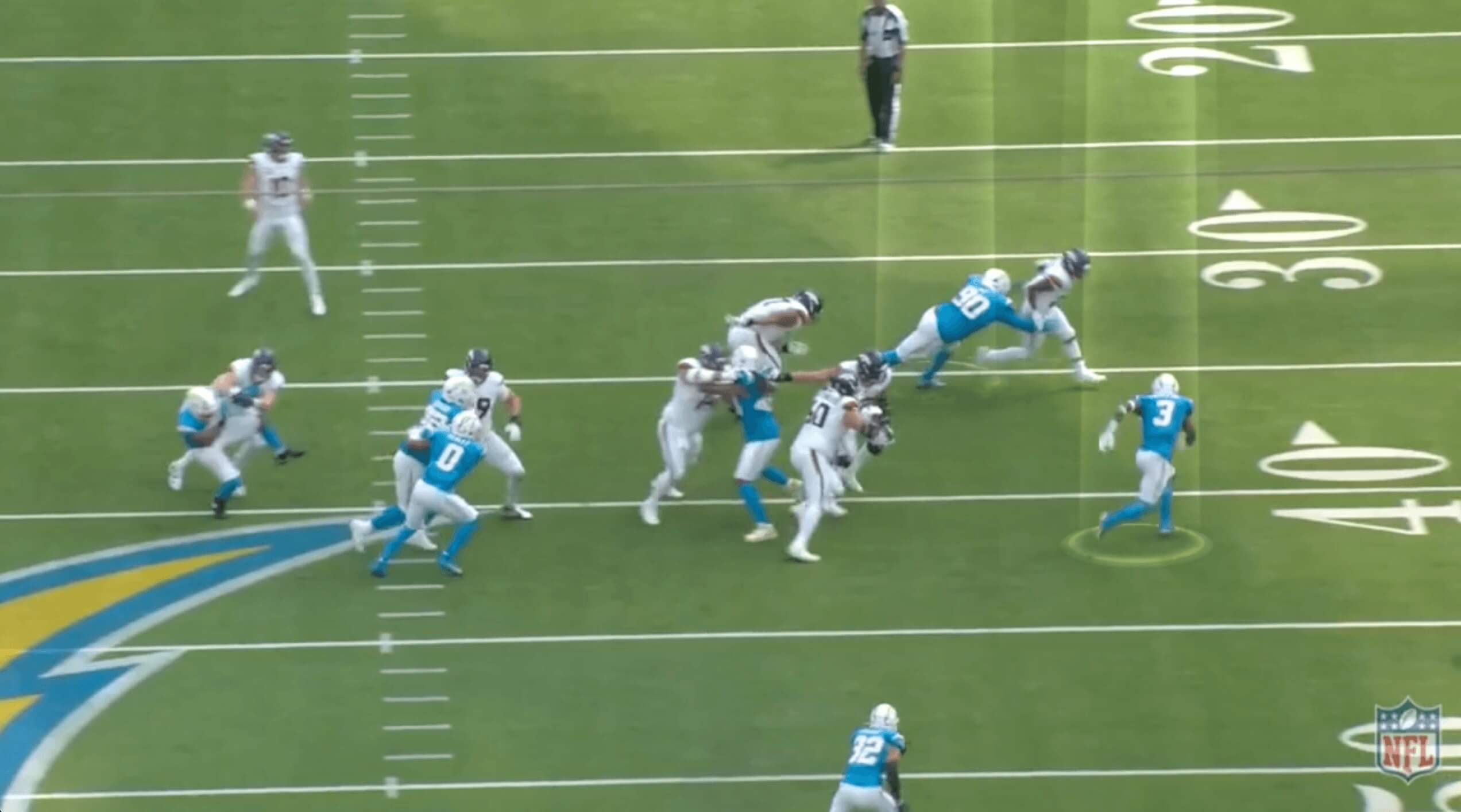
Tart forced the back outside, and James was free to help him finish the tackle. With a light box and dime personnel, the defense still managed to get a tackle for loss against the run.
The most forward-thinking defensive coaches will find ways to slow down the run game schematically to allow themselves to stay in two-high coverages. Of course, personnel will always matter, and we’ve seen the value of bigger defenders up front. But defenses also don’t want to just have big defenders who can’t rush much on the field at the same time. The give-and-take that coaches in this world have to navigate is when to allow their defensive linemen to get upfield and rush the passer versus playing more at the line of scrimmage to defend the run. In a two-high scheme, defensive linemen can’t just fly upfield. That’s what makes the Seahawks’ front special; they have defensive linemen such as Leonard Williams and DeMarcus Lawrence, who are stout against the run but also can rush the passer.
According to defensive coaches, the evolution will continue with defenses finding ways to slow down the run game with light boxes, confusing the quarterback and scheming ways to attack protection plans. Putting an extra safety in the box simply creates too much risk for defenses for the league to cycle back in that direction.