

From Vernon BC to Spokane WA, wildfires are encroaching communities at unprecedented rates this summer, causing significant property damage, displacement and, sometimes, injury and death.
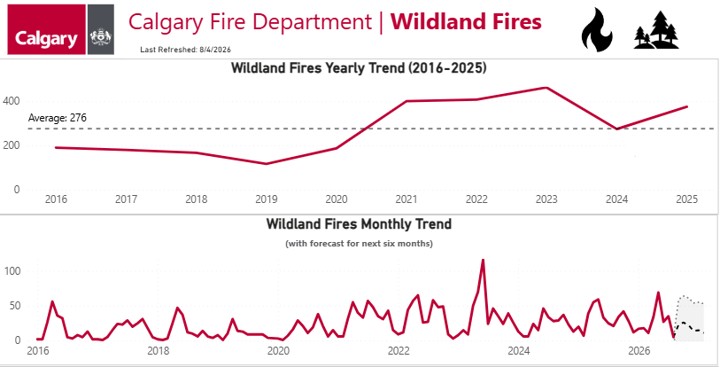
Wildfire, along with other outdoor fire types, have on average seen increased activity in Calgary since 2020, similar to other municipalities in western Canada. While Calgary is not adjacent to large boreal forests, its natural areas inevitably see fires and with increased densification and population growth in our City, more residents than ever are living near urban wildland areas, grasslands and other natural areas.
“Seasonal risk of wildfire, grass fires and other outdoor fires is a growing reality across Canada, especially where residential neighbourhoods join up with wildlands,” says Fire Chief Steve Dongworth.
“While The City of Calgary provides some of Canada’s most effective fire response, planning and emergency preparedness, we also rely on residents and communities to reduce our shared fire risk, both at home and in City parks and natural areas. Hotter, dryer summers mean that we all play a role in keeping our homes and communities safe.”
In response to this shared risk, the Calgary Fire Department (CFD) has developed Calgary’s first dedicated wildfire resilience and prevention campaign, which runs August 3 to September 6 and is supported through funding from the Forest Resource Improvement Association of Alberta (FRIAA) FireSmart Program. Wildfire awareness campaigns are now common in rural and forested areas of Canada, often through provincial and federal FireSmart programs, and are increasingly common in municipalities across Canada.
Like any municipality, Calgary has unique topography and natural areas with a number of “wildland-urban interfaces” where residential development is adjacent to natural vegetation. These areas are detailed in maps at calgary.ca/wildfire where Calgarians can determine their proximity to our City’s major natural and wildland areas, including a community-specific map.
Wildland-urban interface areas exist across Calgary, and they can be found in both established and growing communities. Living in these areas increases exposure to wildfire risk, especially during hot, dry, and windy conditions that are currently being observed across southern Alberta and British Columbia. On July 30, CFD issued a fire advisory for Calgary, asking Calgarians to use extra caution when using open flames or any solid-fueled appliance such as fire pits, barbeques and campfires.
“If nature is next door, wildfire is a risk. Learn about outdoor fire risk specific to where you live – and then take any number of our recommended big and small actions that will make a difference to reduce wildfire, grass and bush fire risk in and around your home and community,” says Chief Dongworth.
Reflecting on his own experience touring the aftermath of the deadly Los Angeles fires in 2025, Chief Dongworth says a little goes a long way in terms of adapting to warming summers and emergency preparedness.
“Becoming more resilient in the face of increasing wildfire risk is a multi-year process,” he says. “We don’t expect everyone to replace their roofing and siding however there is a lot that Calgarians can do today, whether you rent or own your home – or while visiting our City’s parks and natural areas.”
Calgary Fire has specialized equipment to combat wildland fires, and trains regularly to be ready for major incidents. CFD and other City business units also collaborate with wildland-adjacent communities like Discovery Ridge to identify risks and opportunities related to potential wildfire activity. The City is also developing a wildfire threat assessment program to better understand wildfire conditions in natural areas across Calgary.
“Discovery Ridge is a community where we need to balance the beauty of the natural landscape with the risk of wildfires,” says Dana Fleury, Vice President, Discovery Ridge Community Association.
“We encourage our community members here and in other areas of Calgary to learn more about how we can all mitigate the risk of wildfire in our city while preserving our environment.”
Calgarians are asked to:
1. Create a safe perimeter around your home and property. Take steps to remove combustibles. Limit the amount of flammable vegetation in any potential ignition zone close to your residence.
2. Manage fuels and flammable materials. Store propane tanks, firewood and yard waste away from your home. Do not store propane tanks inside.
3. Upgrade when renovating. Choose ignition resistant building materials and construction techniques.
4. Practice outdoor fire safety everywhere. Improper disposal of smoking materials remains one of Calgary’s leading causes of outdoor fires. Extreme caution should be used in the city’s natural areas and green spaces during fire bans and periods of high temperatures.
5. Prepare and know what to do. Learn how to become more resilient during periods of wildfire smoke and maintain an emergency kit with wildfire-specific items such as N95 masks. Always call 9-1-1 in an emergency.
Please visit calgary.ca/wildfire for more information.
-30-
Calgary Fire Department – wildland fire fast facts
Wildfire in Calgary, along with other outdoor fire types, have on average seen increased activity in Calgary since 2020, similar to other municipalities in western Canada.
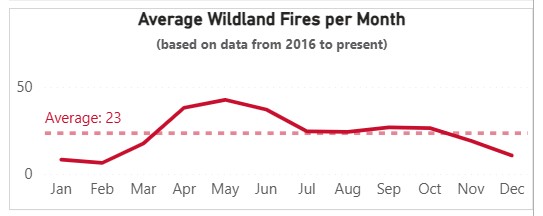
Calgary Fire has responded to an average of 23 wildland fires (wildfire, grass and brush fires) per month annually since 2016. Peak activity usually occurs in May, which on average sees an average of 42 wildland fires.
Seasonal conditions continue to be variable despite long-term trends. From January to June 2026, for example, wildland fires in Calgary declined by 17 per cent, primarily due to fewer brush, or brush and grass mixture fires, compared to the same period in 2025. This was strongly influenced by persistent cold temperatures and heavy snow accumulation during January to April 2026, which reduced several ignition risk factors, including construction activity, outdoor smoking near entrances and balconies, and the use of outdoor heating or open-flame devices.
While spring 2026 wildland fires decreased in frequency compared to Calgary’s historical average due to wet conditions, it is expected that outdoor fire activity will continue to trend upwards this summer and increase, on average, in the coming years.
As of July 2026, Calgary Fire had responded to more wildland fire incidents in the first half of 2026 than recorded for entire individual years between 2017 to 2020.
‘;