
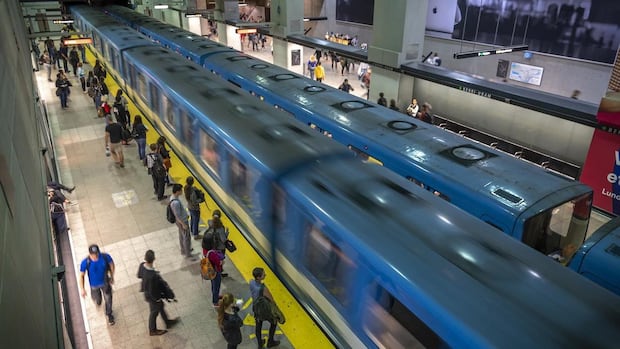

Listen to this article
Estimated 2 minutes
The audio version of this article is generated by AI-based technology. Mispronunciations can occur. We are working with our partners to continually review and improve the results.
By 2031, Montreal Metro’s Green line is going to be stuck with the network’s oldest trains — and not everyone is on board.
The date marks the end of construction for the Blue line expansion.
The old MR-73s trains that are currently running on the Blue line will be exchanged for the Green line’s newer AZUR cars. That’s because, as part of its expansion, the Blue track’s new control system will be incompatible with MR-73s.
The old trains started running during the 1976 Olympics and are already past their original life expectancy. They also have worse ventilation.
WATCH | Green line will only run old trains when Blue line construction ends:
Why the STM will exclusively use old Metro cars on the Green Line as of 2031
The MR-73 trains, which came into service in 1976, will be exclusive to the Green line when the Blue line extension opens in 2031, as the new stations are only compatible with the new AZUR trains. By that time, the old cars will be nearly 55 years old — 15 years past their original life expectancy.
Projet Montréal, the official opposition at city hall, says exclusively servicing the Green line with MR-73s will impact its performance, significantly decreasing its reliability and provide eight per cent less capacity on one of the network’s busiest lines.
“The service life of these cars has already been extended to 2036 thanks to certain upgrades. However, Ensemble Montréal’s current plan calls for the new trains to arrive only in 2040,” said Projet Montréal on its website.
The party has since started a petition to back up their stance.
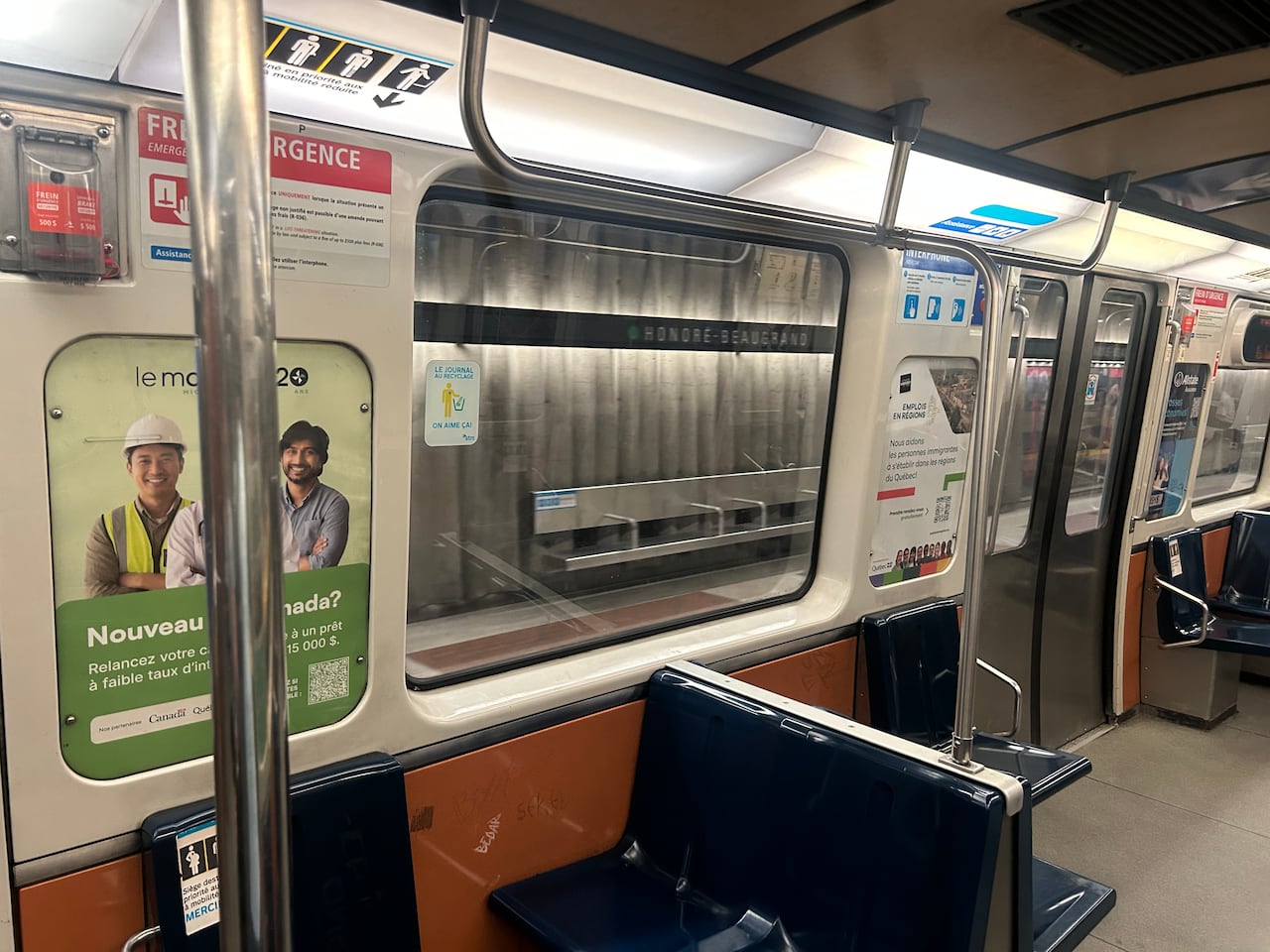 The MR-73 trains started running during the 1976 Olympics. (Kwabena Oduro/CBC)
But according to Montreal Mayor Soraya Martinez Ferrada, the City of Montreal doesn’t have the financial means to replace the trains.
“We still have no commitment from the Government of Quebec on the changes of those wagons,” she said.
In a statement, the Transport Ministry said it offers several programs to fund public transport, but referred questions on train replacements to Montreal’s public transit agency, the Société de transport de Montréal (STM).
The STM says replacing the MR-73 cars is urgent.
“In 2036, the trains will be 60 years old and will have aged 20 years past their intended lifetime, making them the oldest in the world,” it said in a statement.
“Projects of this scale can take more than 15 years to complete.”