
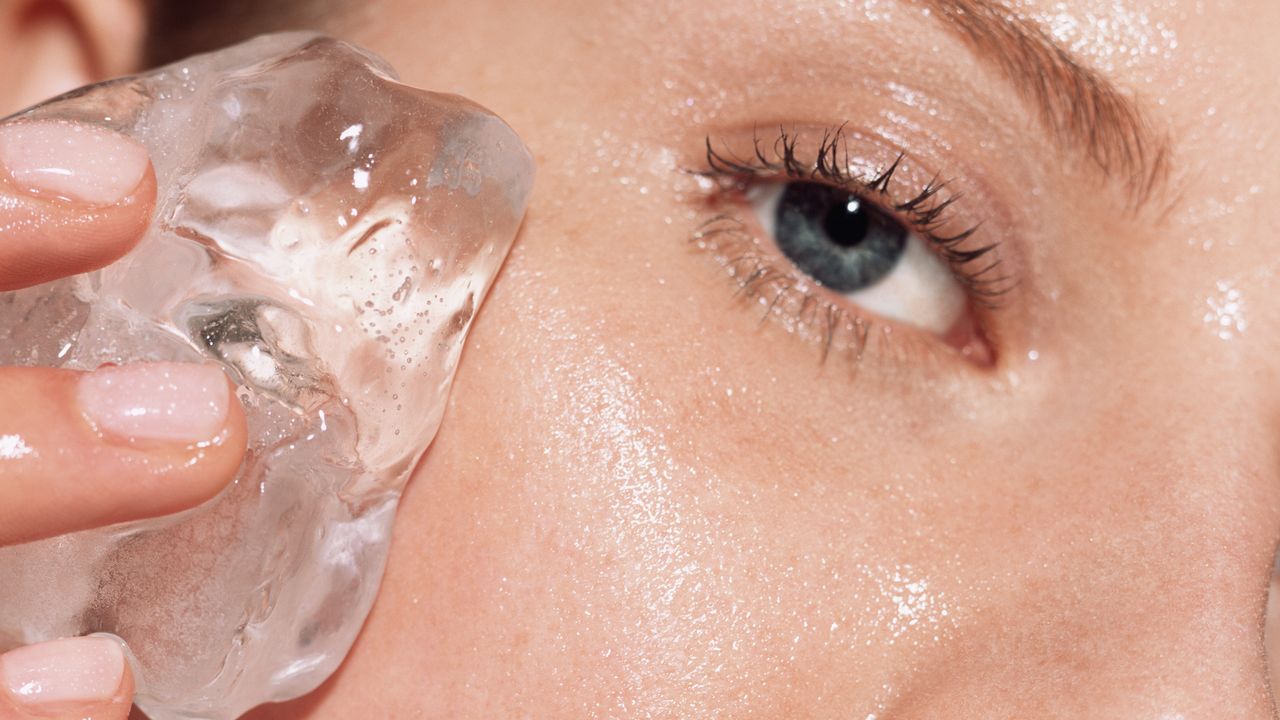
If the internet is to be believed, your freezer may hold the secret to better skin — or at least your favourite celebrities seem to think so. From Priyanka Chopra Jonas to Kylie Jenner to Bella Hadid, everyone seems to be dunking their faces into bowls of ice water, while TikTok swears that a few freezing seconds are all it takes to fake eight hours of sleep, seven glasses of water, and chiselled cheekbones.
While ice is best reserved for martinis, matcha, and your daily iced latte, dermatologists aren’t convinced it’s the skincare miracle it’s made out to be. Yes, it can temporarily reduce puffiness, but when it comes to making it a daily ritual, the cold, hard truth is a little less ‘cool’ than it’s being made out to be.
The temporary effect
“When exposed to cold water, your blood vessels constrict — a process called vasoconstriction — which temporarily decreases puffiness, particularly around the eyes,” explains New York-based, double board-certified dermatologist and Mohs surgeon, Dr Kavita Mariwalla. Skin appears firmer, brighter, and less red, which is probably why your complexion can look refreshed immediately after an ice water plunge.
Diving deeper into the science, Dr Nivine Cheaito, family medicine specialist in aesthetics and anti-ageing medicine at Seline Clinic Dubai, explains that this is simply your body’s natural response to cold. “When exposed to cold, the body instinctively attempts to preserve its core temperature. Small superficial blood vessels rapidly constrict, reducing blood flow near the skin’s surface and temporarily limiting fluid leakage into surrounding tissues. Because puffiness is largely caused by fluid accumulation, this creates the appearance of a slimmer, more sculpted face.”
Cold also slows local nerve activity, creating a soothing sensation while temporarily reducing inflammatory signalling within the skin. But that is exactly what it is…temporary. As Dr Mariwalla notes, these effects sound great, but they’re fleeting. Once the skin gradually returns to its normal temperature, blood flow resumes and the tissues return to their baseline state.
Aside from the physical effects, experts believe the ritual has little to do with skincare. “The most interesting part of this ritual to me is actually the psychological factor,” says Dr Mariwalla. Cold sensors around the eyes and nose activate a survival mechanism that signals the body to slow the heart rate and conserve oxygen. “This response is transmitted via the vagus nerve and can leave you feeling calm afterwards, because your body shifts into a rest mode.”
Contrary to popular belief, however, morning puffiness isn’t particularly a skincare issue, and has a lot more to do with fluid. “Simply put, puffiness is fluid,” says Dr Mariwalla. Normally, gravity, facial muscles, and the lymphatic system keep that fluid moving. Unfortunately, a salty meal, alcohol, poor sleep, hormonal fluctuations, and allergies can all throw that balance off, causing fluid to collect around the eyes and face. “It is also why we look puffy after a hard cry,” she adds.