
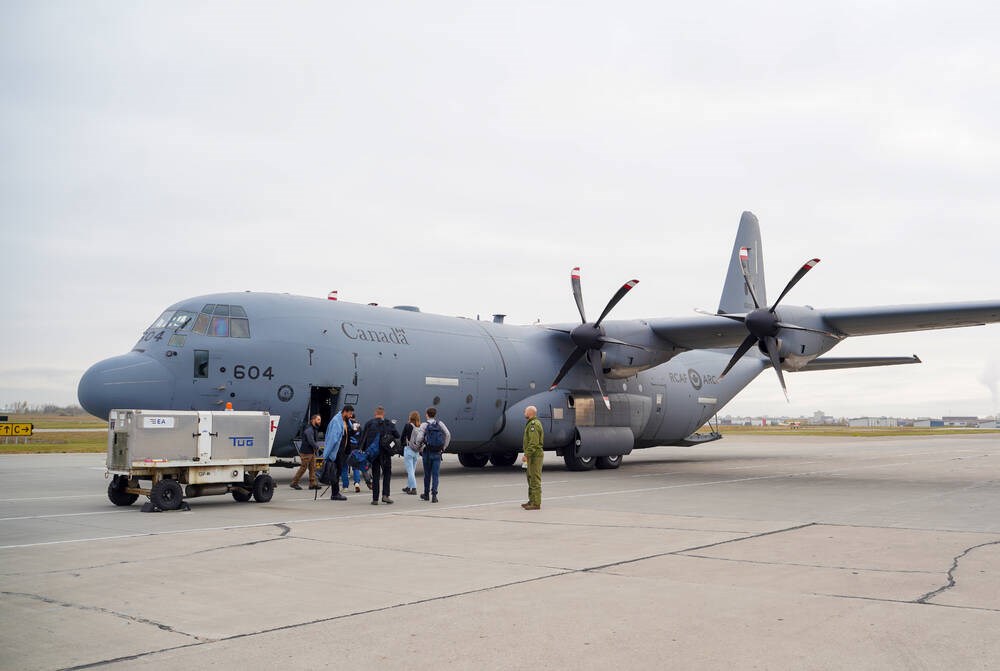
Once equipped with 4,000-gallon tanks, two of the C-130 Hercules airplanes could be ready to fight B.C. wildfires by next season, says Coulson Aviation.
Port Alberni-based Coulson Aviation has acquired 10 C-130 Hercules airplanes from the federal government and plans to convert them into firefighting tankers.
Wayne Coulson, president of the company, said Friday he hopes at least two of the massive planes will be ready to fight wildfires in B.C. by next season.
The planes, to be equipped with 4,000-gallon tanks, will double the size of Coulson’s Hercules fleet and make the company the third-largest operator of the Hercules in the world.
The planes’ power and 4,000-gallon capacity will be a “game changer,” Coulson said. “They are just such a powerful and capable aircraft.”
The planes can take off and land on short, rough runways and have significant range, versatility and suppression ability per drop, said Coulson, making them “a potent firefighting aircraft.”
Coulson has firefighting contracts throughout the world, including in Australia, the United States and South America. It has also had limited contracts to fight fires in Canada, including B.C., but Coulson expects more with the acquisition of the C-130s from the federal government.
“I think the public will be extremely pleased with the performance of this size of airplane working in Canada again,” said Coulson. “We’re extremely excited to be part of it. We’re working with the province and discussing our capability and how we can integrate the C-130s into the province’s air tanker fleet … that’s meant to be.”
The C-130s, long used for transport and search-and-rescue operations, were considered surplus by the federal government.
The 10 Hercules were part of a fleet of 12 retired by the Royal Canadian Air Force in January. The remaining two C-130s will be displayed at bases and museums across the country.
The sale to Coulson remains conditional, pending the completion of contract arrangements and Transport Canada regulatory approvals. The selling price was not disclosed and is considered confidential, according to the Ministry of Public Works and Procurement.
Coulson said the process has begun with Transport Canada to convert the paperwork to allow the C-130s to operate as firefighting aircraft in Canada, and the goal is for the planes to be operational for the next fire season.
He said the bulk of the conversion work on the 10 Hercules will be done in Port Alberni, with others converted at facilities in Abbotsford and Kelowna.
Coulson said the 4,000-gallon double tanking systems, which are filled on the ground, represent a “force multiplier, equivalent to two to three times the current capabilities in Canada air tankers now, just based on its efficiency and its volume tank size.”
Each of the conversions would cost $10 million to $14 million and take about 20,000 work-hours, said Coulson, who had no immediate timeline for when all the planes would be equipped and working as part of the company’s global fleet.
The sale was announced by federal officials in Abbotsford on Friday as the province responds to increasingly severe wildfire seasons.
“Through the conditional sale of these retired Hercules aircraft to a Canadian company with world‑class expertise, we are ensuring that valuable military assets continue to serve Canadians,” Jöel Lightbound, minister of Public Works and Procurement, said in a statement.
“This initiative supports good jobs, strengthens our aerospace sector and enhances Canada’s ability to respond to wildfires and other emergencies.”
Gord Johns, MP for Courtenay-Alberni, applauded the sale, calling it an important step to building the wildfire-response capacity Canada urgently needs.
In a statement Friday, Johns said provinces and territories are often forced to compete for a limited number of aircraft.
The MP said he has pushed the federal government to work with Coulson to convert the retired Hercules aircraft into large air tankers, adding that it’s important to work with “innovators” like Coulson to address a national emergency.
“It should be the beginning of a permanent, sovereign national aerial firefighting capacity that can be deployed across Canada when communities need it most,” said Johns. “This is a practical, made-in-Canada investment that will protect communities, strengthen our aviation sector and save lives.”
Coulson Aviation has also converted Chinook helicopters into air tankers and was the first company in the world to convert a Boeing 737 into a firefighting water bomber.
Coulson owned and operated the last Martin Mars water bombers, known as the largest in the world, and donated both planes to museums in North Saanich and Arizona over the past two years.
The four-engine, turbo-prop Hercules is 30 metres long with a 40-metre wing span and a maximum speed of 550 kilometres per hour.
The Lockheed-designed C-130, which went into production in 1954, is considered one of the most versatile large aircraft ever produced and holds the record for the longest continual production run in aviation history.
It has been used by more than 60 nations for military purposes, polar research and humanitarian efforts.