
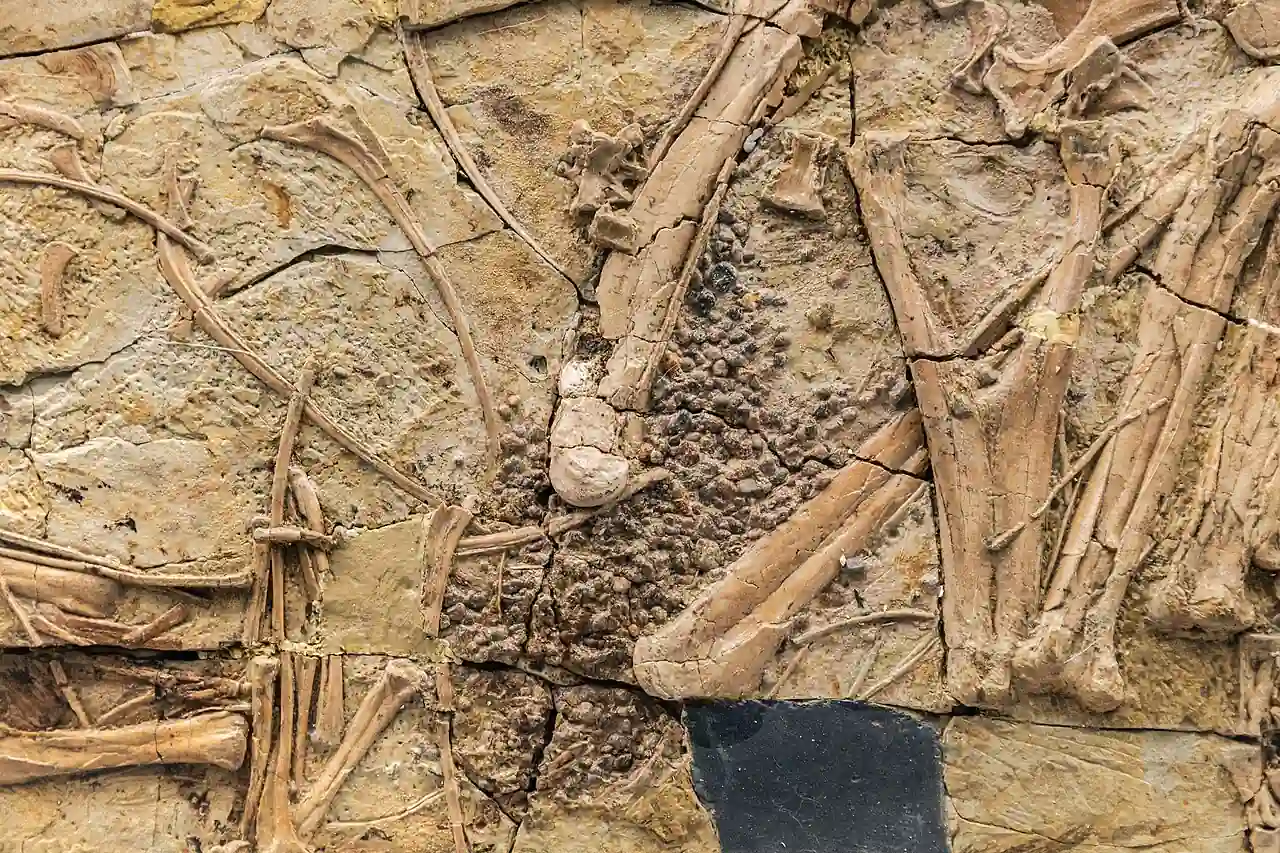
A study shows that the shape of gastroliths, not their presence, reveals the digestive function of dinosaurs and uncovers that birds inherited a muscular stomach from their theropod ancestors.
For decades, paleontologists have used the presence of stones inside the skeletons of dinosaurs as an indicator that the animal was herbivorous. These stones, known as gastroliths, have been found in numerous species and were assumed to serve to grind plant material in the stomach, just like many birds do today.
However, this relationship has always been problematic: gastroliths have also been found in current and extinct carnivores, leaving the interpretation up in the air.
An international team of researchers, led by Ryuji Takasaki from Okayama University of Science (Japan), has turned this issue around. In an article published in the journal Paleobiology, they demonstrate that what matters is not whether a dinosaur had stones in its belly, but what shape those stones had.
The study, which analyzes over a hundred current and fossil species, establishes that rounded gastroliths are an unequivocal sign of a strong, muscular stomach, while angular ones indicate a weak stomach with little grinding ability.
This difference has allowed scientists to trace, for the first time, the evolution of the digestive system in the major groups of dinosaurs and reveal when the gizzard that characterizes modern birds appeared.
The Problem of Stones in the Stomach
Gastroliths are stones that some animals voluntarily swallow and that remain in the digestive tract. In current herbivorous birds, like geese or chickens, these stones help grind food in the gizzard, a highly developed stomach muscle that works as a mill.
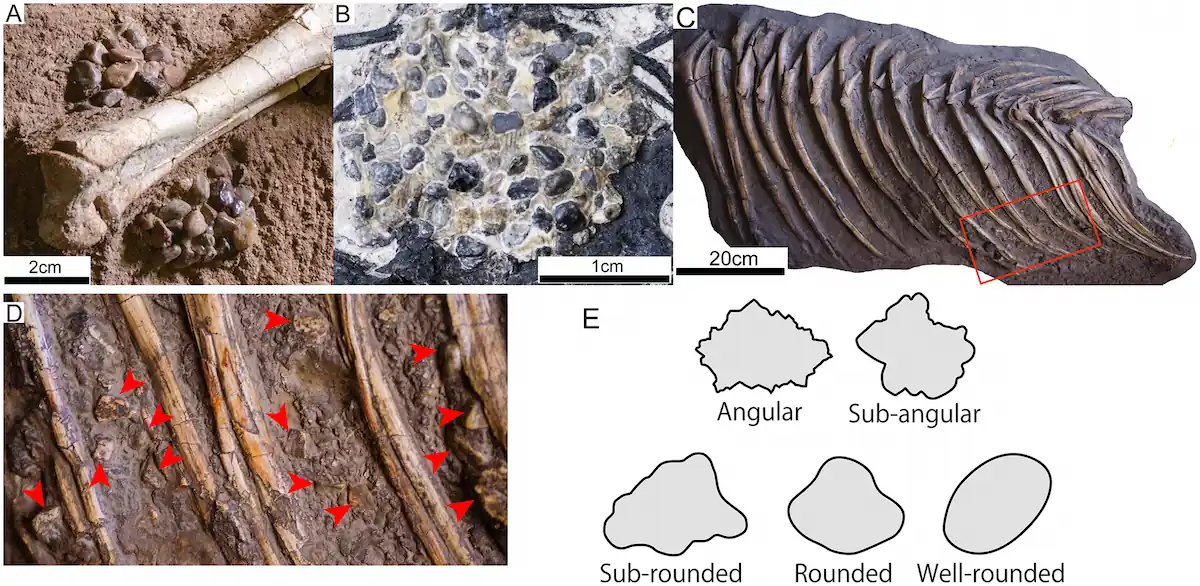 Close-up views of dinosaur gastroliths. Credit: R. Takasaki et al. 2026
For years, finding a pile of stones in the abdominal region of a dinosaur was interpreted as proof that it ate plants. But this idea clashed with the fact that many carnivorous animals, like crocodiles or some birds of prey, also swallow stones without them serving a grinding function.
The study’s authors point out that, in many cases, the presence of stones may be due to accidental ingestion, mineral needs, or even a mechanism to help digest prey without chewing them. In fact, the article cites examples of carnivorous dinosaurs like Tarbosaurus that had abundant gastroliths. Therefore, simple presence was not a reliable indicator.
The team then proposed a different approach: if the gizzard grinds the stones, they should become more rounded over time. Conversely, if the stomach does not exert abrasive force, the stones would retain their original, more angular shape. To test this, they analyzed the shape of gastroliths in 104 individuals from 46 current species of birds and crocodiles, covering very diverse diets: from plant and seed eaters to vertebrates, invertebrates, and omnivores.
Shape of the Stones and Stomach Muscularity
The statistical analysis showed that the shape of gastroliths is directly related to stomach muscularity, measured as stomach mass relative to body weight. The more muscular the stomach, the more rounded the stones. This correlation was significant in both qualitative and quantitative analyses.
The authors explain the causal chain: diet influences the need for a powerful stomach; animals that eat fibrous plants need to grind food, so they develop a muscular gizzard that, as it moves, polishes the stones until they become round. In contrast, carnivores do not require that grinding, their stomachs are less muscular, and the stones, if swallowed, do not wear down and remain angular.
This relationship is key because it allows the shape of the stones to be an indicator not just of diet, but of the mechanical function of the stomach. As the researchers state: by observing the shape of the stone, the most direct inference that can be made is about the mechanical function of the stomach.
Application to Dinosaurs: Two Digestive Strategies
The next step was to apply this model to 29 fossil specimens from 16 dinosaur species, including theropods, sauropods, and ornithischians. Since many fossils have stones embedded in the matrix and cannot be isolated, the authors used only the qualitative method, directly observing stones exposed in museums or in high-resolution photographs.
The results revealed a deep division in the evolution of digestion. Herbivorous ornithischian dinosaurs, like Psittacosaurus and Haya, as well as long-necked sauropods, like Diplodocus and Cedrosaurus, had mostly angular gastroliths.
This indicates that their stomachs were not muscular enough to round the stones. How, then, did they digest plants? The authors propose that these groups compensated for the lack of a grinding stomach with other mechanisms.
In the case of ornithischians, they had highly effective oral chewing, with specialized teeth and strong jaw muscles that crushed the food before swallowing. In sauropods, which had very limited or no chewing, digestion likely relied on long retention times in the digestive tract and microbial fermentation, similar to today’s large herbivores like elephants.
Conversely, theropods (the group of carnivorous dinosaurs that includes Tyrannosaurus and birds) showed a very different pattern. Species like Archaeorhynchus, Caudipteryx, Jeholornis, or Limusaurus had rounded gastroliths, indicating a muscular, active stomach.
Even the carnivore Tarbosaurus, although classified as a vertebrate eater (consistent with its diet), showed angular stones, indicating that despite having many, its stomach did not grind them, which fits the non-abrasive role of gastroliths in carnivores.
The Origin of the Gizzard in the Bird Line
The study also reconstructed the ancestral state of gastrolith shape along the evolutionary tree of archosaurs. The results place the appearance of a muscular stomach (indicated by rounded gastroliths) in the group of Maniraptoriformes, within theropods, at least 150 million years ago. This group includes oviraptorosaurs, therizinosaurs, ornithomimosaurs, and birds.
The authors conclude that the muscular gizzard evolved early in the theropod lineage and that this innovation was a prerequisite for many of these dinosaurs to lose their teeth and adopt herbivorous diets. A key example is Limusaurus, a ceratosaur that was toothless as an adult and had moderately rounded gastroliths. According to the article, this species shows an ontogenetic transition: as it lost its teeth, its stomach became more muscular to compensate for the lack of oral grinding.
The researchers note: acquisition of a muscular stomach was probably an evolutionary innovation that allowed tooth reduction in many maniraptoriform groups, including ornithomimosaurs, therizinosaurs, oviraptorosaurs, and ultimately birds.
Implications for Bird Evolution
This discovery has implications beyond digestion. By moving the grinding of food from the mouth to the stomach, theropods could reduce the size of their jaw muscles and, in turn, free up space in the skull.
This may have facilitated the expansion of the brain and sensory organs, a key step in the evolution toward modern birds. Although the authors warn that this hypothesis is not directly proven, it opens a line of research into how dietary changes influenced the evolution of the skull and brain.
The study also provides a practical method for paleontologists: a protocol to use the shape of gastroliths as another tool, along with dentition analysis, stable isotopes, and stomach contents, to reconstruct dinosaur diets. They stress that the shape of the stones should not be taken as a standalone diagnostic, but as one piece within a multiple-evidence approach.
The authors themselves acknowledge that the method is not foolproof. Factors can distort the shape of gastroliths: for example, if the animal selects already-rounded stones from the environment, or if the stones were pre-smoothed by prior transport. However, the high correlation between shape, diet, and muscularity in current species suggests these effects are secondary to internal abrasion.
They also note that predictions for fossils with fewer than 35 stones should be treated with caution; in fact, the two specimens with only 6 stones (Iteravis and Jeholornis) fell outside the main morphometric space. Therefore, the article recommends that future studies prioritize fossils that preserve a sufficient number of gastroliths.
Another important nuance is that the shape of the stones reflects the function of the stomach, not the diet directly. In groups like ornithischians or sauropods, which had other processing mechanisms, angular stones do not mean they were not herbivores; they simply indicate that their stomach was not responsible for grinding. This distinction is crucial to avoid misinterpretation.
The work of Takasaki and collaborators changes our understanding of how dinosaurs processed food. For years, the presence of gastroliths was used as a simple proof of herbivory; now we know that the shape of those stones is a record of the stomach’s mechanical activity. Dinosaurs with muscular, grinding stomachs left rounded stones; those without that capacity kept them angular.
This distinction reveals that the major dinosaur groups followed divergent digestive strategies. Sauropods and ornithischians relied on oral chewing, fermentation, or retention time, while theropods, especially the relatives of birds, developed a grinding stomach that allowed them to forgo teeth and open up new evolutionary possibilities.
As the article concludes: the muscular stomach, indicated by rounded gastroliths, evolved early within Theropoda, appearing at least at the base of Maniraptoriformes. This innovation was likely a crucial prerequisite for repeated transitions to herbivory in maniraptoriform theropods with reduced dentition.
SOURCES
Takasaki R, Kobayashi Y, Fiorillo AR, Chinzorig T, Funston GF. Gastrolith shape as an indicator of digestive function and its implications for dinosaurian digestive strategies. Paleobiology. Published online 2026:1-12. doi:10.1017/pab.2026.10112