
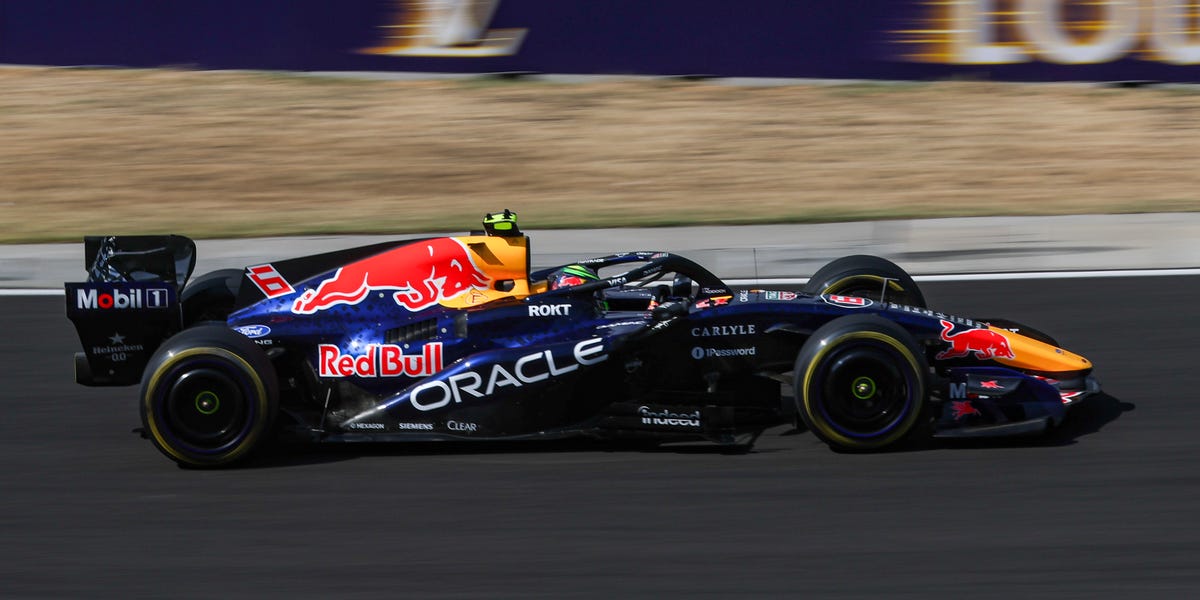
Championship position: 4th (177 points)
It has been something of a curate’s egg of a season for Red Bull Racing. On paper this is set to be its worst season since 2015: no victories, no pole positions, no sign of title contention, and fourth in the Constructors’ Championship. But another perspective is one of a team—its first as a de facto engine manufacturer—that started the year slower than some midfield teams and reached the midway mark back in the mix among the front-runners.
Red Bull Racing is fourth in the standings, 202 points behind Mercedes, but has scored only 40 fewer points than the leaders since Monaco. In the first five events, three of which had Sprint races, Red Bull scored 157 fewer than Mercedes—it wasn’t even until the fourth round, in Miami, that Red Bull cleared Haas and Alpine.
“We don’t sign for anything other than winning races, but I have to take the opportunity to say well done to our people, on the chassis side, and the power unit side,” said Red Bull Team Principal Laurent Mekies. “Because we started from 1.2 seconds [behind] and finished 0.3 seconds [behind], in half the season, and with the level of competition. We know where we started, why we started there—when we put things in perspective with the late push of last year and the PU adventures.”
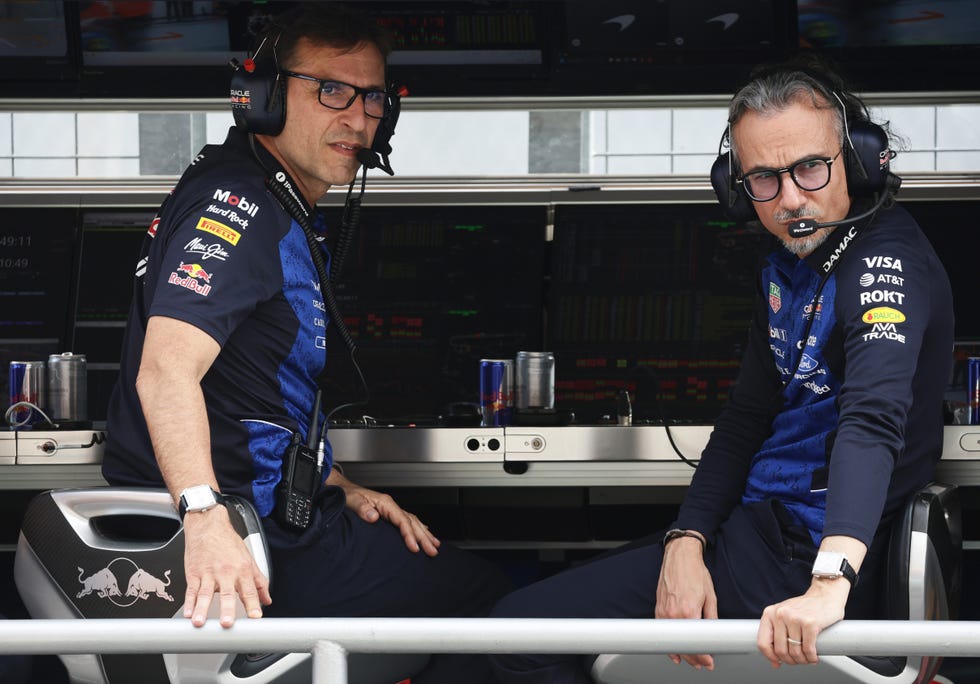 Mark Thompson//Getty Images
Red Bull Technical Director, Pierre Wache (left), and Team Principal Laurent Mekies.
Mekies, who has now been in the post for a year, emphasized that “we will not be satisfied until we have a race car that has the pace to win on merit,” though cautioned that given the rapid rate of chassis development so far in 2026 “it’s probably difficult to imagine we can continue with that rhythm” across the remainder of the year. So, again, a mixed bag.
The RB22 has not been the strongest chassis, but a key limitation has been the lack of balance and the corner entry instability that forced the team to bench its rotating rear wing, after successive offs in Austria and Britain for Max Verstappen.
“We have to see why we are so much on the edge of car balance, corner balance, car performing, car not performing,” Mekies said. “It’s been hard for the drivers in particular to keep the car in its window these last races.
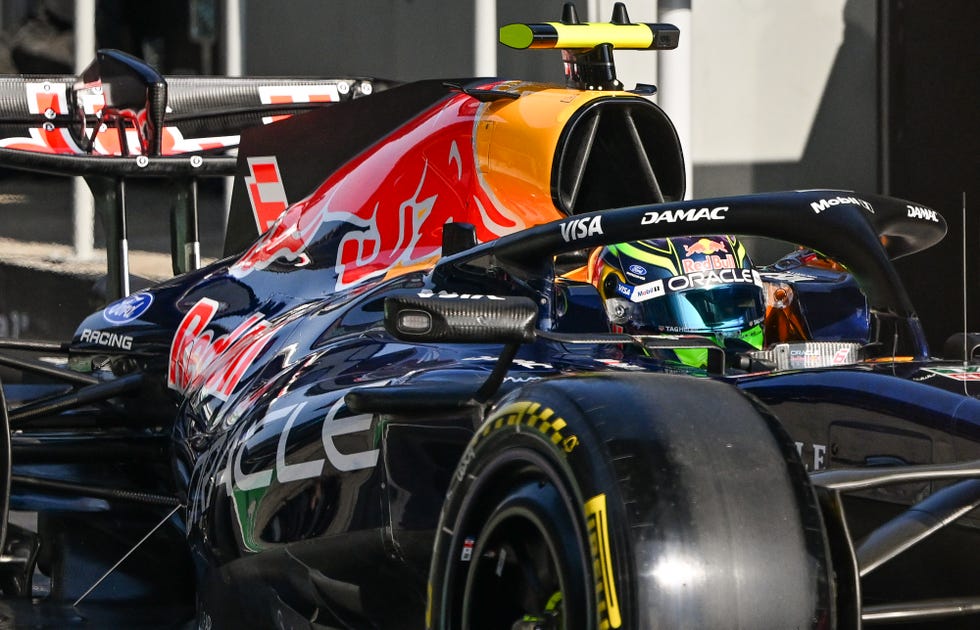
Red Bull Powertrains has so far proved to be a resounding success with its first from-scratch power unit. There have been some glitches and setbacks, particularly off the line early in the year, but the level of performance and reliability from the DM01 has been impressive, highlighting the astute recruitment undertaken and structure implemented by the organization.
 NurPhoto//Getty Images
The level of performance and reliability from the DM01 has been impressive.
Such has been RBPT’s success that the FIA deemed it to be the benchmark power unit under the complex metrics used by the governing body’s ADUO system. That has proven to be a controversial political football in which Red Bull has been outmaneuvered, which risks hamstringing RBPT’s medium-term development, considering that to several key metrics it remains adrift of Mercedes. It is hard to imagine previous management taking it so lightly. Yet again, a mixed bag.
“I would love to have some ADUO as well,” Verstappen said. “Yeah, somehow. But that’s—I don’t know. We’ll see. We’ll have another look after the break.”
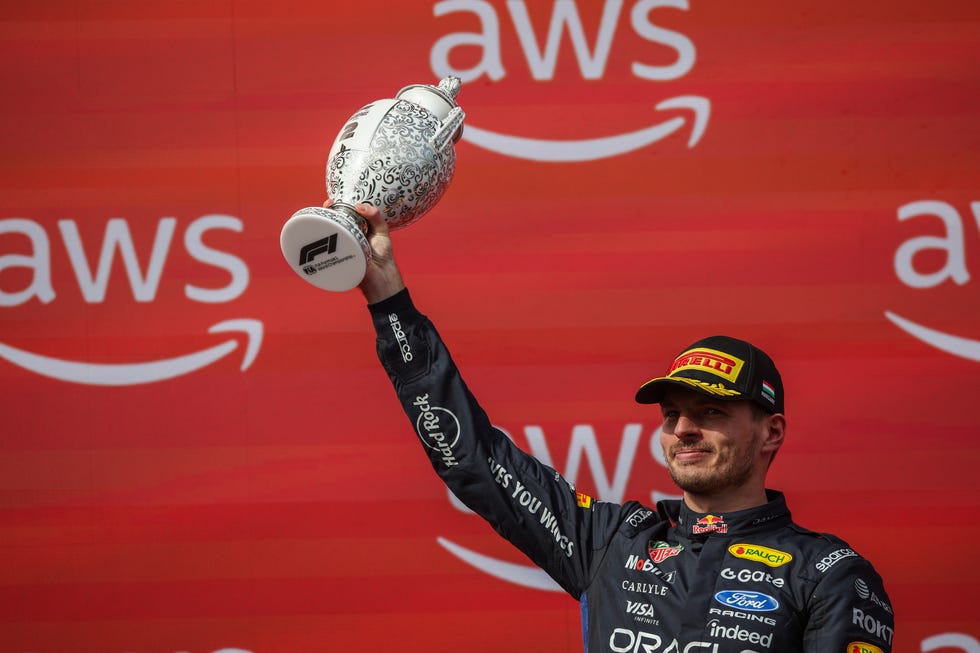
The saga surrounding Verstappen’s future has dominated much of the talk surrounding Red Bull. Verstappen has long been a vociferous critic of the 2026 regulations and doubled down early in the campaign, outlining he was considering walking away at the end of the season. Red Bull’s uplift, and minor rule tweaks in conjunction with further changes for 2027/28, have cooled such talk, but the four-time World Champion’s future remains an open topic, and he is simply tired of repeating his tropes about the rules ad nauseam. Verstappen has pulled rabbits out of the hat on occasion—coming close to victory in Austria and replicating the runner-up result in Hungary—but is clear on what he wants across the rest of 2026.
 NurPhoto//Getty Images
Max Verstappen celebrates his podium finish at the Hungarian Grand Prix last month.
“In general, it’s been very tough,” Verstappen said. “Some good moments, some bright, shining moments, I guess, but overall, tough. I think we need to try and be more solid, a bit more all-round, to have more straightforward weekends. Plus, we need to find more performance. I mean, it’s as simple as that at the end of the day. Then, besides finding more performance, just not having the issues as well with the current package, let’s say, that we have.”
Verstappen added that “we sometimes just lose performance over a weekend, or even from the start of the race to the end,” describing a remedy as “a big priority.”
Isack Hadjar has slotted seamlessly into Red Bull and was initially aided by the team being out of the front-running spotlight, allowing him to bed in while focus was elsewhere, compared to the battering Liam Lawson and Yuki Tsunoda took alongside Verstappen in a pace-setting ground effect era machine. Hadjar, who is still only halfway through his second season in Formula 1, initially scored a podium in Monaco, only to be demoted when Pierre Gasly was reinstalled. Nonetheless, he has pocketed seven straight top six finishes, the best run of form by a second Red Bull driver in some time.

U.K.-based Phillip Horton started covering Grands Prix while still at university and swiftly deemed that writing about Formula 1 and the behind-the-scenes machinations was much more engaging than reading centuries-old novels. Degree gained, he went on to cover the sport full-time from 2014 and is as intrigued and excited by the destinations Formula 1 visits during its lengthy annual world tour as the racing itself. Phillip joined Autoweek in 2021 and while he has just about learned to spell in American English he has yet to find anywhere in America that makes a proper cup of tea.