

Listen to this article
Estimated 4 minutes
The audio version of this article is generated by AI-based technology. Mispronunciations can occur. We are working with our partners to continually review and improve the results.
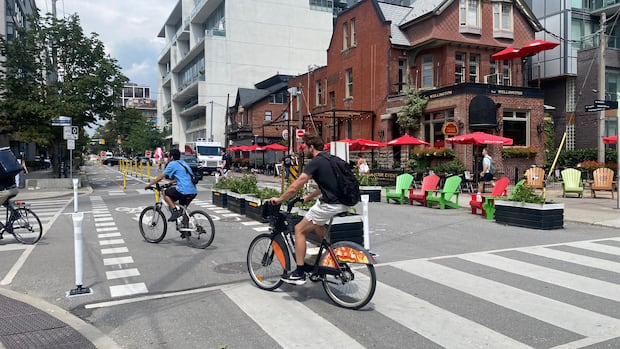
The number of cars is significantly down, while cycling and walking are up at the downtown intersection of Wellington Street W. and Portland Street, according to early data from the City of Toronto — soon after the city made changes to how motor vehicles can use the area.
In early June, the city made it so anyone driving on Wellington towards the disjointed intersection is now forced to turn onto Portland, while those driving up or down that road now have no choice but to be diverted onto Wellington. A two-way, protected bike lane was also installed along Portland.
The city measured travel types at the intersection and along Portland on Tuesday, June 30 from 6 a.m. to 8 p.m. and compared it to data from Tuesday, June 24, 2025. In the intersection, cycling crossings went up 38 per cent, walking went up 20 per cent and vehicle traffic went down 52 per cent.
Pedestrians and cyclists represented 89 per cent of all trips up and down Portland, compared to 74 per cent in 2025.
“This is the type of outcome that we want to see when we implement these types of active transportation measures,” said Matti Siemiatycki, director of the Infrastructure Institute at the University of Toronto.
“This shows what can happen when good quality pedestrian and cycling infrastructure is put in place, that people in Toronto will use it.”
WATCH | Residents react to initial changes in June: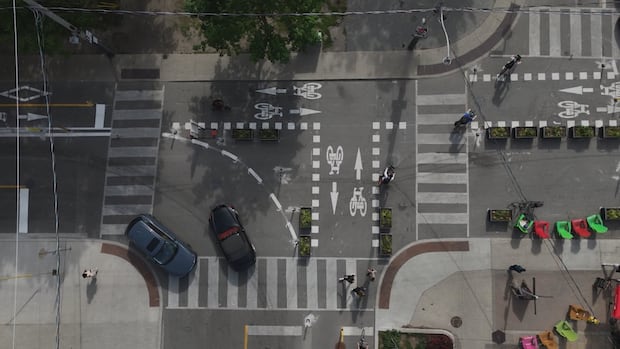
Why this Toronto intersection is prioritizing cyclists over cars
Toronto has redesigned the intersection of Wellington and Portland streets, making it one of the city’s most welcoming spaces for pedestrians and cyclists. But not everyone is happy with the changes. CBC’s Lane Harrison has the reaction.
A significant drop in car traffic both at the intersection and along Portland Street was one of the goals of the project, as the city tries to stop drivers from using it as a “cut-through” street, according to the recent report. Less cut-through car traffic means a safer commute for the cyclists and pedestrians in the area, the report says.
The city says most drivers using Portland as a shortcut don’t live in the area and now use Bathurst or Spadina to enter and exit the city.
Michael Longfield, executive director of the advocacy organization Cycle Toronto, said the changes help connect the city’s cycling network. People can now safely ride from the lanes on Dan Leckie Way up Portland to connect with popular pieces of the city’s cycling network on Richmond and Adelaide streets.
“One of the reasons why Portland and Dan Leckie were chosen, as secondary roads, was to not build bike lanes on the major arterials parallel to it on Bathurst [Street] and Spadina [Avenue],” he said.
City tinkering with traffic lights to help drivers
Some in the area who spoke to CBC Toronto when the changes were first made worried about the impact on drivers. In the report, city staff acknowledge that drivers are experiencing traffic jams heading west on Wellington towards Bathurst Street.
On July 6, the city made changes to the traffic lights to allow more vehicles to clear the intersection per light cycle. Those changes resulted in a modest improvement, from four to six vehicles per light, to six to eight, according to preliminary data.
Siemiatycki said the impact on drivers highlights that every infrastructure decision has trade-offs.
“But we’re trying to balance a scarce resource. And if you can create a really vibrant area where thousands of people are moving through, that’s part of the equation,” he said.
The city notes that drivers feel the most traffic pain during peak evening travel times, “while at most other times of the day there is virtually no delay westbound.”
WATCH | Check out Toronto Bike Share’s new e-bikes: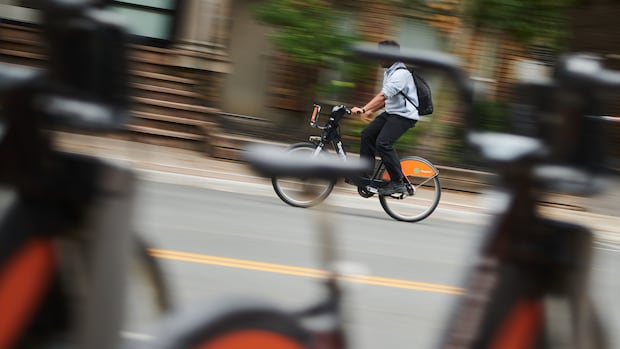
Better baskets, automatic gears: We tested out Toronto’s new e-bikes
Toronto Bike Share is testing out a new e-bike prototype. Our unofficial cyclist-in-chief Lane Harrison tested them out to see how they compare to the old ones.
Siemiatycki added that while some of the reduction in car trips are people switching modes of travel or not taking their trips altogether, some will also go on adjacent roads.
The city says when there are delays, the level of congestion is no different than the typical traffic people driving during rush hour experience across the downtown core.
There were “significant” traffic jams on Wellington heading towards Bathurst in the weeks after the changes were first made, according to the report. But the city says those were because of a glitch in the traffic lights that resulted in “unnecessarily extended red-lights” for drivers at the intersection.