
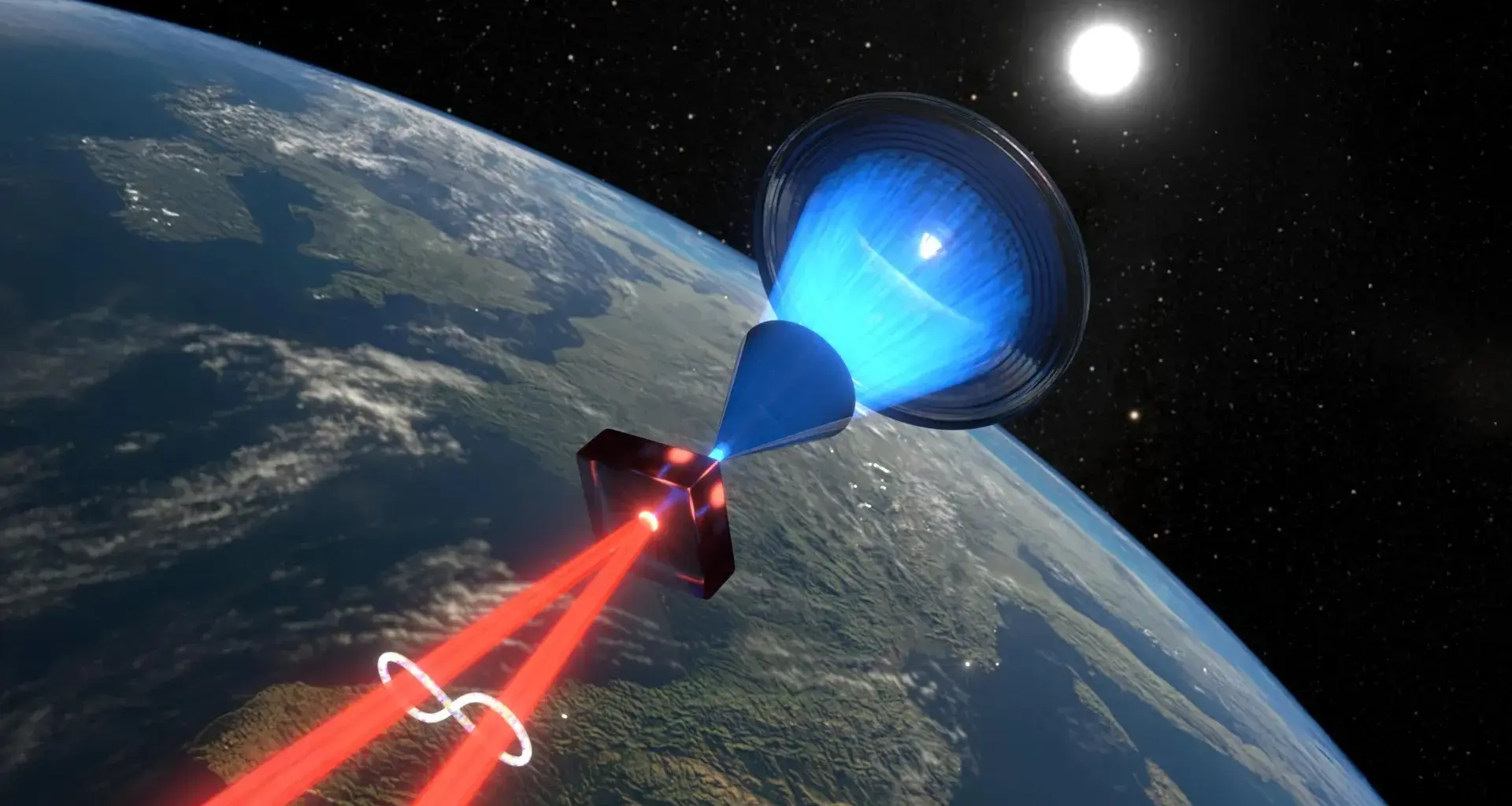
For decades, physicists believed that lasers were the only viable way to generate entangled photons, pairs of light particles whose mysterious correlations defy classical physics. But a new study published in Optica has turned that assumption on its head: researchers have shown that sunlight itself can produce quantum-entangled photon pairs.
The team harnessed spontaneous parametric down-conversion (SPDC), in which photons from a pump beam shoot into a nonlinear crystal and split into entangled pairs. Traditionally, lasers provided the coherence and intensity needed for this. Sunlight, by contrast, was dismissed as too incoherent and weak.
But the researchers demonstrated that Polarization entanglement can still emerge even if sunlight is incoherent in space or time.
A custom-built solar concentrator collected light over 1.4 m² and funneled it into a fiber thinner than a human hair, delivering enough power to drive SPDC.
The photon pairs then had 94% fidelity of a Bell state and violated Bell’s inequality that’s characteristic of real quantum entanglement.
This breakthrough challenges the long‑standing dominance of lasers in quantum optics by showing that entanglement can be driven directly by sunlight.
The approach presents several impressive benefits: it is energy‑efficient, as this method does not rely on electrical-to-optical conversion, saving waste heat and points of failure; the process is sustainable since sunlight can be found almost anywhere (especially in space or remote regions) and broadens access to characteristics that cannot have lasers available at specific wavelengths for entangled photons.
“Sunlight is an abundant and reliable resource in many environments, especially in space. Being able to generate quantum-entangled photons directly from sunlight could enable simpler and more resilient quantum systems for satellites and future deep-space missions,” said Dr. Hanieh Fattahi of the Max Planck Institute.
This is only the beginning. Other nonlinear optical processes could also exploit sunlight for entanglement, including four-wave mixing. The consequences of sunlight-based quantum entanglement (SQE) are wide-ranging. This then enables quantum communications by satellites circling around the Sun, where power-guzzling lasers are replaced with the abundance of light.
This holds the prospect of robust quantum sensors in resource‑restricted areas such as the Arctic, where power efficiency is paramount. It even whispers of interplanetary journeys bathed in the Sun’s concurrent quantum light, chauffeuring entangled photons through space to galvanize new forms of travel and communication.
Ultimately, the Sun could be not only a source of life on Earth but also an engine for quantum technologies, making us look at sustainable computing and communication in a different light.
Journal Reference:
Cheng Li, Jasvinder Brar, Michael Küblböck, Jeremy Upham, Hanieh Fattahi, Robert W. Boyd. Generating quantum entanglement from sunlight. Optica, 2026; 13 (8): 1508 DOI: 10.1364/OPTICA.601797