
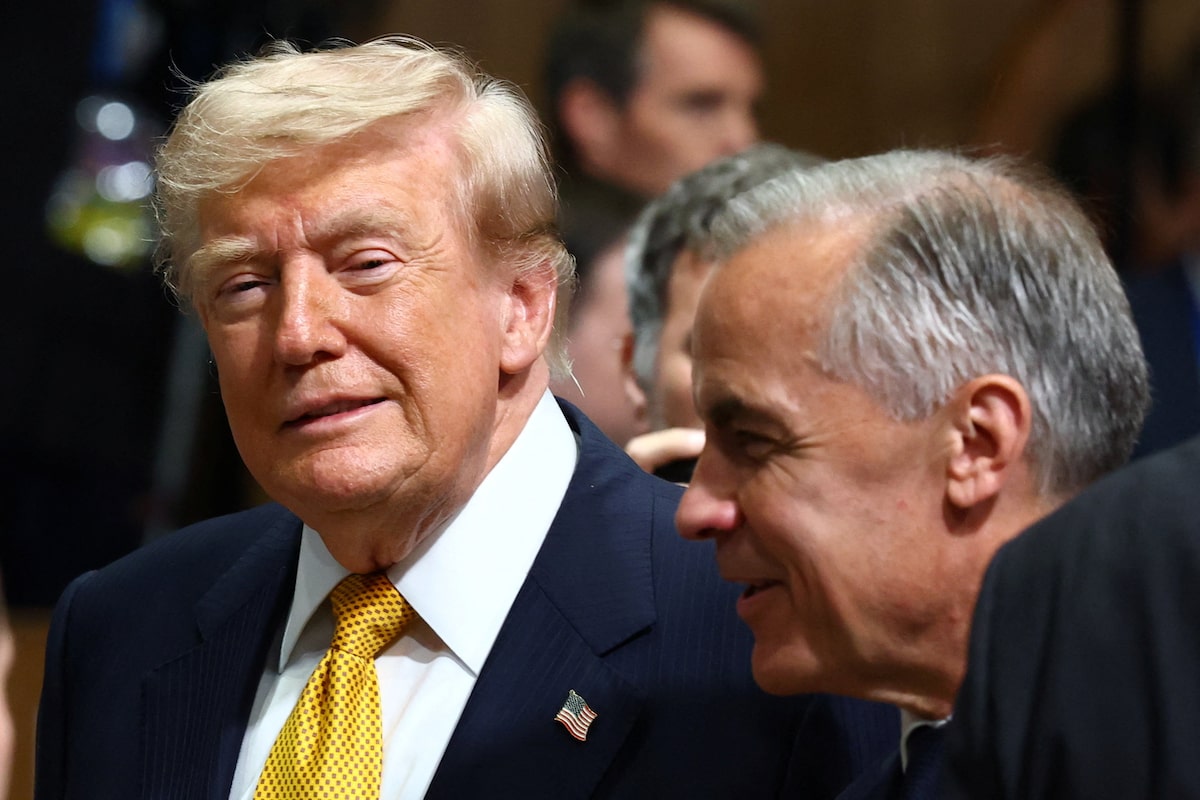
On July 20, President Trump triggered a five-week countdown when he threatened the imposition of 50-per-cent tariffs on a range of Canadian goods. They are set to take effect on Aug. 19.Yves Herman/Reuters
Just hours after Prime Minister Mark Carney delivered his viral speech on Donald Trump’s disrupted world order at Davos, he stopped in at Anthony Scaramucci’s annual winetasting party.
The event – always on the Tuesday of the World Economic Forum – attracts the elite of the elite with the allure of expensive wines with a perfect rating.
On the menu this year: a Bordeaux ringing in at $2,900 a bottle.
That’s the last time Mr. Scaramucci, known as “the Mooch” to his legions of podcast fans, saw the Prime Minister in person. The two have a relationship spanning three decades, beginning when they both worked at investment bank Goldman Sachs in the 1990s.
Mr. Scaramucci said they got to know each other better during Mr. Carney’s tenure at the Bank of England, and they still keep in touch. He cautioned that he’s not on the Prime Minister’s regular call list, though he conducted one of Mr. Carney’s first interviews during last year’s Liberal leadership race.
The connection leaves Mr. Scaramucci with a rare vantage point on the strained state of affairs between Canada and the United States.
The businessman and media heavyweight also worked briefly with the President. Mr. Scaramucci has described his tumultuous 10-day run as Mr. Trump’s communications director in 2017 as the most brutal period in his life. But the publicity helped him launch a podcast and media empire with hundreds of thousands of subscribers for his shows, including The Rest is Politics: US, which is coming to Toronto on Oct. 4 for a live event.
By the time he’s in Toronto, alongside his co-host, Katty Kay, Mr. Scaramucci says Canada should expect to still be stuck in Mr. Trump’s threaten-then-fold tariff cycle. But he doesn’t think the country will suffer the worst of the economic consequences that the President has promised to unleash.
Mr. Scaramucci spoke to The Globe and Mail last week as Canadian negotiators met with their American counterparts in Washington, trying to find a more stable trade footing with the U.S. On July 20, Mr. Trump triggered a five-week countdown when he threatened the imposition of 50-per-cent tariffs on a range of Canadian goods. They are set to take effect on Aug. 19, but Mr. Scaramucci doubts they will see the light of day.
“There’s a lot of pressure on Trump to do the TACO thing,” Mr. Scaramucci said, referring to a term coined by a Financial Times columnist who argued in 2025 that “Trump Always Chickens Out.”
“Trump is getting a lot of pressure from inside the United States, and so I think this will be a good outcome, and I think it’ll probably improve Carney’s favourability.”
What Canadians aren’t seeing, Mr. Scaramucci said, is the pressure that the Trump administration is under from corporate leaders in the U.S., who he said are heavily lobbying the White House for tariff relief.
Add to that the fundraising demands that Mr. Trump’s staff are making of corporate leaders, where chief executives are donating millions to the President as they lobby for policy changes.
“Every time we’ve come up against this in the last 18 months, Trump has blinked. And he’s blinking for money reasons,” Mr. Scaramucci said, pointing to The Wall Street Journal’s reporting on the President’s cash-for-access events.
He argues that when push comes to shove, Mr. Trump won’t want to risk the lucrative relationships he’s built with CEOs who rely on the integrated North American economy.
Mr. Scaramucci said a likely scenario is a deal with carveouts for some sectors and quotas for others, and a 60- to 90-day delay to the threatened tariffs, with more talks again in the fall.
It’s a familiar pattern for Trump-watchers and is in line with reporting from The Globe on Friday that negotiators are aiming to strike an interim deal to avert the Aug. 19 tariffs and address other longer-standing levies that apply to steel, aluminum, autos and lumber.
Based on sources familiar with the secret talks, The Globe reported that Ottawa may agree to some tariffs and quotas on some sectors in exchange for the U.S. lifting the more punitive tariffs.
“I think they’ll probably get a deal done, but it’s not going to be 100 per cent on Trump’s terms,” Mr. Scaramucci said. “Carney’s smart enough to know the auto executives and others are putting enormous pressure on them.”
He cautioned that the Prime Minister “can’t win outright. He’s the smaller trading partner to the behemoth.”
Mr. Carney is facing increasing scrutiny at home for the concessions he’s already made to the President.
In the past year, the Prime Minister has cancelled the digital services tax, removed retaliatory tariffs and repealed a requirement for American streaming services to pay Canadian content creators. The capitulation that has seized the spotlight is a net-revenue-splitting deal to get the Canadian-financed Gordie Howe International Bridge open.
Mr. Scaramucci, who has a glowing assessment of Mr. Carney’s handling of the President, said he doesn’t see those concessions as signs of weakness. Instead, he said he views them as pragmatic moves to get the administration to the negotiating table. And, he argues, they could just as easily be seen as concessions to Canadian consumers and businesses.
“I don’t need to give him any advice on Trump,” Mr. Scaramucci said. “He should be giving the advice on Trump. I tell all the Western leaders that I come in touch with that Mark Carney should be your life coach.”
Early in the Prime Minister’s tenure, he appeared to have a cordial relationship with Mr. Trump, a marked departure from former prime minister Justin Trudeau, whom the President derisively referred to as “Governor.” However, Mr. Carney has missed several self-imposed deadlines for trade deals, and Mr. Trump pulled the rug out from under him in October when Ottawa thought a deal was close.
The relationship appeared to sour after the now-famous Davos speech in which the Prime Minister – without naming Mr. Trump directly – called on middle powers to band together to resist American abuses of power.
The speech was widely celebrated in capitals around the world but drew the ire of the White House. Five months later, Mr. Carney pivoted and argued in a New York speech that a strong Canada could help “make America great again.”
Mr. Scaramucci said reports that Mr. Trump was angry at the Prime Minister over the speech are “malarkey” and that the President continues to respect Mr. Carney.
“You fight with Trump, he respects you,” Mr. Scaramucci said, noting that Mr. Trump speaks more with the Canadian Prime Minister than any other Western leader.
“Carney is tough on him, Carney sort of forechecks him with his elbows, and a result of it, Trump doesn’t like that, but he respects that.”