
B.C.’s deficit ends fiscal year $3.2 billion lower than budget
Published 4:17 pm Monday, August 10, 2026
Turns out, B.C. spent $3.2 billion less than budgeted last year — at least when a large tobacco settlement and some delays to expensive projects are factored in.
After a full accounting of the province’s 2025/26 fiscal year spending, the deficit shrank from the original $10.9 billion shortfall to a more modest $7.7 billion. The total spend for the year was a little more than $94.9 billion.
While the revision includes a one-time $2.561 billion tobacco settlement added to the books after the budget was released, provincial coffers were also boosted by better-than-expected economic growth and tighter spending.
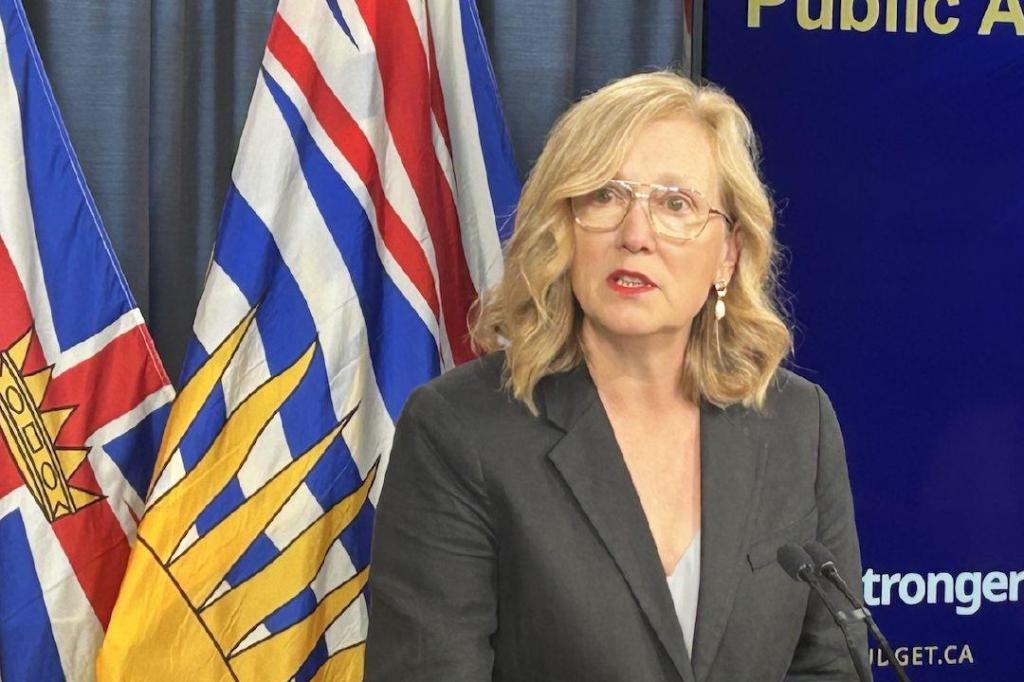
Finance Minister Brenda Bailey attributed some of the cost-cutting to what she called “slippage” in the capital spending plan. The province had budgeted $15.4 billion for capital projects, but spent just $11.4 billion.
But this money is not off the books for good.
“Slippage happens every year,” Bailey said, as she unveiled the province’s audited financial statements at a Monday morning press conference in Victoria. “It was quite an aggressive capital allotment at $15 billion, and the slippage of $4 billion will in fact carry over into other years.”
Some of this she blamed on labour shortages and supply-chain disruptions.
Bailey distinguished the “slippage” in last year’s budget from the “repacing” of projects, which the province says it is doing this year to rein in spending.
“Repacing is a deliberate pulling back of a project and looking at when we can deliver it and how to keep the cost down,” she said. “The projects that are experiencing slippage, maybe it’s a five-year build and part of the build didn’t happen in year two, but will happen in year three.”
The Finance Ministry has yet to provide a thorough breakdown of what projects have experienced “slippage,” but officials say this is normal practice.
Broadly, it includes $466 million in lower education expenses due to slow project progression and labour shortages, $1.266 billion less in highways and transit spending due to slow project progression, and $1.863 billion less in health facilities spending due to “changes in in-progress projects.”
Despite the project delays and tobacco settlement money making accounts for the province appear rosier than they actually are, Bailey projected optimism. She noted that GDP growth last year reached two per cent, which is 0.2 per cent higher than the forecast, and that unemployment, at 6.2 per cent, continues to be lower than the national average of 6.8 per cent.
“These are positive indicators that our economy’s going in the right direction,” she said.
She also points out that this is the first time since 2017 that actual spending has not exceeded the budgetary forecast. That is the year the NDP took power from the B.C Liberals.
“We’re starting to see — albeit modest — but starting to see results from our expenditure management work,” she said.
B.C. Conservative Finance Critic Peter Milobar said the government is using the tobacco settlement to “artificially” depress the deficit numbers to have a “momentary look of fiscal management.”
“For a brief snapshot in time, it might make them feel good,” he said.
According to Milobar, repacing and slippage are synonymous with cancelled, and the end result is that the government is not delivering on projects in promised timelines.
He says this latest budgetary release just continues the government’s use of creative financial maneuvering to mask fiscal mismanagement and the “ever-spiralling of the operational costs of government.”