
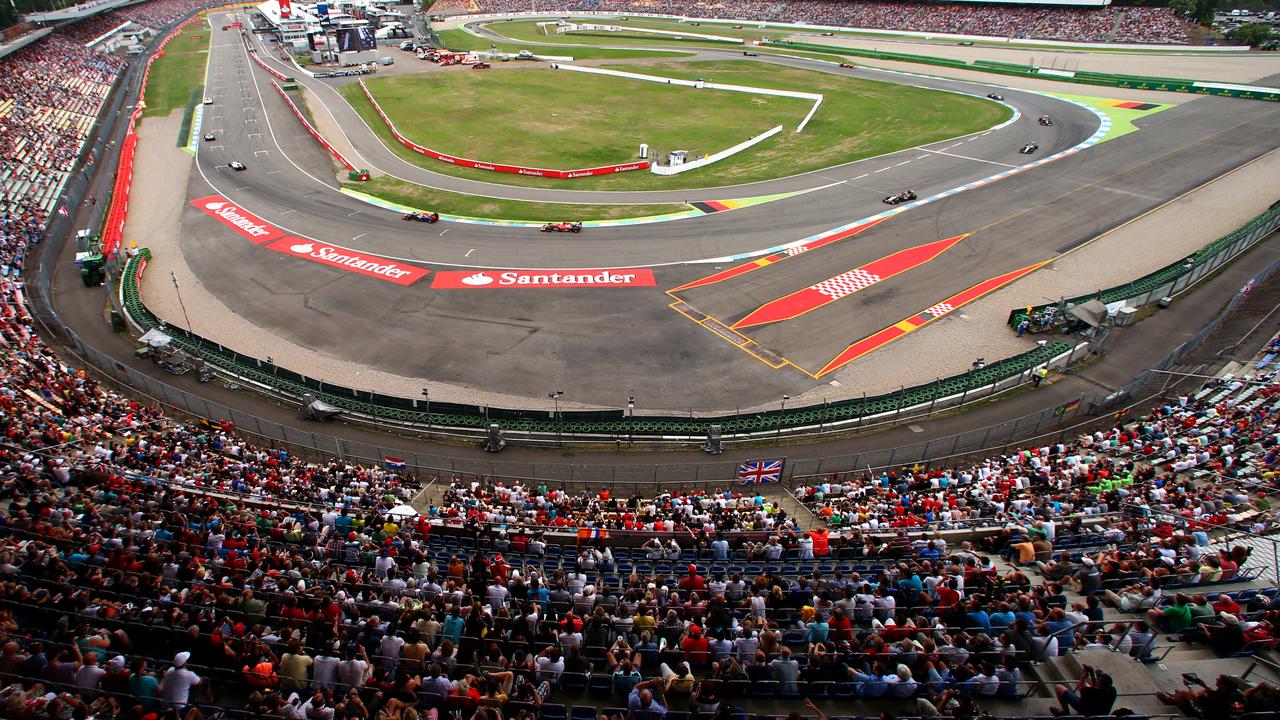
The Hockenheimring is investigating a revival of the German Grand Prix to capitalise on booming European interest in Formula 1, but its prospects are dependent on matching hosting fees paid by big-spending rivals on other continents.
Hockenheimring, located around 80 kilometres south of Frankfurt and a similar distance northwest of Stuttgart, hosted 37 grands prix between 1970 and 2019, in its later years alternating with the Nürburgring before the costs of hosting F1 became prohibitive for both.
Its final race was funded by Mercedes to ensure the team could celebrate its 125th year in motorsport with a home race, while the Nürburgring held a one-off race under the Eifel Grand Prix banner in 2020 during the pandemic.

Fox Sports, available on Kayo Sports, is the only place to watch every practice, qualifying session and race in the 2026 FIA Formula One World Championship™ LIVE in 4K. New to Kayo? Join now and get your first month for just $1.
But new ownership in 2024 has promised a €250 million ($410 million) upgrade and renovation plan for the historic Hockenheim circuit and is contemplating the return of grand prix racing.
F1 CEO Stefano Domenicali said communication was open between the sport and the circuit but added it would take more than just new facilities to get the race over the line.
“It was Hockenheim that connected with us, and they had the first discussion,” he said, per The Race.
“They are developing the motorsport park there with a different objective.
“If they want to discuss a possible F1 event, of course the investment needs to be different, because our platform needs to have a different kind of investment. But we have discussed that.”
In other words, the circuit would have to stump up for a hosting fee that would see it overcome bids from other would-be host nations.
Intriguingly, however, Domenicali noted that Europe was becoming a strategically important market for the sport after a decades-long shift to other territories, particularly the Middle East and North America.
“We are watching of course the growth of the United States,” he said. “We are watching the growth of Europe, because it’s becoming an important market again, because the growth, the numbers, are there.”
Raul Fernandez dominates British MotoGP | 00:39
The interest is clear not only from the run of sold-out races on the continent but also from television ratings and competition between broadcasters for the right to televise the sport.
“Let me take two examples in Europe: Germany and France,” Domenicali said, per Racer. “The relation with [French broadcaster] Canal+ is fantastic. We are not having grand prix [in] France, not because we don’t want [to] … my phone is always available to have a race in France, [and] if they want to do it, we are here.
“But Canal+ is really looking forward to extend our deal because the numbers are really good and the sport is really in a great shape.
“Now, with the deal we are having with [German broadcaster] RTL, the numbers are getting different, and in the new tender on the German market, we will have, for the first time, more than one operator that is interested to be part of this tender.
“It’s another sign that in Europe, that is our very important market, the attention is getting even bigger.”
PIT TALK PODCAST: Who are the top 10 drivers in Formula 1 at the midseason break — and who didn’t make the cut? | Listen to Pit Talk here >
But he added that “the possibility of having contact with the Hockenheim people” is for the “long term, not short term”.
That’s because the calendar is fully subscribed for at least the next two seasons.
Next year will see the return of the Turkish Grand Prix on a five-year contract and the Portuguese Grand Prix on a two-year deal. They effectively replace the Dutch Grand Prix, which turned down a contract extension beyond this season on cost grounds, and the Barcelona-Catalunya Grand Prix, which will drop off the calendar next year in the first season of its alternating deal with the Belgian Grand Prix.
Both new contracts are outliers at a time Formula 1 is routinely stitching up decade-long deals, with Portugal’s two-year contract a particular peculiarity.
The short-term deal for Portimão can be read in the context of the sport being on the precipice of new grands prix in new markets, with Domenicali having previously said interest from non-F1 countries is through the roof.
Bezzecchi Smashes British Lap Record | 01:00
A mooted grand prix in Thailand has been on the cards since 2025, when the government approved a multimillion-dollar plan to set up a Bangkok street race, though little has been said of the project since then, and there has been a change of government in the interim.
Korea also has plans for a $1.1 billion street track in Incheon, a city just outside Seoul that hosts the country’s biggest airport.
Formula 1 has also been working on returning to Africa, the only inhabited continent without a grand prix, having last hosted a race in South Africa in 1993.
Kyalami, the previous host of the South African Grand Prix on the outskirts of Johannesburg, is being pushed by the government as the preferred bid after competition with a proposed street race in Cape Town.
A government-funded project near Rwandan capital Kigali was reportedly close to securing an agreement with Formula 1, but its prospects have been overtaken by regional conflict that has seen talks around the race quieten.
Morocco has more recently emerged as a potential destination, with a planned tourism development in the northern city of Tangier supported by former McLaren and Renault boss Eric Boullier.
Domenicali said “negotiations are progressing very well in Africa” as well as in Asia and South America, where a return to Argentina has been rumoured since Franco Colapinto’s 2024 debut.
He also acknowledged bids for extra races in Japan — the Osaka tourism board first raised the prospect of a street race in 2024 — and China, though Domenicali ruled out the latter as a possibility until the popularity of the Shanghai race became better established.
F1 contracts expiring
2026: Netherlands*
2028: Mexico City, Portugal, Singapore
2029: Japan
2030: Abu Dhabi, Azerbaijan, China, Sao Paulo, Saudi Arabia
2031: Belgium, Italy, Türkiye
2032: Hungary, Qatar, Barcelona-Catalunya
2034: Great Britain, United States (Austin)
2035: Canada, Monaco, Spain (Madrid)
2036: Bahrain
2037: Australia, Las Vegas
2041: Austria, Miami
*not renewed
Payne triumphs after Kostecki crash | 01:40
THE 2027 CALENDAR IS TAKING SHAPE
Next year’s calendar has yet to be announced but is likely to bear a strong resemblance to this year’s schedule, albeit with some key tweaks.
The Australian Grand Prix will not host the opening round, with the timing of Ramadan shifting to early enough in the year to allow Bahrain and Saudi Arabia to return to the season-opening slots in mid-March.
The Race has reported that Malaysia could step in to replace the Middle Eastern rounds if neither can take place owing to ongoing conflict in the region, with pre-season testing — for now scheduled at the end of February in Bahrain — likely to switch to Barcelona instead.
Malaysia is returning to the calendar this year for the first time since 2017, but funding by the Bahraini government for the one-off event will see it run as the ‘Bahrain Grand Prix in Malaysia’.
The Australian Grand Prix will likely take place on 2–4 April as the first leg of a triple-header with Japan and China, their order switched after recent seasons.
The Portuguese Grand Prix will likely replace the Barcelona-Catalunya Grand Prix in mid-June after Monaco, while the Turkish Grand Prix will pair with Azerbaijan in late September or early October before the Singapore Grand Prix.
The season will end with a swing through the Americas and the Middle East.
Domenicali has foreshadowed that the calendar will be confirmed in the northern autumn, after the mid-season break, but has already said it will “1000 per cent” feature more sprint races.
Rumours suggest next year’s campaign could feature as many 12 sprints, with up to half of all grands prix running to the alternative format.
“Our sprint format continues to drive higher Friday attendances and stronger daily attendances through our race weekend,” he told an investor call recently.
“We are going to have more sprint races next year, and we will inform when we announce the [2027] calendar how many.
“The principle is simple. This is an opportunity to increment the revenue stream that we can really leverage from a commercial point of view.”
But the F1 CEO ruled out a future in which every race hosted a sprint, noting the competition for the popular format could be used to drive up hosting fees.
“If commercially we would go everywhere, that’s not any more a value that we can really produce from the commercial point of view,” he said.
“But definitely we’re going to move further up in terms of what the number is in the future. That’s 1000% what will happen already next year.”