
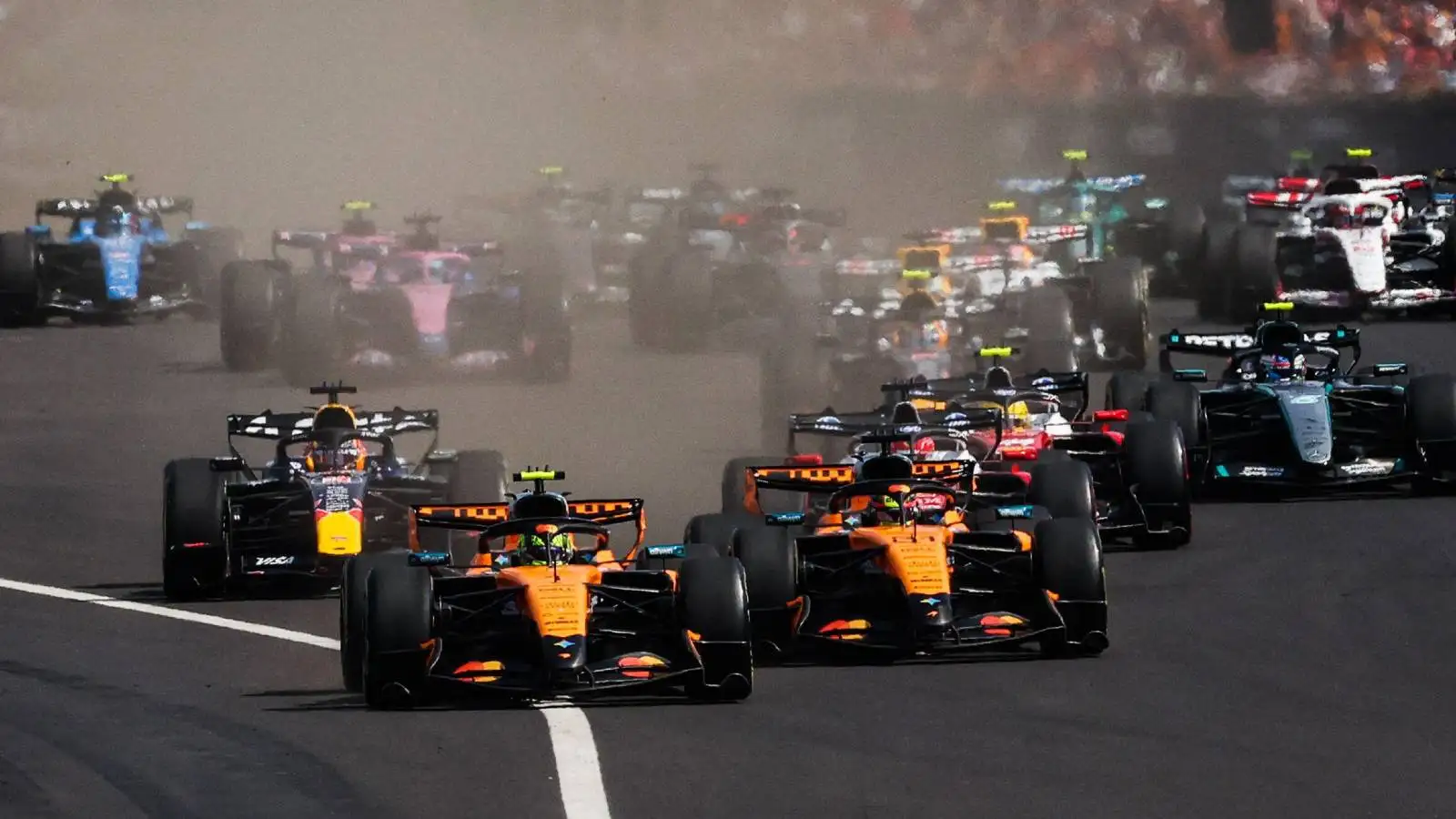
Formula 1’s boom in popularity shows no signs of slowing down, with the surface only ‘scratched’ as the focus remains on the on-track product being as strong and entertaining as possible.
F1 has never been more visible in the global zeitgeist than it has in the last few years, as Liberty Media can look back on its near-decade of commercial ownership with pride.
Formula 1 growth remains strong as Liberty Media plans for the future
Want more PlanetF1.com coverage? Add us as a preferred source on Google for news you can trust.
Having initially purchased a minority stake in 2016, Liberty Media completed its takeover in January 2017 to succeed CVC Capital Partners as the commercial rights holder of Formula 1.
While already an immensely popular sport globally, the American entertainment consortium had identified F1, then led by Bernie Ecclestone, as a sport that was simply not making the most of what was possible in terms of reach.
The sport now reports a global fanbase that reaches over 830 million people, representing a year-on-year increase of 12 per cent, and a 64 per cent increase relative to 2018, the first full year after Liberty Media’s acquisition.
The F1 audience demographic continues to skew ever younger too, with 43 per cent of the total fanbase now under 35, with growth of 51 million fans under 35 year-on-year.
Over the last year, 57 per cent of all new fans were under 35, while the gender imbalance that once seemed impossible to overcome is well on the way to finding equilibrium: 42 per cent is now female, compared to 37 per cent in 2018, with a growth of 43 million female fans year-on-year. In 2025, 48 per cent of all new fans were female, while the figures for the first half of 2026 show this has increased to a circa 75/25 split in favour of female fans onboarding.
It seems impossible to imagine now, but 10 years ago, F1’s online visibility was in a very different place to nowadays. In August 2016, F1’s Twitter account boasted just two million followers signed up, who were rewarded with a sterile feed of press conference transcripts, isolated snapshots from the TV world feed, and zero attempts to engage or entertain.
12.6 million followers are now on board, with the social media feed full of video, eye-catching graphics and statistics, and a lively, involved community of fans.
On Instagram, the growth is even more pronounced: 1.5 million followers in August 2016 has grown to 43.5 million.
Platform
August 2016
August 2026
Instagram
1.5 million
43.5 million
YouTube
210,000
11.8 million
Twitter/X
2.2 million
12.63 million
Facebook
2.6 million
16.69 million
On the financial side, F1’s stock now trades at $100+, having traded at around $25 during 2015 and ’16 – the uptick beginning almost immediately as Liberty Media took control of the sport’s commercial elements.
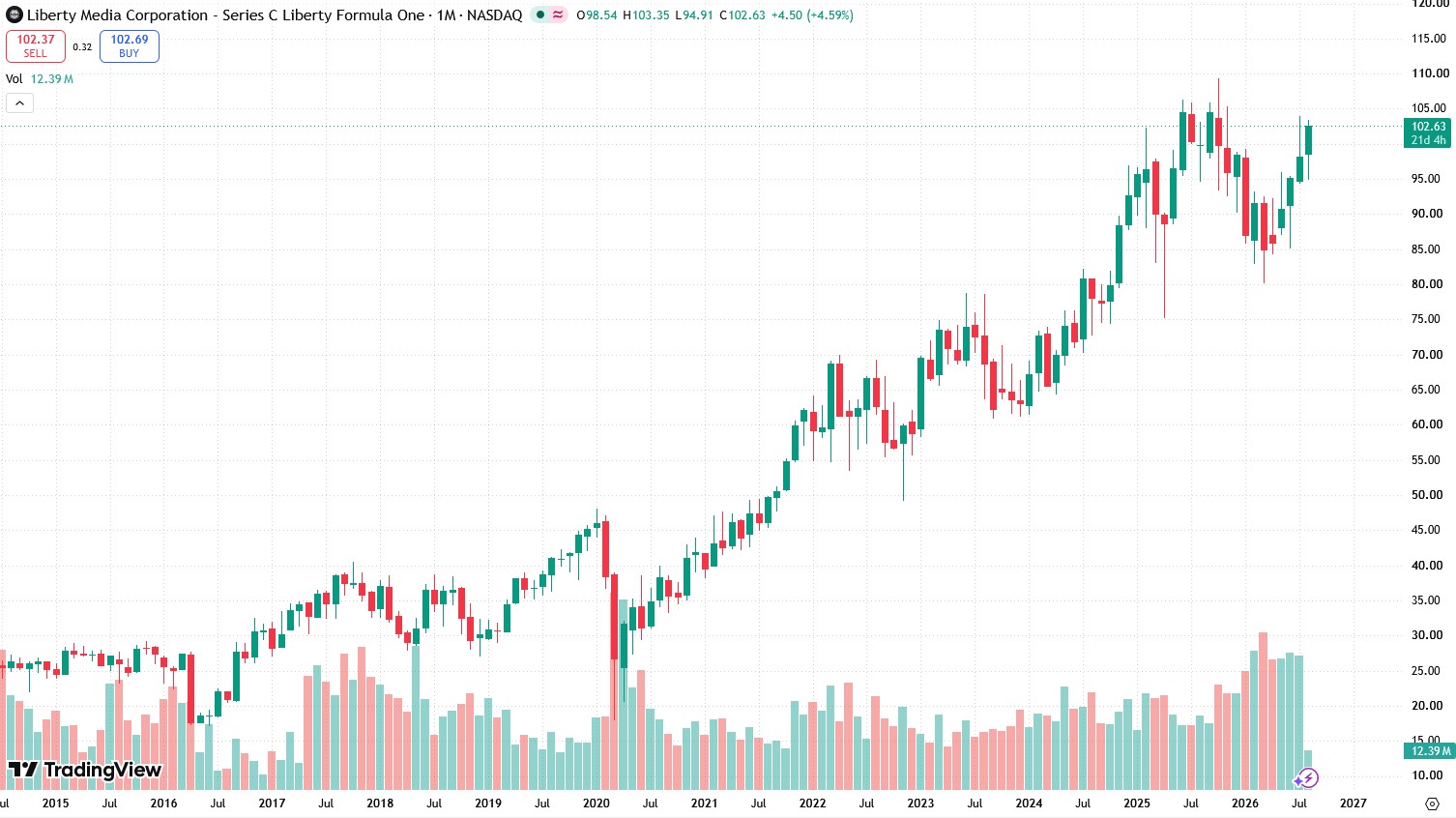
F1’s stock now trades at over $100, having being valued at $25 at the time of Liberty Media’s purchase.
Indeed, aside from an obvious downturn when the COVID-19 pandemic struck in early 2020, F1’s valuation has relentlessly climbed, year-on-year, to the point where it is now on the verge of reaching its highest-ever valuation.
Not only that, but F1 is no longer a niche sport with the perception that it was something to be consumed only by well-off but nerdy anoraks, while the young and trendy were off doing something, anything, else.
Instead, F1 is in cinemas, with a Brad Pitt swagger. It’s on Netflix, where the Drive to Survive series has become a mainstay – not only anticipated by the F1 community, but by the global streaming market. F1 merchandise and team kit is in every shopfront, and landing at international airports now sees visitors greeted by sponsor ads featuring midfield drivers, once unthinkable in a world where only the likes of Michael Schumacher and Lewis Hamilton may have broken through into the global consciousness.
But how was this all achieved? The answer is surprisingly simple. Ecclestone’s approach to F1 was to maintain an air of exclusivity around the sport, making it feel haughty and disconnected from a world that, unlike soccer, had no easily accessible grassroots way for the average person to figure out what motorsport was all about.
Liberty Media’s approach was to do the complete opposite: open it up, shout from the rooftops, and seek to bridge the gap between a motorsport paddock or pitlane, seen as a noisy, oily, fume-filled idiosyncracy, and the likes of venerated stadiums such as the Nou Camp, Bernabeu, or Wembley, and turn it into a similarly venerated place to be for any sports fan.
“We shouldn’t forget Formula 1 was a big international sport, a global sport, when Bernie was running it, and what Bernie did with it over those many years – what he wrestled and did what he did with the sport – was pretty impressive, you know?” Liam Parker says as PlanetF1 settled into his office in Formula 1’s spacious hospitality unit at the Belgian Grand Prix.
Parker is an emerging force in the Formula 1 organisation, with his official title being that of chief communications and corporate relations officer. But his involvement in all things to do with the sport has seen him become a de facto right-hand man for the CEO, Stefano Domenicali, with the pair often inseparable during a weekend’s business – to the point where Parker can step up to involvement with the likes of team boss meetings and F1 Commission appearances.
With a background in UK politics, Parker is a former press secretary to Mark Carney, before becoming special advisor to then-foreign secretary Boris Johnson, but his FOM role has seen him take on responsibility for dragging the sport into the limelight, with his job being to take F1 to a brand new audience. Initially working with Chase Carey, Parker’s synergy with Carey’s successor, Domenicali, has seen his own profile grow as he’s taken on more and more responsibilities.
Kicking off with a question about how F1 has evolved over the 10 years of Liberty Media ownership as the decade mark approaches, Parker’s political skills are evident: he barely needs to gather his thoughts before delivering a polished and measured assessment of what he’s witnessed.
“I think most people knew what Formula 1 was back in the day. They knew who [Ayrton] Senna was. They knew who Michael Schumacher was. They knew who Lewis [Hamilton] was, still, under Bernie, right? So I don’t think we should forget that. He did a pretty amazing job on that front,” Parker said.
“But what they did at Liberty, and I was lucky that I came in almost in the first years of Liberty, so I can’t compare it back but, when you talk to the people that were around at that time, from a team point of view, within the organisation of F1 itself and within the ecosystem, what they basically did is they took a look at this thing.
“They said, ‘It’s big, it’s global, but it’s under-monetised. It’s underutilised. We’re not doing what could be done with it, and we need to look at what we should do’.
“I think some of the key components of that are, number one, let’s just take some risks and try some stuff. And if it doesn’t work, it doesn’t work. And if it does, great, we’ll keep doing it.
“Secondly, we needed to open up the sport. It was so controlled here; you guys [media] being able to do anything in the paddock from a media point of view was very restricted.
“The drivers weren’t allowed to post, the teams weren’t allowed to post, and Sean [Bratches] and Chase’s view was to open this up, allow the drivers to post social media, to start to create some content, and that became more accessible, more open, and grew the sport as an immediate touchpoint.
“But, if you’re talking about the whole transition, it’s kind of coming in stages, right? I think everyone looks just purely at Netflix and says that was it. Netflix was a big part, but there have been so many things along the road that were helping get to where it’s got to.
“Opening it up, talking to people in a different way, we didn’t have a social media team at Formula 1, and if we did, we had two or three people posting two or three things a week.
“Growing that and using all the content and access and footage and everything we got around us and pushing to our fans was a big deal – not something I’m taking personal credit for, but there was a mindset shift within the communications approach of ‘let’s just stop talking to the same people. Let’s get out and tell Formula 1 as a story to a totally different demographic, to women, to young girls, to young boys, to people that are football fans, to people that are NBA fans. Let’s go out and get to their news feeds rather than waiting for them to come to us’.
“In and amongst all of that, people do forget that the most important thing to any growth of any sport is that the sport has to be good, and we’ve been pretty lucky. Though there have been years of dominance in certain elements, we’re pretty good with season finales, dramatic rivalries, the Verstappen era, last year.
“Now we’re changing regulations in the sport, and the on-track has been pretty good, and that allows us the strength to grow elsewhere.
“When the sport’s good, you have the strength to push into Disney and Lego and social and otherwise. The long and short is that it was a mindset for Liberty to just be more open, less protectionist, and to monetise and maximise what Formula 1 was to a far greater audience, and almost drag it to that audience proactively in many, many different ways.
“You’ve seen the movie, you’ve seen Netflix. Those are big touch points along the way, but they would never have happened if the sport wasn’t good and the mindset of Liberty wasn’t open to it.”
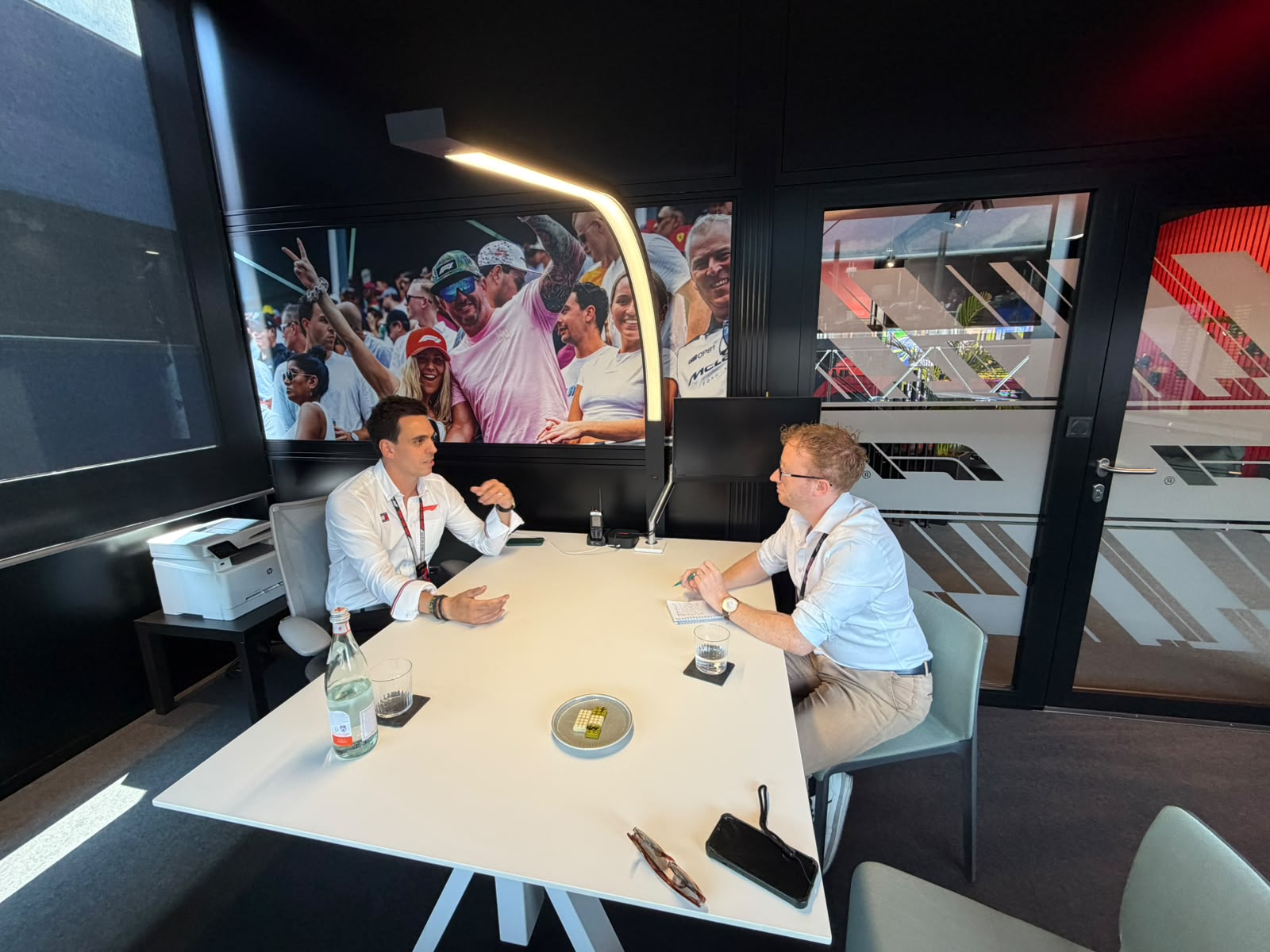
PlanetF1.com’s Thomas Maher sits with Liam Parker, F1’s Chief Communications and Corporate Relations Officer.
With such unprecedented growth seeing Formula 1 becoming mainstream, to the point where it now boasts a stature that has seen it able to shut down the middle of Las Vegas for a night race, it would be easy to think that F1 is hitting a saturation point – a plateau where the fanbase stops growing, the demand slows, and its increasing visibility starts to dip.
That moment, Parker says, has not yet been reached. TV audiences and attendance figures continue to climb (more on that in a later article), but, in an age where the way fans consume media is rapidly evolving, the nature of evaluating reach is something Parker says will need to change along with it over the coming years.
“It’s natural for people to look at saturation points when you’ve gone from A to B in such a short time. The sport’s been around for 76 years, and you’ve really only seen this huge acceleration in growth and reach in six or seven of those 76 years, and probably five or six out of those 10 of Liberty’s,” he said.
“Momentum has only really grown very recently, and what that leads to, as an example, is people saying, ‘America, three races there now. You must be hitting saturation’.
“The argument back, and Stefano and Liberty would make this argument as well, is that 2014 had one race. We were looking at the U.S. and saying, ‘One race? Can we maintain one race? Should we be looking elsewhere?’
“Now, we’ve got three races, a fan base of 50 million plus and growing, reaching all different touch points, a younger audience, a more female audience, partnerships and sponsors from the U.S. market.
“Honestly, in a place like the U.S., we’ve only just scratched what’s possible. But I think it looks to most people like a saturation point because so much has happened in such a short time.
“My argument would be that a lot has happened in a short time. So imagine what more can be delivered as those partnerships and those growth tentacles get deeper into the market.
“In certain places like the US, we don’t yet have a US driver in Formula 1. We don’t have other drivers in Formula 1. We don’t have races in certain locations. But I still think there’s a huge amount for us to do, and we’re still evolving.
“The advent of AI and talking in different languages to customers, and growth of social media platforms, and diversity of content, and what you guys do [print media], what consumer lifestyle media do.
“We don’t look at it like that. It might be that the growth curve has been this, and the growth curve might be like that, but it still would be upwards. That would be my view.
“And, as an insider seeing it, we never sit internally and think, ‘What’s our saturation point?’ It’s where the opportunity is.”
The revolutionary F1 2026 regulations could have been a fly in the ointment for the sport’s growth, given the vocal backlash against them by the drivers and the media, but the fanbase hasn’t been put off by the on-track changes.
While there’s an argument to be made that the regulations created an entertainment-led product, with a driver’s natural abilities neutered by the need to focus on battery management and energy harvesting moreso than raw speed, audience and fan figures continue to thrive (also more on that in a later article!), but that doesn’t mean change won’t come to ensure this scenario doesn’t change.
With FIA President Mohammed Ben Sulayem making it clear a V8 future awaits, the synergy and close working partnership between the FIA as the governing body and FOM as the commercial rights holder means there’s no argument to be had about the next regulation cycle, and the importance of ensuring the right balance between sports and entertainment.
Put to him by PlanetF1.com that it appears, externally, as though the focus has switched to creating a more entertainment-led product, rather than the sporting, Parker offered a riposte.
“What you’ve got here in Stefano is a guy who’s been in the sport for 30 years. He watched from the hills of Imola, worked in the paddock, went to Ferrari, and spent most of his working life on Ferrari. Went to Audi, Lamborghini, and now he’s back. He’s a car guy, a racing guy,” he said.
“It’s fantastic to have Disney with us, fantastic to have Lego, fantastic to have brands like LVMH investing in us.
“But, in any conversation we have about anything, ultimately, it’s nothing if what’s on track is not working.
“The term entertainment can sometimes be seen as a pejorative term. Entertainment feels like it’s just music and celebrity. I know that’s not what you’re saying, but the product on track should be entertaining. If it’s not, it’s boring. And if it’s boring, people drift away. Sponsors are not interested. Teams’ valuations drop.
“The whole microclimate depends on that being good. So I would always say that entertaining racing is good. The focus is always on the sport first. All the other elements come as a result of that being strong.”
With huge success achieved by Liberty Media over the past decade, how will the sport evolve further over the next decade?
“What I’d say in terms of five or 10 years, I can tell you one thing: it will still be the best racing, and still have the best drivers in the world. It will not be electric. It will be V8; vary that by 10 years’ time,” he said.
“But it will be the best racing in the best venues and the best cities and best locations in the world, with the best brands, probably the best automotive companies around us, maybe new ones that come. Who knows?
“But it will still be the most visible and strongest global motorsport in the world. In 10 years’ time, I’d be amazed if we don’t have over a billion fans. I’d be amazed if our audience hasn’t grown. I’d be amazed if it’s not younger. I’d be amazed if big brands are still not invested in us.
“And I’d be amazed if most people in the world wouldn’t be able to look at at least one or two of our drivers and say, ‘I know who they are’, regardless of where they are in the world, because we attract the best and the biggest names in the history of any sport: Lewis, Max, Senna, Schumacher.
“Honestly, I don’t want to sound cheesy or cliché, but the future for Formula 1 has always been bright, and that will be the same in the future.”
How F1 continues to thrive on social media
F1’s Instagram platform continues to be one of the most engaged channels across world sport
+125 million across social media followers, an increase of +19 per cent year-on-year.
+12 per cent year-on-year increase in social impressions across social accounts.
+54 per cent year-on-year increase in video views, driven by strong TikTok engagement.
+70 million views across social platforms for the Drivers’ Parade Lego activation at Silverstone this year.
+7 million hours of viewing time spent on expanded video content across F1.com and F1 App.
Want to be the first to know exclusive information from the F1 paddock? Join our broadcast channel on WhatsApp to get the scoop on the latest developments from our team of accredited journalists.
You can also subscribe to the PlanetF1 YouTube channel for exclusive features, hear from our paddock journalists with stories from the heart of Formula 1 and much more!
Read Next: Mercedes promises major W17 gains after summer break