
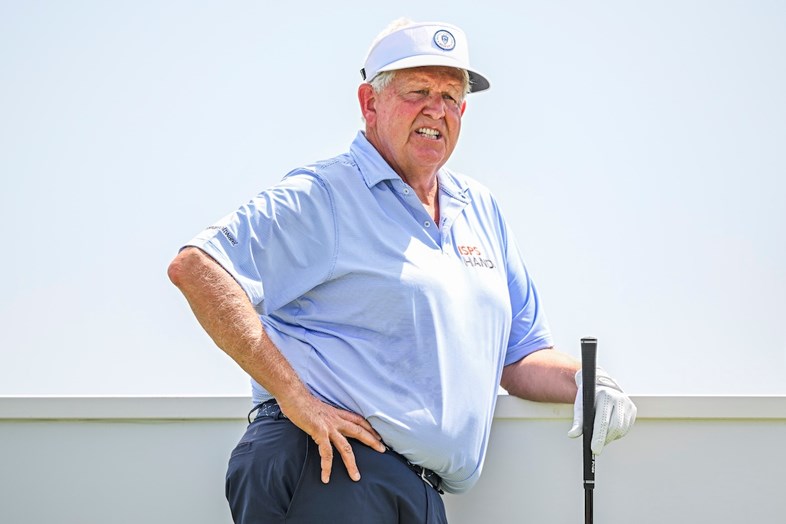
In this interview with TG, Colin Montgomerie takes aim at some of the biggest problems he sees in modern golf.
Colin Montgomerie believes that procrastination from golf’s authorities is further damaging an already “one dimensional” modern game that has rendered some of his favorite courses obselete.
Much to the chagrin of Montgomerie and many other greats of the sport, it was revealed before this year’s US Open that the R&A and USGA would be delaying the implementation of golf ball testing rules that would roll back driving distances by up to 15 yards until January 2030 at the earliest.
Average distances have rocketed by more than 50 yards since Montgomerie dominated European golf in the 1990s and the 63-year-old Scot insists the battle between the turbo-charged equipment and the game’s storied venues was lost long ago.
“This one dimensional game that’s being played right now is bombing, find it if you’re lucky, and then putt, he tells TG. “In our day it was a four or five dimensional game.”
The original proposal to rein in the golf ball was supposed to be introduced at the elite level in 2028 and two years later for amateurs, but the governing bodies are now working with the tours and re-evaluating whether their plan was actually a tangible solution. Fears their plans would have no profound effect were realized this year when it emerged that Cameron Young won The Players with a ball that already conforms to the proposed new testing standards.
“People say it’s the ball, now that hasn’t really worked well,” Montgomerie sighs, reflecting on Young’s win. “It goes like seven yards less! No, no, no. Seventy yards less, not seven. Something has to be done because these great old courses are becoming obsolete. And you’ll find that at St Andrews [at The Open] next year, if we have a warm summer, my god, the ball won’t stop. We’ve got to do something.”
Montgomerie, though, isn’t committing to an alternative solution – but he seems keen on a couple of ideas.
“There’s theories going on all over the place,” he says. “Do we go to 12 clubs in the bag? Or do we go to a smaller-headed driver, which means that the ball’s going to go offline more with less dispersion?”
On a recent Instagram post, Montgomerie proved his point by digging out the driver he used in the final of the British Amateur against Jose Maria Olazabal in 1984 and put the club alongside his 2026 weapon of choice. In comparison, Montgomerie’s latest driver head looks the size of a frying pan.
A merciful evolution for the weekend warriors, perhaps, but Montgomerie says that has come to the detriment of the pro game as a spectacle. It is unclear where R&A and USGA will go next, but the apparent dithering on such an existential issue, as the various stakeholders agree on a way forward, infuriates Montgomerie.
“What I would like to see happen is make a decision and go with it now as opposed to having to wait four years for the next rule to change,” he says. “Four years? Come on! What the hell? Let’s just do it now.”
Montgomerie’s other concern is that these revered venues aren’t only running out of space to accommodate the big-hitting pros, but also fans. He is speaking with TG during The Open at Royal Birkdale, which drew a record-breaking attendance of 306,000. The upshot of the game’s oldest major becoming a commercial behemoth is that venues are now cramped in their bids to meet demand.
“You see what’s happening to The Open and the numbers involved now,” says Montgomerie. “Some of these classic courses are running out room. Muirfield is running out of room. Turnberry is running out of room. There’s a number of them that infrastructurally cannot cope with 300,000 fans. At St Andrews next year they’re talking about 400,000. Hang on. These old courses at the end of a train line can’t cope. It’s unfortunate that way that we’re having to play courses that have more space other than the ones that are true Open venues to accommodate what’s gone on.”
“I think it was less than 100,000 during last Turnberry Open in 2009. It’s dramatic, we’re talking four times that. It is a shame we have to go to the bigger venues as opposed to the best ones. Is it a sign of the times? Yes it is. It’s good for golf that we want people to come and watch, [but] it has to be the word ‘money’ is involved. That word wins every time.”
The R&A’s chief executive Mark Darbon stressed at Birkdale that the tournament’s return to Royal Lytham in 2028 is proof that the Open is prioritizing the best courses over their bottom line.
“If we’re able to facilitate spectator volumes onsite, we’ll always consider that, but it’s not the primary driver for us,” Darbon said. “Lytham has a much smaller footprint. There’s absolutely no way we’ll be near the volume of spectators at Lytham that we have [at Birkdale].
“Our choices, first and foremost, start with the underlying principle for us, which is we want to take the Open Championship to venues that will offer a true test of links golf. We’re not taking venues off the rotation because they’re smaller than others, but there’s a balance to be struck too, and we think we’re getting that right.”
Montgomerie’s fierce passion for golf is still evidenced by his play on the Champions Tour. He also still loves watching the elite game, even if he believes it has diminished as a viewing product. But he is clearly concerned about the direction in which it is heading. His biggest gripe still relates to slow play and Montgomerie harks back to the time when Lee Trevino won the Open in 1971 playing in three-balls that took fewer than four hours. The first two rounds at Birkdale in July closed in on the six-hour mark.
“It’s too long a chat between the caddie and the player,” Montgomerie says. “My god, it goes on forever. The book comes out. How many times have they got the bloody book out? Once that ball is placed on the green it should not be marked again to get the line on the ball.
“They say there’s a huge deterrent for slow play. But was anybody penalised? No.”
Montgomerie was speaking in Southport shortly before Bryson DeChambeau’s rules fiasco engulfed the final major of the season. As his mainstream media blackout continues, DeChambeau is still yet to fully address the chaos at Birkdale that saw him given a two-shot penalty and allegedly threaten to quit the tournament. Montgomerie believes it should now be an obligation for golfers to fulfil post-round media duties.
“This social media day that we live in, Bryson’s made an awful lot of money through the YouTube channels and all the media involvement,” he says. “A bit like the tennis, if you’re given 10-15 minutes and the media know you’re coming in, but it might be a slightly delayed 15 minutes as opposed to straight away, I think that’s fair. But I think it’s right that we as players give to the media.
“As long as you’re there to say what you feel about the round, I think we should be compulsory to do that.”
Colin Montgomerie was speaking to TG as an ambassador for Loch Lomond Whiskies.