

Listen to this article
Estimated 2 minutes
The audio version of this article is generated by AI-based technology. Mispronunciations can occur. We are working with our partners to continually review and improve the results.
The moon is crossing in front of the sun’s path Wednesday afternoon so, if skies are clear, Islanders can expect to see a partial solar eclipse.
Earth’s only natural satellite is expected to block about a third of the sun at peak time, and the University of Prince Edward Island is inviting people to it’s campus to view the event.
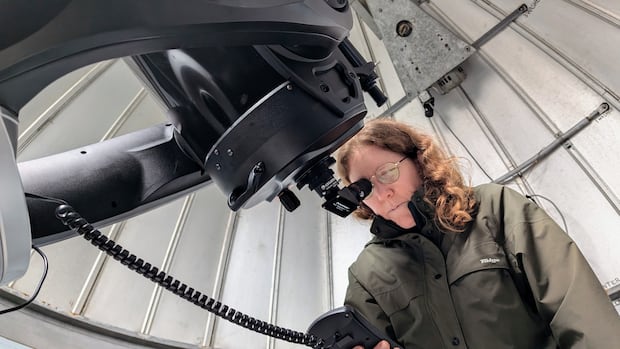
UPEI physics lab technician Megan Glover said telescopes will be set up in the grassy area between the school’s Memorial and Dalton halls between 2 and 4 p.m. Maximum coverage will occur at 2:57 p.m.
“This is sort of like one of our regular solar viewings that we do over the summer for the public, except that the moon’s going to be involved in it,” Glover said.
“We will be setting up our telescopes. We have a couple of different types that let us see different parts of the sun.”
CBC meteorologist Jay Scotland said cloudy periods Wednesday morning should begin to clear in time for the viewing.
“The sky should clear up enough in the afternoon for folks to see the partial solar eclipse (with the appropriate safety glasses or a pinhole projector), although a few scattered showers may linger into the afternoon,” he said.
“While I can’t promise a perfectly clear sky, any clouds or showers should be fairly isolated and short-lived.”
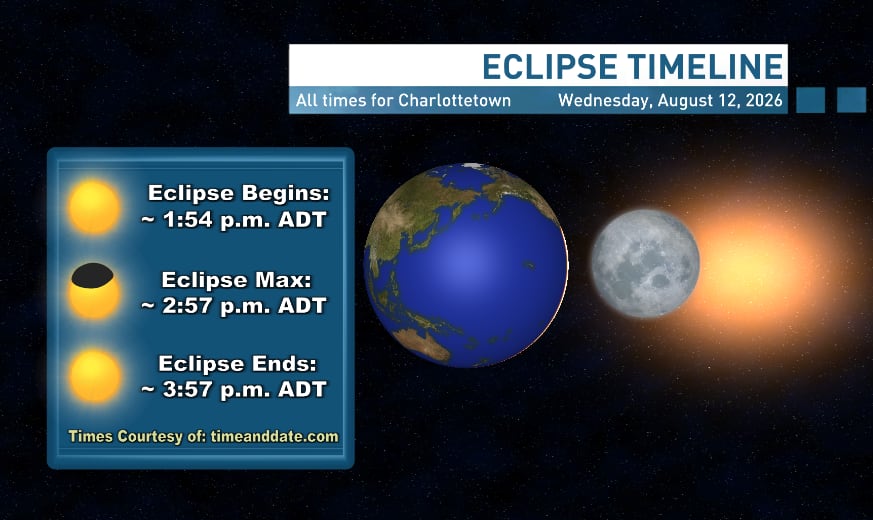 (Jay Scotland/CBC)
Glover said attendees at UPEI will have a chance to go to the university’s observatory, allowing people to look at “the photosphere of the sun.” She said eclipse-viewing glasses will also be available.
If you plan to use eclipse glasses at home, Glover said to make sure they don’t have scratches or holes. She advises holding them up to a bright light and, if the light shines through, don’t use them.
“It’s a neat coincidence of nature that our moon gets to move into the path of the sun and block sometimes all of it or even just a good portion of it,” Glover said.
More information on the partial solar eclipse can be found on UPEI’s website.