
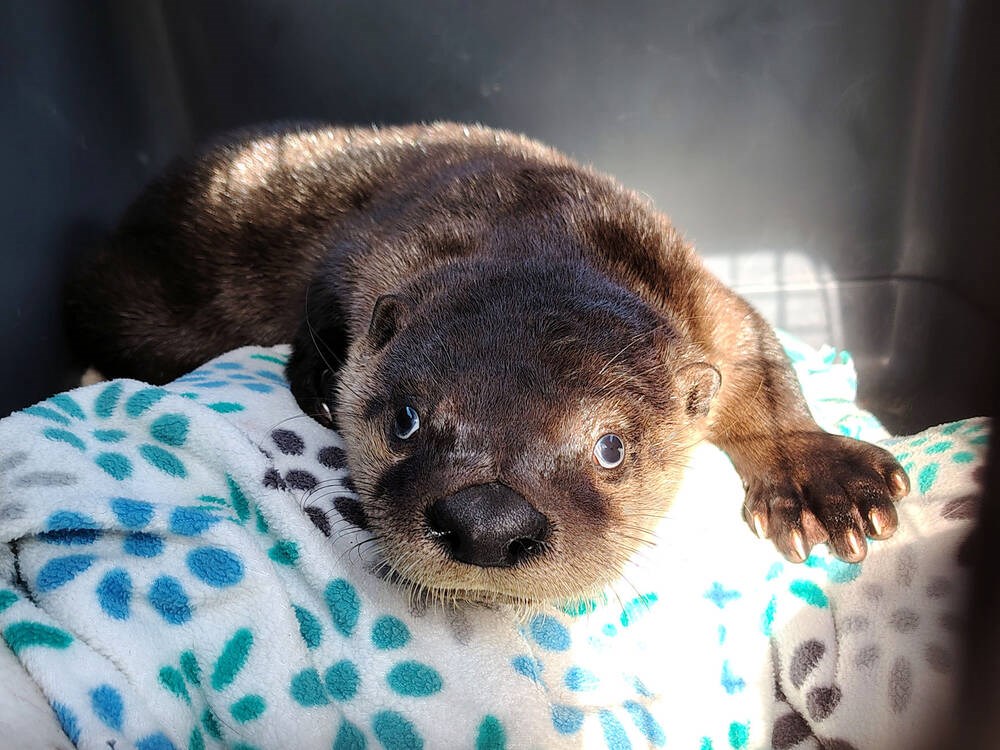
Well-versed in first aid, Gordon Mellish treated the unconscious river otter pup like a baby or small child.
Faced with an unconscious river otter pup that had been tangled in a fish net, Gordon Mellish didn’t think twice before covering the wild animal’s mouth with his own to resuscitate it.
“It was just an automatic reaction. It had to be done,” the 68-year-old former logger and fisherman said by phone from his home in Alert Bay on Cormorant Island, a short ferry ride from Port McNeill.
Mellish knew he first needed to push on the otter’s belly to empty its stomach of water. Foam started to come out of the pup’s mouth and, with two other otters caught in the same net, Mellish realized he needed to prioritize the two in better shape.
Along with his niece and her husband, who found the otters after hearing what sounded like a baby crying near a dock in Alert Bay’s marina, Mellish spent 20 minutes cutting the otters out of the net.
Mellish got “a little cranky” when one of the otters bit him on the thumb, he said.
“I’m just trying to save your life!” he recalled yelling at the otter.
Once the other two otters were freed and slipped back into the ocean, Mellish returned his attention to the unconscious otter, which had netting wrapped around its neck.
It was motionless and wasn’t breathing, so Mellish covered the animal’s nose and placed his mouth over its mouth, giving small breaths. Well-versed in first aid, Mellish treated the pup like a baby or small child, recognizing he couldn’t provide full breaths to the small animal.
Mellish alternated mouth-to-mouth with chest compressions, guessing at the location of the otter’s heart.
“I must have gotten the right spot,” he said with a laugh, because after about 20 minutes, the pup started to move its head.
With the otter stable and lots of help down on the dock, including RCMP officers, Mellish decided to get a tetanus shot for the otter bite.
When he returned, the otter’s fur was “all fluffed up,” and it was looking healthy. When he approached the animal, it turned its head to sniff his hand.
“I said, ‘You can rest now,’ ” Mellish recalled.
Robin Quirk, who has helped rescue eagles and other birds, was called by police and asked to help. She bumped into Mellish covered in blood as he left the dock to seek a tetanus shot. Quirk phoned MARS Wildlife Rescue, which agreed to take in the animal if she brought it to the wildlife hospital in Merville.
The otter was revived when she arrived, but it was still unclear if it would survive, she said.
“I saw the looks on everyone’s faces. Someone said, ‘I don’t think it’s going to make it,’ ” Quirk said in a phone interview.
Quirk and others got the otter into a box, and Quirk later transferred it to a dog crate. She gave the pup her cat’s old bed and a bowl of water, and it started drinking.
“It went from absolutely lifeless to moving its head and more alert,” she said. After a third bowl of water, it looked like a different animal, Quirk said.
The pup spent the night in its crate inside Quirk’s car, because Quirk lives in an apartment building and couldn’t bring the animal inside.
She took the pup on an early ferry to Port McNeill and drove it to Sayward, whistling a short melody on repeat during the hour-and-a-half drive to try to let the animal know it was safe. Quirk met someone in Sayward who drove the pup the rest of the way to the wildlife hospital.
By the time the otter pup was received at the hospital, he was in pretty “okay shape,” said MARS assistant manager Kiersten Shyian.
The 3.5-kilogram otter, estimated to be about three to four months old, had some crackling in its lungs that cleared up with antibiotics, she said.
Shyian praised Mellish for giving the pup mouth-to-mouth, calling his actions “incredible,” although she said she can’t recommend it due to the risk of disease and injury from biting.
The hospital kept the otter for 10 days before it made the return trip to Alert Bay.
Quirk, Mellish and others involved in the rescue went out early in the morning on Aug. 7 looking for the otter’s family, hoping to release it to its mother.
When the mother didn’t turn up after several hours, the team decided to release the otter after consulting the SPCA, which said the pup was likely old enough to survive on its own, Mellish said.
Mellish was given the honour of opening the door of the otter’s enclosure to release it.
“Before she left, she turned and looked at me and nodded her head,” he said.
Mellish said he has saved the lives of 10 people, including several who survived a plane crash in the 1980s, but he had never brought an animal back to life.
“You only get that chance probably once in a lifetime,” he said.
A member of ‘Namgis First Nation, Mellish believes in reincarnation.
“You never know what you’re going to come back as. That’s why I always try to do good in life. I might come back as an otter,” he said.
Mellish hopes the incident serves as a reminder to fishermen to always collect their nets, and for everyone to consider how our actions impact the wildlife around us.
“No matter what got trapped in the net, it shouldn’t have happened,” he said.
About an hour after the otter was released, a friend sent Quirk a video of a mother otter and three pups. Hours later, she went down to the marina where the otter was found and repeated the melody she had whistled while transporting the otter to the hospital.
She heard a sound and looked down to see a little otter pup looking up at her. Quirk threw a piece of fish down and the otter dove down towards the fish, as two other otters surfaced at the end of the dock.
“So whether it’s with its own family or whether it’s a different family, it’s not alone,” Quirk said. “We had achieved what we wanted to achieve.”