
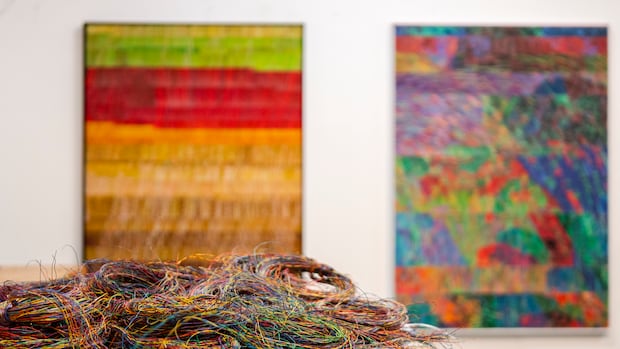
Emily Hermant, the Vancouver-based artist on display in the Vancouver Art Gallery’s (VAG) latest exhibition, sees textile as a language. In fact, it might be one of the oldest languages.
“From very early on, textile has been [a] kind of transmitter,” Hermant says. “So much of how we understand contemporary communication is really indebted to these much older systems that have been in place for thousands of years.”
Hermant explores that link between textile and communication in her sculpture and weaving. The pieces on display in her exhibition are constructed from stripped telecommunications wires and ethernet cable jackets, threading the materials of modern communication through an ancient medium — one that civilizations around the world have used to record meaning for millenia.
The exhibition is the first in the VAG’s new Vancouver Now! series dedicated to contemporary Vancouver-based artists whose work the curatorial team see as representative of the city’s art scene.
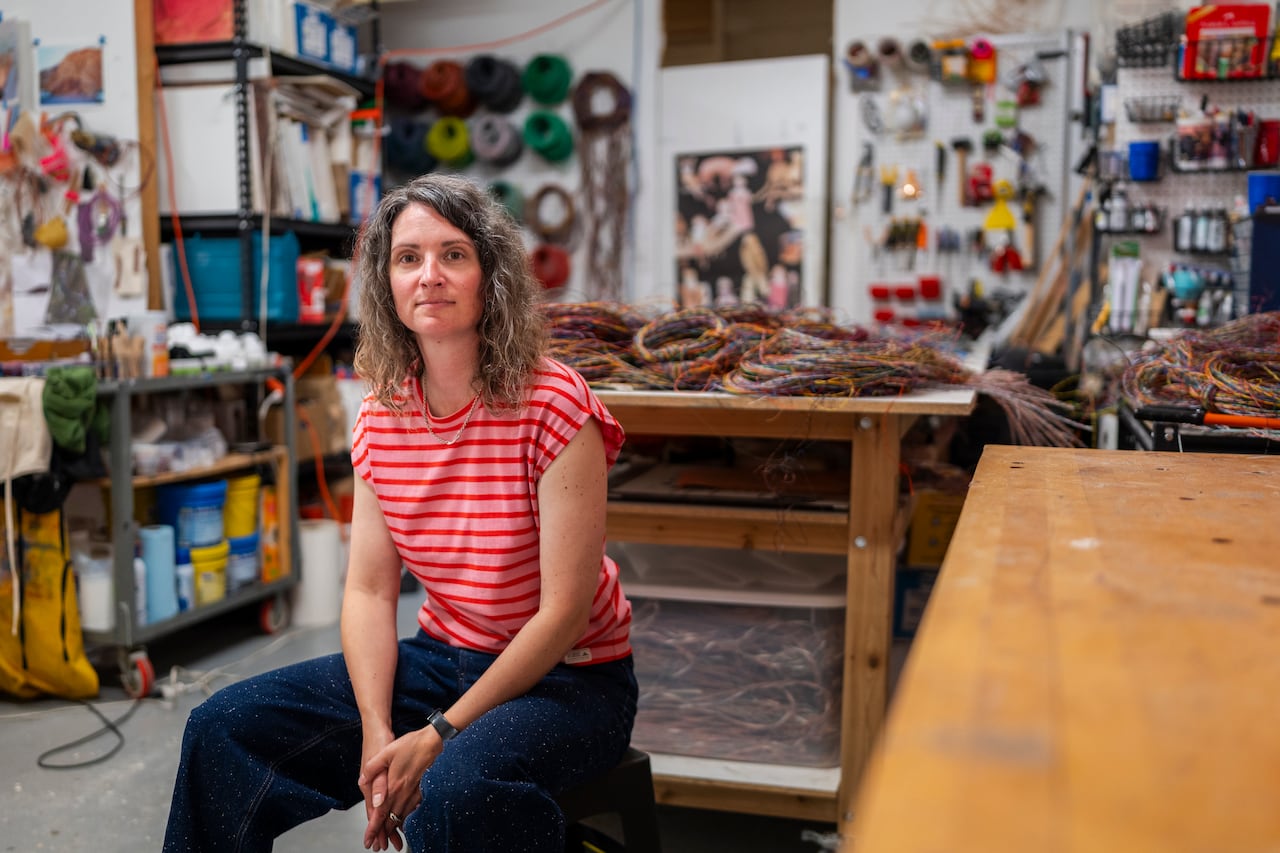 Emily Hermant in her studio ahead of her opening at the Vancouver Art Gallery on July 15, 2026. (Vancouver Art Gallery)
The idea came up when the team — including Richard Hill, who curated Hermant’s exhibition — was putting together another exhibition, Highlights from the Collection. As the name suggests, the show put a spotlight on pieces from the gallery’s permanent collection, much of which is work by established artists from outside Vancouver. It’s important stuff, but the VAG team wanted to make sure they weren’t focusing on the big picture at the expense of the local scene.
“As an institution, we’re not always agile,” says Hill. “Because, when we do a big show, we plan that years out. We can only shine that big spotlight so many times per year. It’s one of the frustrating things about being a curator, how often you disappoint worthy artists who deserve that spotlight.”
Hill sees Vancouver Now! as a comparatively “nimble, timely” instrument that the Gallery can use to “connect to that pulse so that, as an institution, [the VAG] never lose[s] track of the city that is central to the mission.”
That nimbleness comes in part from the series’s smaller scale. Hermant’s exhibition is on the third floor of the gallery, in a room separated from the permanent collections exhibition.
The pieces on display are spread across three distinct forms. Pile It On and Talk Through Me — the latter of which the VAG recently acquired for its permanent collection — are reminiscent of high-pile shag carpets. Hermant assembled them from thousands of locally collected ethernet cable jackets, some of which still bear terminals, connectors or electrician’s labels scrawled on masking tape. These break up the flow of the pieces’ geometric patterns — small reminders of the material uses its components once served.
Drift and Billow are perhaps Hermant’s most immediately striking pieces; undulating monoliths of multicoloured telecommunication wires braided in overlapping layers. The ends of each wire are stripped and knotted together, creating patches of shining copper that dot the sculptures’ surfaces.
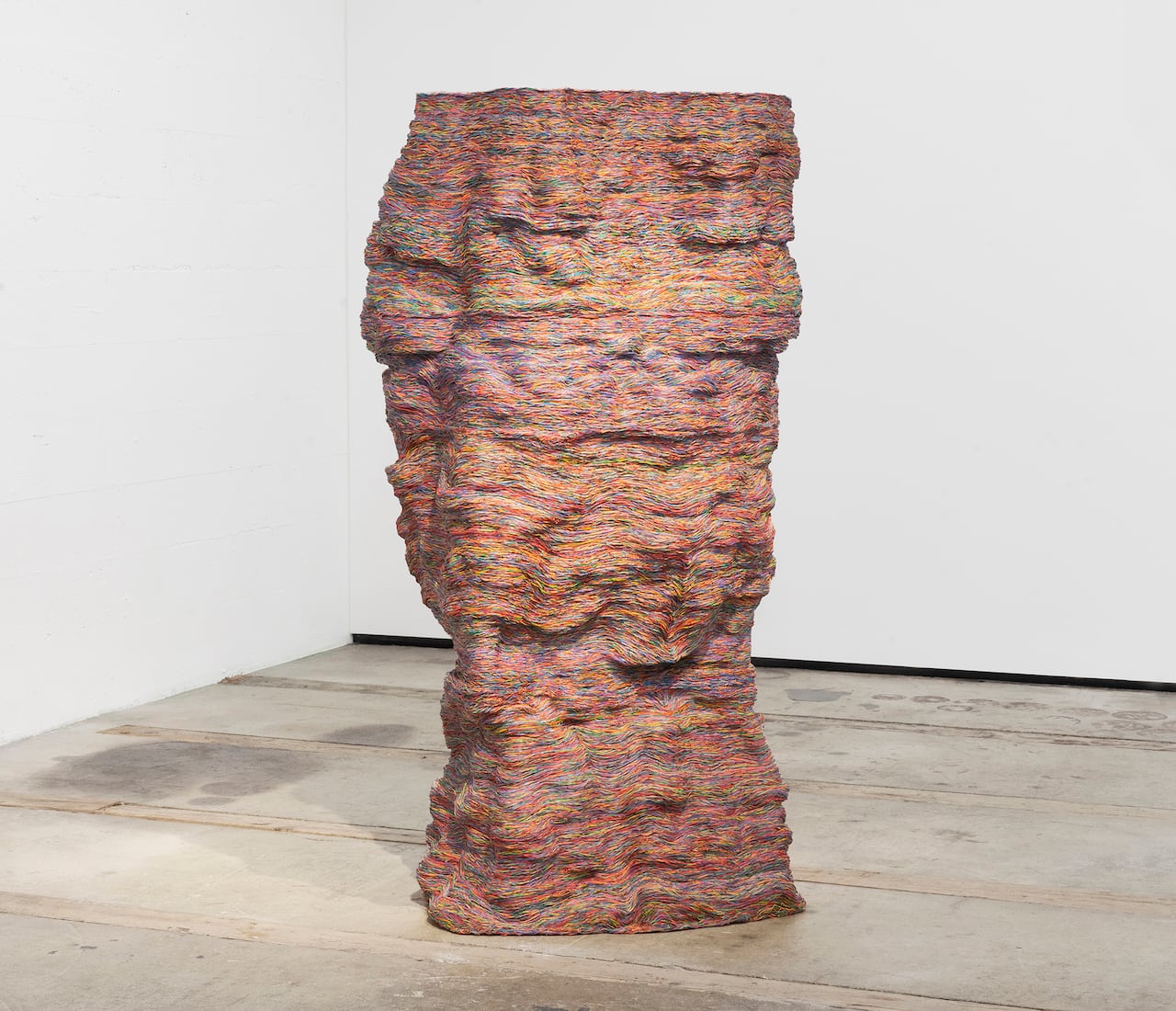 Emily Hermant’s Billow. (Vancouver Art Gallery)
Both are interesting variations on the form, but Drift is the more successful. At either end of its horizontal mass, the wires that make it up lose structure and hang loose from the stand where it sits. Thinking about Drift as a representation of our modern communication systems — structures so complex as to seem magical to the average user — that loss of form is intriguing and a little unsettling.
The rest of Hermant’s pieces are two-dimensional and made from telecommunication wires mounted on canvas. The pieces are segmented horizontally, with arcing wires arranged to evoke time-lapse land- and skyscapes.
Illumination is the most immediately legible, where Hermant outlines the familiar shapes of trees and a mountainous island in the background with impressive fidelity. Other pieces, like Reflections on Geminid (No. 3), appear abstract before one recognizes the paths of stars in the long wires that cut paths across the canvas.
These pieces are where Hermant’s exploration of material and its purpose is strongest. The wires she mounts on these canvases are displaced, removed from their original function and thrust into this new one. Still, as if the material had a will of its own, it continues in its role, working in tandem to carry the weight of information, of an image coming through the wires.
Hermant’s work photographs well: it’s intricate, colourful and often mesmerizing. But it’s in person that the texture and detail of the pieces come through, particularly in the case of Pile It On and Talk Through Me, which visitors can walk around to view from every angle.
Hermant doesn’t think of herself as an artist that consciously tries to represent her city in her work, but she’s deeply interested in how the materials she works with are simultaneously local and global. All of the wires and casings she uses in her work are gathered in and around Vancouver — but you wouldn’t know it.
“These materials are also in every single place in the world, so they’re ubiquitous,” Hermant says. Like the overwhelming intricacy of Drift, her materials call attention to the secret world that telecommunication technology represents; a massive network of infrastructure that few ever really see.
The exhibition comes at a meaningful time for Hermant. She wasn’t born in Vancouver. She grew up in Toronto and completed her BFA at Concordia, eventually moving west to take up a teaching position at the Emily Carr University of Art and Design. Now, being named as a representative of her new home’s local scene is a big moment.
“[Vancouver Now!] marks a decade of being here,” she says. “It’s a really special occasion for me to have this show and this platform and have the work be celebrated.”
Hermant’s work is on display at the VAG until Nov. 22. The gallery has a slate of local artists booked after her, with Annie Briard, Manjot Kaur, Lauren Crazybull and Karice Mitchell displaying work in succession through to 2028.
Emily Hermant’s work is on display at the Vancouver Art Gallery (750 Hornby St.) in Vancouver, as part of Vancouver Now!, until Nov. 22. 2026.