
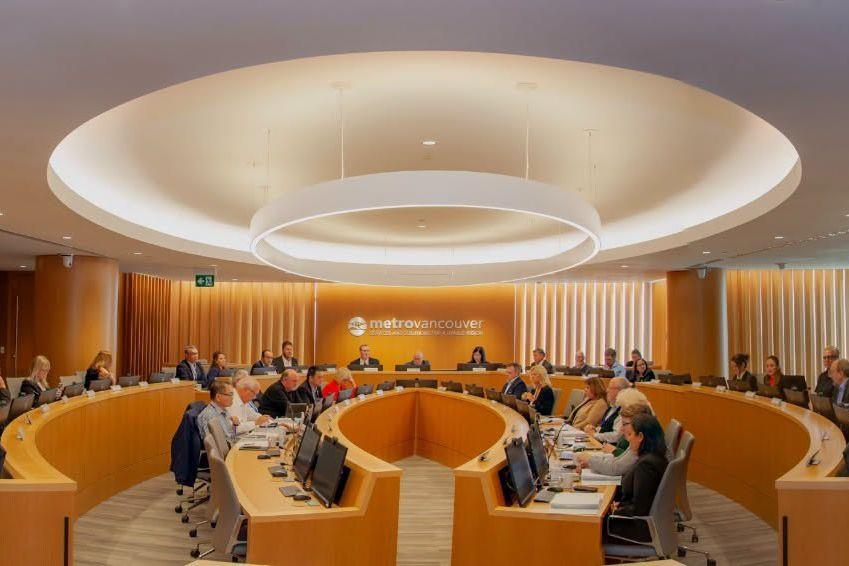
Metro Vancouver board votes to cap number of directors
Published 12:30 pm Tuesday, August 11, 2026
Delta mayoral candidate and city councillor Dylan Kruger says he’s thankful his fellow directors at Metro Vancouver have voted to support a proposed cap on the size of the board, a “structural change aimed at improving efficiency and strengthening regional decision-making” he says is “another step toward regaining public trust.”
Kruger is one two Delta representatives on Metro Vancouver’s board of directors and vice-chair of the governance committee, where he introduced a motion last fall directing staff to examine options to reduce the size of the board.
Following the committee’s recommendation, the board of directors voted July 24 in favour of capping the number of directors at three per member jurisdiction while maintaining weighted voting, a move that could see the board’s size reduced by nearly 25 per cent in the coming years — from 45 directors to 34 — pending provincial government approval.
The change would also apply to Metro Vancouver’s housing corporation and water, sewerage and drainage boards.
The motion was supported by all directors present (including Kruger and Delta Coun. Rod Binder) except those from the City of Surrey and Langley Township, with 107 votes for and 36 against.
“Analysis of this option identified that it could improve decision-making speed, efficiency, and strategic focus while maintaining proportional representation. It was the option most preferred during engagement on the size and structure of the boards,” reads a Metro Vancouver press release.
“Under this model, the size of the Boards would grow more slowly over time, not even reaching the current size by the year 2050.”
Board chair and Burnaby Mayor Mike Hurley said Metro Vancouver “has taken a really thoughtful process for finding strong options for reducing the size of the board and improving the organization’s governance.”
“The option that we are putting forward would ensure that all municipalities continue to have proportional representation at the table, but it also reduces board size and helps with efficiency. We heard clearly through engagement that achieving meaningful change is important.”
Metro Vancouver is now requesting that the province make necessary changes to either the Local Government Act or the Municipalities Enabling and Validating Act to enable a smaller regional district board — a process that may take up to two years to complete.
Kruger, in a campaign press release issued the day of the board’s decision, said it’s clear that reform is needed at Metro Vancouver.
“We need to be more accountable and effective. This allows that work to begin in a real way.”
Kruger said recent reforms such as eliminating international travel for board members, ending double meeting fees and the implementation of several recommendations from Deloitte’s independent governance review were “important first steps, but modernizing the board itself is the most significant structural change we can make.”
“At some point, we have to ask whether adding more directors improves decision-making or simply makes governance more cumbersome and less accountable,” Kruger said. “Today, we said no to growing the size of the government.”
Kruger noted that the board’s support for a size cap reflects a broader effort to streamline governance while maintaining strong representation from member municipalities.
“This is part of a larger conversation about how Metro Vancouver can operate more effectively as our region continues to grow,” he said.
Kruger called on the province to make the required legislative amendments swiftly so the governance reform can be implemented “without unnecessary delay.”