

Listen to this article
Estimated 4 minutes
The audio version of this article is generated by AI-based technology. Mispronunciations can occur. We are working with our partners to continually review and improve the results.
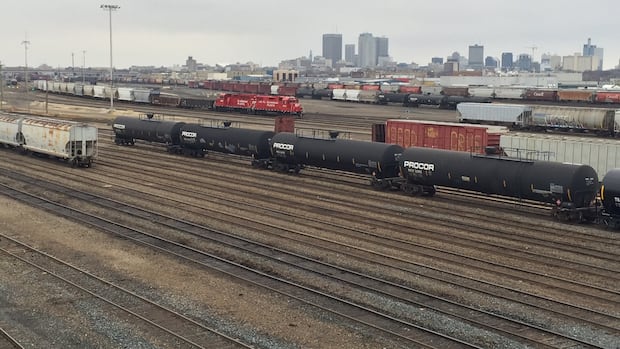
Winnipeg’s rail-relocation study group plans to examine the feasibility of creating a corridor outside the city that would allow all three major railways to bypass the Manitoba capital.
Lloyd Axworthy, the former federal cabinet minister who heads up the rail-relocation study, said his group plans to spend three months looking at a bypass around Winnipeg for the Canadian Pacific Kansas City, Canadian National and Burlington Northern Santa Fe railways.
The bypass corridor could utilize provincially owned land, including Manitoba Hydro corridors, preventing the need for costly and time-consuming land expropriations, he said.
It could also allow a greenway — an area with no development — to be established between the bypass corridor and areas where the city intends to build itself out, Axworthy added.
He said the bypass could also benefit CentrePort, the industrial park that straddles the border of the Rural Municipality of Rosser and the City of Winnipeg to the north and west of Richardson International Airport.
“It’s a big idea, but it’s one that maybe it’s time has come,” Axworthy said Tuesday in an interview, promising to reveal the proposed location for the bypass corridor at a news conference slated for Wednesday afternoon.
“We’re not going to commit any dollars or any sort of structures until we’ve had a very good look at the feasibility of making this happen. So, that’s what my study group’s going to do for the next three months.”
Axworthy said his rail-relocation study group will work with the city, railroad companies, businesses and Indigenous communities to determine whether a bypass is “a workable idea” from technical, economic and social perspectives.
He said the resulting feasibility study will not involve detailed engineering or financial estimates. The project would require 20 to 25 years to implement, Axworthy said, and would require an immense amount of funding.
New railyards and rail lines, for example, would require the construction of new bridges or underpasses, at a cost estimated in the billions.
“We’re not going to come down with the exact numbers of what it’s going to cost to do an overpass over Highway 75. But what we can give you is where is the potential funding benefits and where are the potential costs,” Axworthy said.
Those benefits, he said, include speeding the flow of rail traffic that’s currently forced to move slowly through Winnipeg residential neighbourhoods for safety and noise-reduction reasons. About 60 per cent of the traffic that flows through Winnipeg on the major railroads neither originates nor terminates within the city, Axworthy said.
A bypass outside the city would also free up valuable urban space, he added.
“What we’re talking about is something that’s going to be have a lasting impact on the city for the next 75 years,” he said, suggesting the opportunity could outweigh the cost.
“When [former Manitoba premier] Duff Roblin said, ‘Let’s do the floodway’ and everybody said, ‘Oh my god, you’re wasting all that money,’ how many billions does it save us in the meantime?”
Winnipeg Mayor Scott Gillingham said in a statement a bypass is an interesting concept and he wants to see what the study says about it.
Gillingham said the goal of the rail-relocation study was to examine options to get vehicles moving while protecting thousands of railway jobs in Winnipeg.
 Former Liberal member of Parliament and cabinet minister Lloyd Axworthy says a rail-relocation study group plans to spend three months looking at a bypass around Winnipeg for three railways. (Zoom)
An interim report into Winnipeg rail relocation was published in October. It recommended the study group conduct financial and technical analyses of the phased-in relocation of both the 200-hectare CPKC railway yards, which separate the North End from the inner city, as well as CN’s 321-hectare Symington Yards in St. Boniface.
That report also recommended “phased implementation plans that maintain operational continuity while progressively reducing impacts on residential and commercial areas.”
The province set aside $200,000 in 2024 for the study group.