
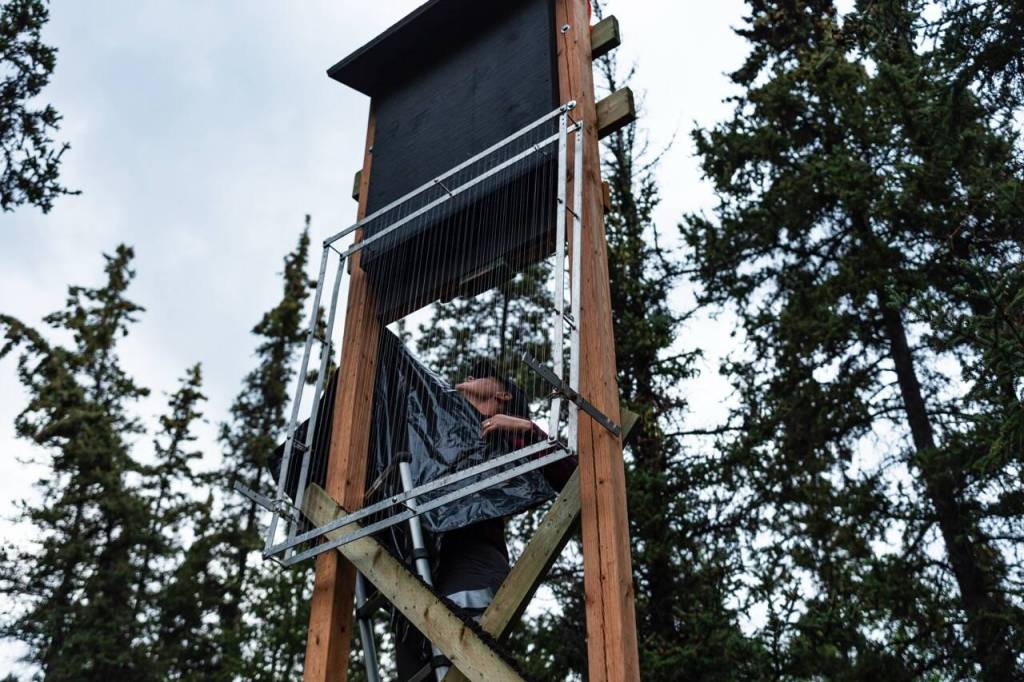
Yukoners got the opportunity to get up close and personal with one the territory’s most seldom seen mammals last Friday during a public bat banding event put on by the Yukon Department of the Environment.
Held near Chadburn Lake, the event provided a window into a rarely seen corner of the department’s wildlife study programs.
Roughly 20 people attended the event, following education and outreach staff from Yukon Environment, into the darkened forest in search of the territory’s only flying mammals.
Staff led the group down roughly half a kilometre of trails to the site of a bat box setup as part of the department’s ongoing bat research program. Once there, staff set up a bat trap underneath the entrance and exit of the house.
Consisting of a square metal frame strung with a two layers fishing line, the aptly named harp net looks exactly like its namesake instrument. A catch bag is suspended below to catch the bats as they fall down the net’s strings. To ensure the tiny creatures are directed into the trap, a black garbage bag is draped from the exit hole opposite the net.
Once the bats had been entrapped, they were gently removed for examination and banding.
Wearing thick leather gloves to protect her fingers from the animal’s tiny teeth, Education and Outreach Biologist Carrie McClelland demonstrated a typical examination and banding procedure.
The animals’ wings were measured with a set of calipers before McClelland turned the tiny creatures on their backs to determine their sex and whether the female bats were actively nursing or not. Those bats not already sporting a band received one before being released back into the wild. The tiny bands consist of a thin strip of malleable metal with an identification number etched onto them. The bands are gently clamped around the front of the bat’s wing. The whole process is designed to be as minimally invasive as possible and the bands do not affect the animal’s ability to fly.
Throughout the roughly two hour long event, attendees learned about the Yukon’s most numerous bat species, the Little Brown Bat.
Listed as an endangered species in Canada, little brown bats have seen significant declines in population across much of their historical range. The only mammals capable of true, powered flight, the nocturnal animals are sometimes assumed to be a type of rodent. In fact, bats belong to an entirely unique biological order called Chiroptera.
During the summer months, female bats roost in colonies of up to several hundred where they can use communal body heat to keep their roosts at a toasty 23-35 degrees, according to the Canadian Wildlife Federation and Yukon Environment. Like all mammals the baby bats feed on milk from their mothers. The pups begin to wean at around 4-6 weeks when they become strong enough to learn to fly and catch insects for themselves.
Once the bats are able to fly and feed on their own they become independent, striking out on their own around the same time the colonies break up for fall migration. Male bats roost alone or in small loose groups and typically only interact with the females during mating in the fall.
Here in the Yukon, the tiny mammals play an important role in the ecosystem. According to Tom Jung, a Senior Wildlife Biologist and head of Yukon Environment’s bat program, the animals help to control populations of flying insects that daytime predators might otherwise miss.
“Most of the birds that eat insects go to sleep in the evening, like us,” Jung said.
“Bats provide the night shift. They’re the ones out there eating mosquitoes, [and] moths and things of that nature. So, without bats, we wouldn’t have control or regulation of some of the nightly flying insects.”
While for many,awareness of bats in the Yukon may be brand new, the study of bats in the Yukon goes back roughly 30 years. The first bat surveys happened in the late 1990s and the Department of Environment’s program dates back to 2004.
According to Jung, the program was among the first of its kind in the North and was established to help advance scientists’ knowledge in order to better understand how best to protect what remains of their struggling populations across Canada.
The work is also part of Yukon Environment’s efforts to monitor and educate Yukoners about lesser known, non-game species in the Yukon, with bats being of particular interest given their often close or even overlapping proximity to humans.
“They’re wildlife that maybe Yukoners may not be so aware of, that we live often in very close proximity to. They live in our communities, sometimes in our buildings,”Jung said.
“Providing information on how they make their living here, and how well their populations are doing, enriches a lot of Yukoner’s [understanding of] the wildlife we live with.”
Jung said that in addition to learning more about bats through events like the one held last week, he hopes this work will motivate Yukoners to take a proactive role in helping bat conservation.
Working to avoid disturbing bat colonies during the day and keeping important habitats such as dead trees and wetland areas intact are two ways that Yukoners can help protect bats.
Additionally, Jung said that those experiencing “coexistence issues” with bats roosting in their homes should consider installing a bat box.
“Install bat houses to provide an alternative place for the bats to go.”
According to Jung, active help from the public remains the best way to protect bats.
“The conservation is done at a community or individual level here in the territory, but with a lot of Yukoners participating.”
Contact reporter Noah Korver at noah.korver@yukon-news.com