
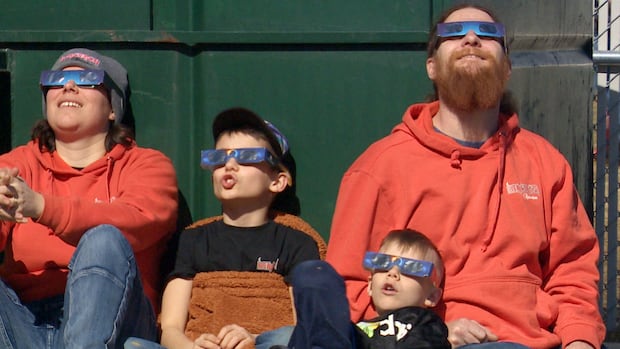
Amateur astronomers and space enthusiasts gathered in parts of New Brunswick Wednesday afternoon for a front-row seat view of a partial solar eclipse.
Olivia Ingalls, 14, who lives in Grand Manan, was among those to went to Irving Nature Park, where a local group — Astronomy by the Bay — was holding a watch event.
“I go stargazing with my grandfather a lot,” she said.
“And this is our first time coming to an Astronomy by the Bay event and I think this is our first time observing a solar eclipse together.”
While a total solar eclipse was visible across Greenland, Iceland and Spain, along with a very small part of Portugal, Atlantic Canadians got to see the moon partially obscure the sun.
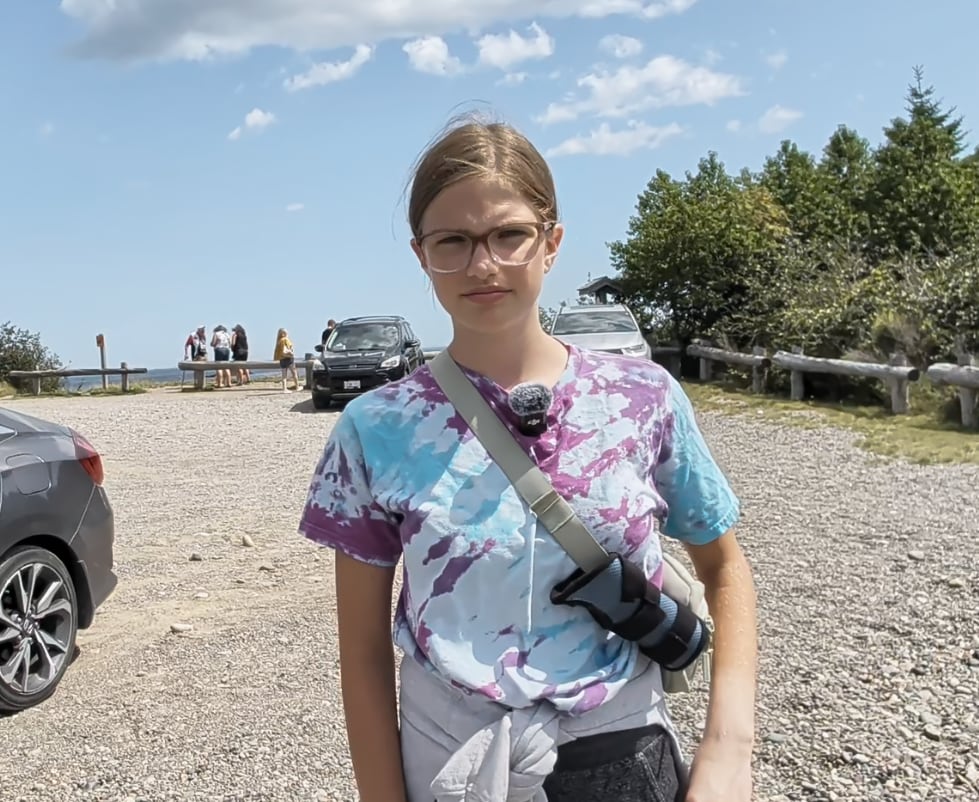 Olivia Ingalls, a 14-year-old resident of Grand Manan, went to Irving Nature Park in Saint John with her grandfather to watch the eclipse. (Nipun Tiwari/CBC)
Ingalls said she reads about astronomy in her spare time and has watched a total solar eclipse in the past.
“We drove up to Fredericton to go see it,” she said.
“It’s amazing how big the universe is and how beautiful and vast it is and how many stars are out there.”
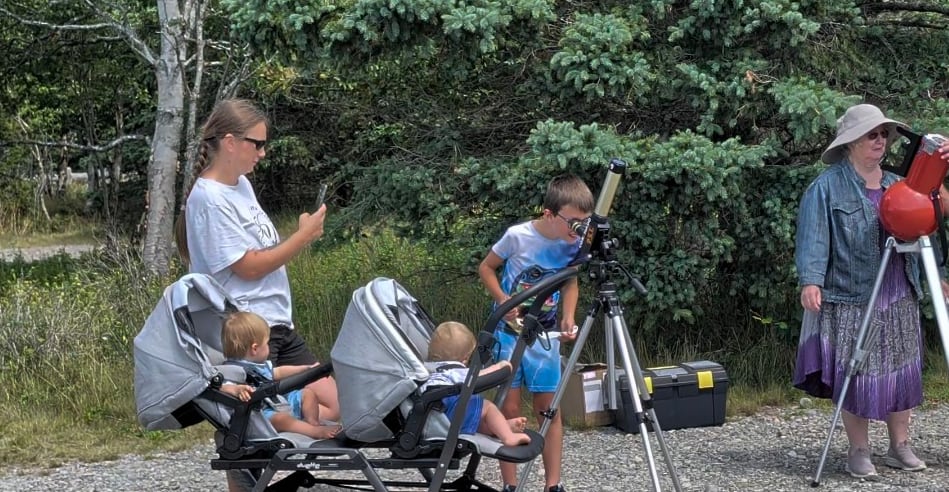 Roughly 20 to 30 people gathered in Saint John’s Irving Nature Park to watch the eclipse. Many came with telescopes and other viewing equipment. (Nipun Tiwari/CBC)
Chris Curwin, a Saint John-based amateur astronomer who runs Astronomy by the Bay, calls the event “magical”.
“To me, the best things in nature are free. Moon rises, moon sets, aurora, meteor showers, eclipses — all that’s free. You don’t need anything special.” he said.
“I’d like to show people how simple things can be when you want to get outside and look up.”
Curwin livestreamed the eclipse for TimeandDate.com — having done something similar last year in Moncton during a partial eclipse.
“The moon is either usually five degrees above us or five degrees below us in a path that we call the ecliptic — that’s the path that the sun and moon … take across the sky,” Curwin said.
“So, the moon has to be completely lined up, and obviously it has to be the right distance away from us to make sure that it can actually block out the disc of the sun.”
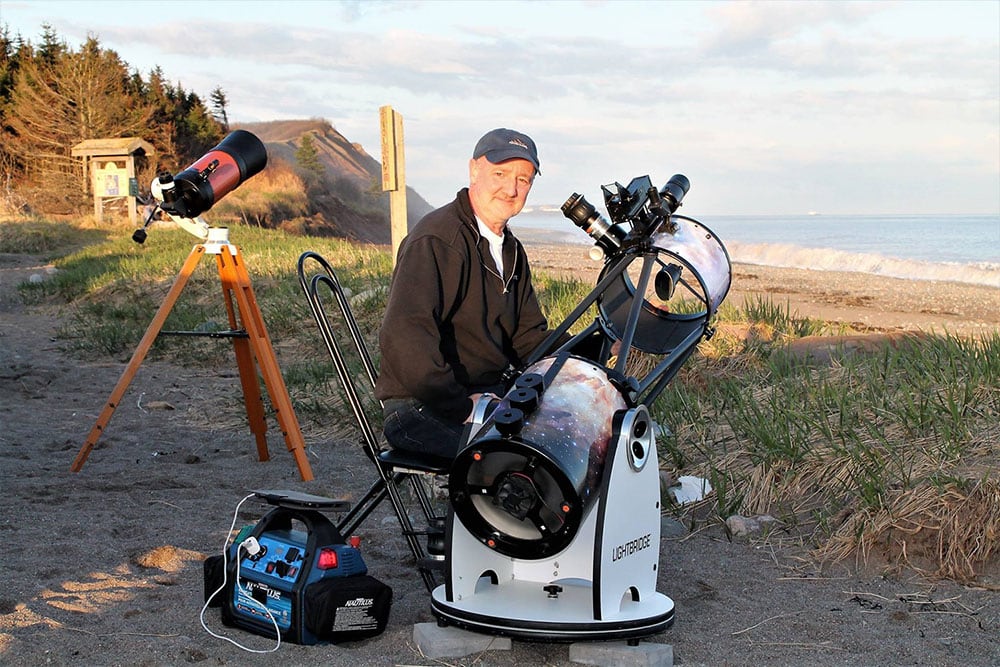 Amateur astronomer Chris Curwin. (Paul Owen)
According to TimeandDate.com, different locations had slightly different start times. In Edmundston, the eclipse began at 1:48 p.m. (AT) with maximum eclipse at 2:49 p.m.
But in Saint John, the eclipse began at 1:55 p.m. (AT) and reached maximum coverage at 2:55 p.m.
In Fredericton it began at 1:52 p.m. (AT), and in Moncton at 1:53 p.m. (AT).
People watching the eclipse were told they needed to wear solar eclipse glasses.
Before the eclipse, Dr. Alexis Keeling, an optometrist in Dieppe, said the glasses that were distributed during the 2024 event were still good to use. She said the glasses should have the number ISO 12312-2 on them, which is an international standard number that certifies the glasses are safe.
Keeling said the glasses have a special coating that protects the retina, and more specifically, the macula — a small area located near the centre of the retina in the back of the eye.
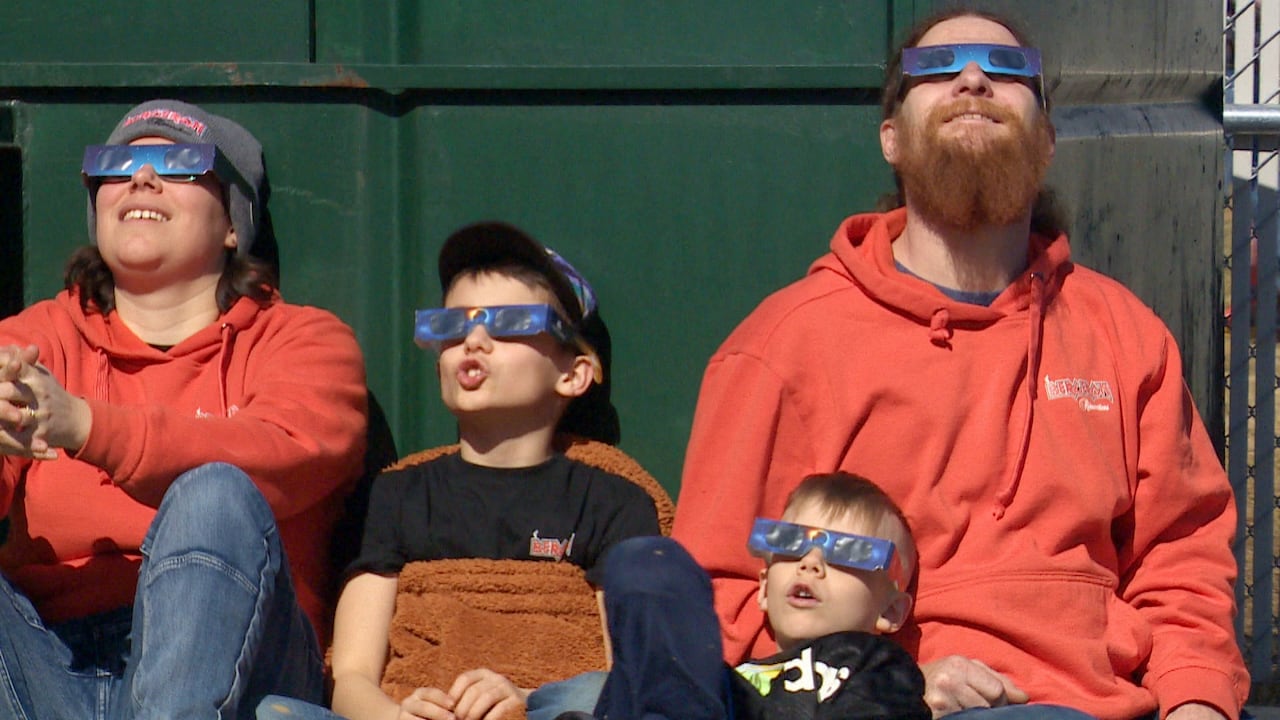 A family in Florenceville-Bristol in April 2024 watches the eclipse in its partial phase using eclipse glasses. An optometrist is warning people to use eclipse glasses on Wednesday if they want to watch the partial solar eclipse. (Ed Hunter/CBC)
She said looking at the sun during a solar eclipse can damage or burn the retina and symptoms won’t show until about 12 to 24 hours after looking at the sun.
“If there’s damage that’s done, it usually happens the next morning,” she said. “The person wakes up and notices a big black spot in their central vision, and that’s why it’s imperative we do not look at the sun unless we’re wearing specialty-approved glasses.”
Keeling said she is also very happy that during the huge total solar eclipse in April 2024, there wasn’t a single reported case of solar retinopathy in the province. The condition is called solar retinopathy when someone gets a burn from looking at the sun, Keeling said.
She said this causes irreversible blindness, and no medication or surgery can restore the lost vision.
“I’m proud of all the New Brunswickers who took the precautions, who had fun, who enjoyed the day and enjoyed the eclipse, and made sure to wear their specialty solar eclipse glasses,” Keeling said.
Perseids meteor shower
And the partial eclipse won’t be the only astronomical event on Wednesday.
The Perseids meteor shower is often considered one of the best of the year because of the number and brightness of its meteors, along with the usually favourable viewing weather.
The Perseids will peak late Wednesday night and into Thursday morning, Curwin said. He said the best time will be between 2 a.m. (AT) and 4 a.m. For people who might not be able to get out at that time though, Curwin said people will still likely be able to see some activity on Wednesday night around 10 p.m.
While it happens annually, Curwin said this year is probably one of the best in the past 10 years.
“We’re on the day of a new moon, of course,” Curwin said. “That means there’ll be no moon in the sky, which means that you’re going to get the darkest skies possible. So you’ll be able to get the maximum show this year with no moon in the sky.”
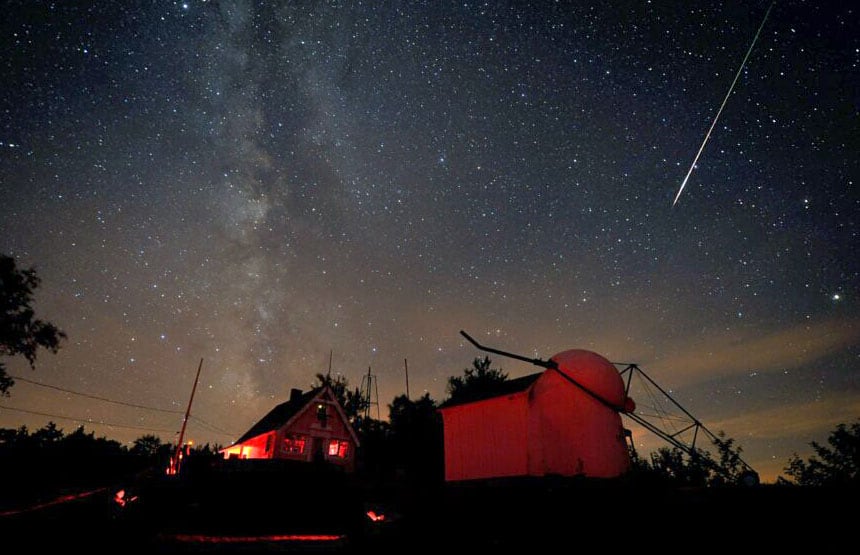 A bright Perseid meteor is seen here over buildings at the Stellafane amateur astronomy convention in Springfield, Vermont. This year, a new moon means even faint meteors may be seen. (Sky & Telescope/Dennis di Cicco)
Curwin said people should go to a dark area and give their eyes a chance to adjust to the darkness to have the best chance at seeing the shower.
Curwin said there will be a public observation event on Wednesday for the eclipse and Perseids in Saint John. He said they’ll be at Irving Nature Park in the upper parking lot with telescopes for people to safely look at the sky from 1:30 p.m. to 4 p.m. Then, they’ll be back from 9 p.m. to 11 p.m. with around 28 telescopes set up to wait for the meteor shower.
“To have two events like this right close together and have the opportunity … to share it with others is my goal,” Curwin said.