
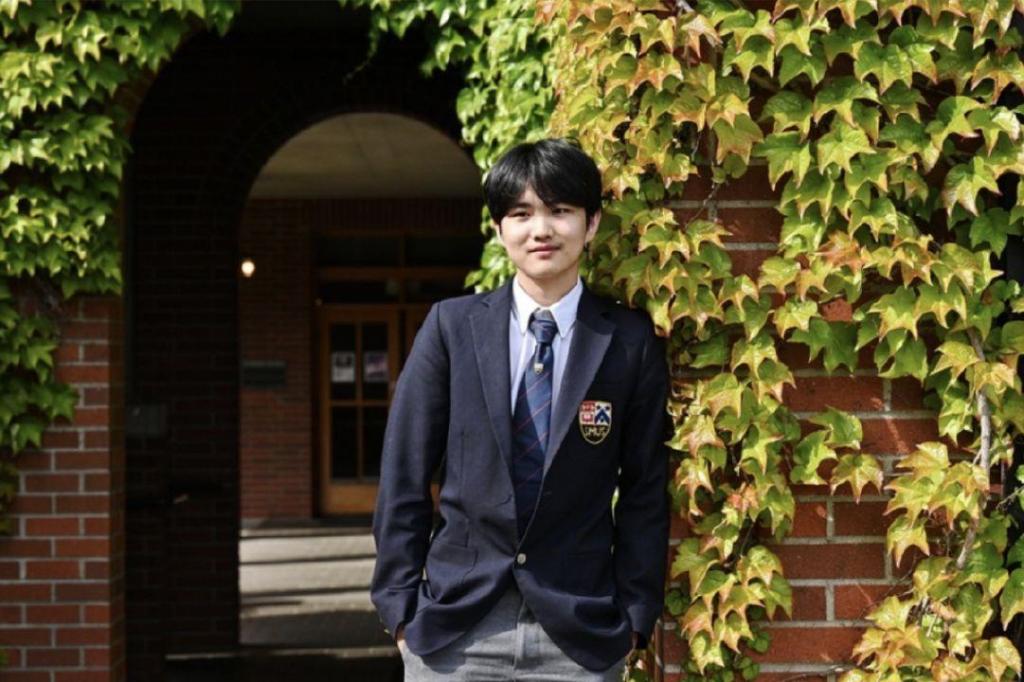
Saanich teen wins international award for galaxy-plotting AI model
Published 4:00 pm Wednesday, August 12, 2026
A Saanich student is being recognized for his work with AI and astrophysics as one of 10 award winners who were chosen from 3,400 applications across the globe.
On Wednesday, Aug. 12, St. Michaels University School student Jared Qin was named a winner of the 2026 Leaders of Today Award, awarding him a $1,000 grant to further a potentially groundbreaking AI model he developed that finds galaxies that have collided.
“When I found out about this award, you only have to write a paragraph. It doesn’t look at your actual recognitions, how old you are, what college you [go to], it’s [based on] pure ability,” said 16-year-old Qin. “I really was just having this mindset of ‘I’m just gonna shoot my shot,’ and I had zero expectations of winning this grant. It was just crazy.”
In simple terms, a galaxy merger is when two galaxies merge – a normal process that is fundamental to measuring how galaxies change over time.
Recently, the James Webb Telescope took a deep-sky survey that found some galaxy mergers and supermassive black holes that have existed earlier than scientists have previously thought.
“This is basically saying that our entire understanding of astronomy is all wrong. Our entire understanding of the history of the universe is all wrong,” he said. “And one of the major hypotheses is that we’re under-counting the amount of galaxy mergers, because when two galaxies merge, they become bigger. So if we found bigger ones earlier, that means that there must have been more mergers that happened.”
His AI model learns inside simulated universes where the collisions are already labelled by the international community, then it’s turned onto real telescope images to pull out the ones everyone had labelled as normal galaxies.
His biggest barrier, he says, is the fact his model is used on a laptop, while scientists elsewhere are using expensive supercomputers.
“Currently the best performing classifier that is looking for galaxy mergers is trained on very high-level deep machine learning in big supercomputers with a lot of money that don’t use my feature,” he said. “And if they use my feature with the same amount of training that they have, then we would be able to have exponentially more recoveries, and we would be able to exponentially understand the universe better.”
With his grant, he hopes to expand his model from his laptop to something that can be trained to be used by some of the leading minds in astrophysics and astronomy.
“Most awards go to young people who already have everything. We built this one for the 99 per cent who do not usually win awards, and Jared is exactly why,” said Ziyaan Virji, co-founder of Leaders of Today, in a news release.
Like many, Qin looks at the sky and sees potential. With the effects of climate change increasing and an ever-crowded planet, humanity’s future is in space, he says.
“When galaxies merge, they directly affect all the elements we know; they affect the possibility of life on alien planets, they affect whether or not we’ll be able to travel out of our galaxy, whether or not we’ll be able to talk with alien civilizations,” he said. “These big problems, people think that they can ignore them, but they’re still always going to be in the back of their minds, and if the normal person is not going to care about it, then researchers and teams are going to care about it.”