
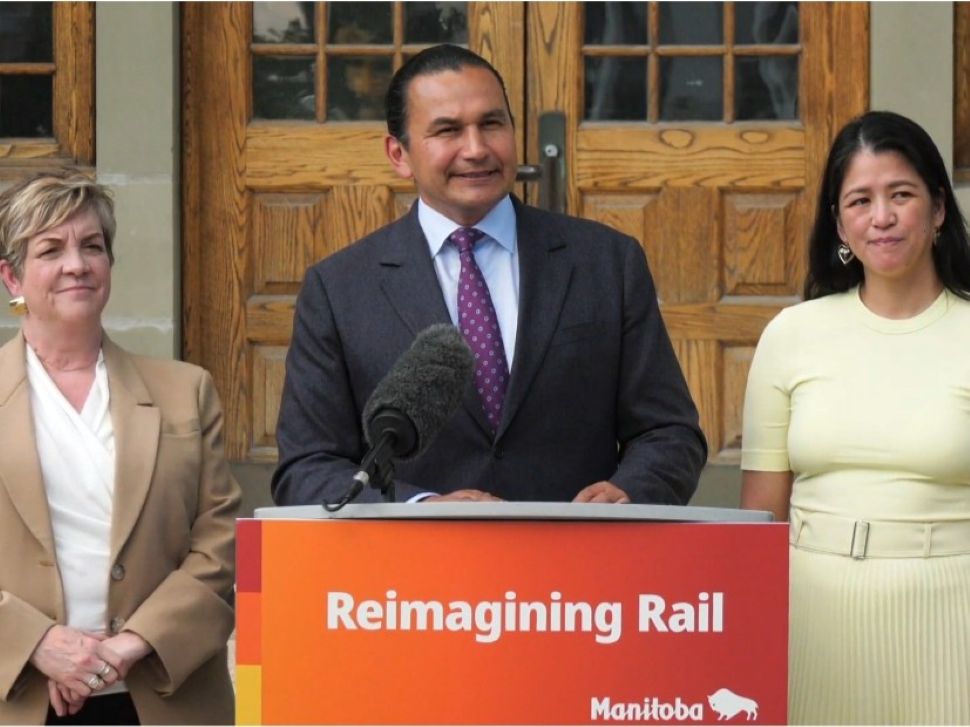
The Manitoba government is moving ahead with a three month feasibility study examining a proposed southern rail bypass that could eventually move more freight traffic outside Winnipeg’s urban core.
Premier Wab Kinew announced the study Wednesday, saying the long-term vision could also create opportunities for housing, green space, recreation, and economic development within Winnipeg.
“This is a vision for the future,” Kinew said. “It’s an exciting vision for the future of Winnipeg. It’s an exciting vision for the future of Manitoba.”
Related Stories:
The proposed bypass would run along an existing Manitoba Hydro transmission corridor south of Winnipeg, connecting east to west near the Perimeter Highway.
The study will be chaired by Lloyd Axworthy, former federal minister and former president of the University of Winnipeg. Axworthy previously led the Winnipeg Rail Relocation and Renewal Study launched in 2024.
Existing corridor could ease land challenges
Axworthy said using the existing Manitoba Hydro corridor could reduce some of the land acquisition and expropriation challenges that have affected other rail relocation projects.
“What makes this one work is it’s a bypass that will be built inside the corridor of the Manitoba Hydro,” Axworthy said.
The feasibility study will examine whether freight rail operations could be moved outside residential areas while maintaining safe and effective rail service.
It will also consider the project’s costs, potential economic benefits, and whether the proposal would be operationally and commercially practical for railway companies.
Canadian National Railway, Canadian Pacific Kansas City, and BNSF Railway will be involved, with senior technical representatives from each company providing information about infrastructure and operations.
The province also plans to consult with municipal and Indigenous governments, CentrePort Canada, businesses, rail customers, and shippers.
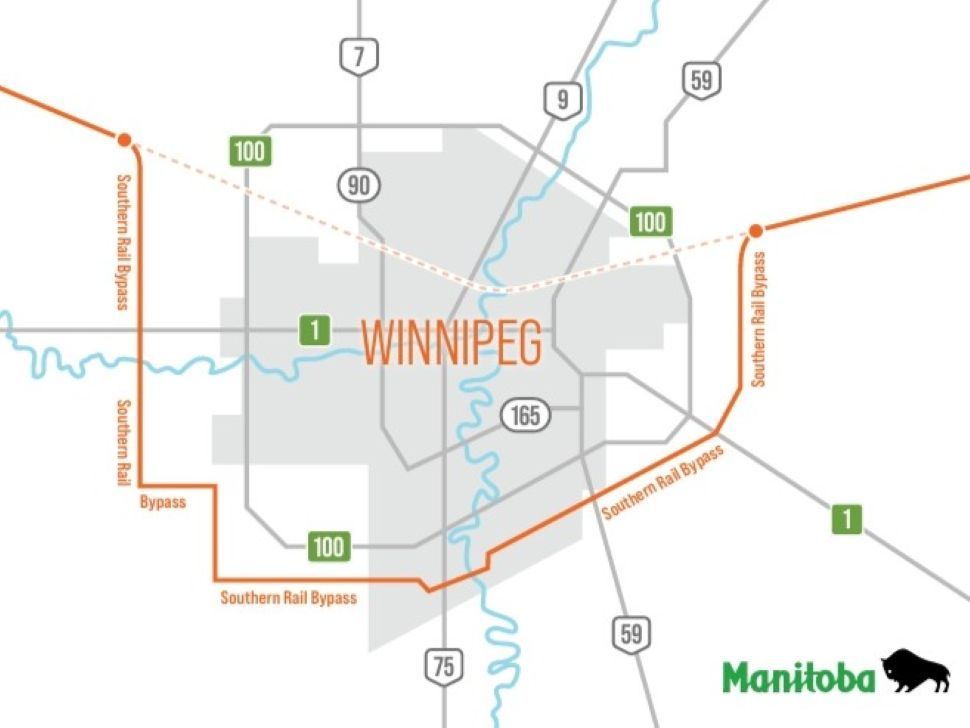 Winnipeg Southren Rail Bypass (Province of Manitoba)
Rail relocation could create new development opportunities
Transportation and Infrastructure Minister Lisa Naylor said Winnipeg’s rail network has played an important role in the city’s growth, but infrastructure needs to evolve as the city expands.
“Good infrastructure planning is about building the kind of communities that we want to live in,” Naylor said.
The province says moving rail infrastructure could eventually free existing corridors for housing, parks, trails, green space, and other development.
Kinew pointed to rail infrastructure near Polo Park as one potential example of land that could eventually be repurposed.
The proposal also includes examining a possible greenbelt along the Perimeter Highway alongside the proposed rail and Hydro corridors.
The province says the greenbelt could help protect agricultural land and infrastructure while creating opportunities for ecological corridors, trails, recreation, and Indigenous stewardship.
Province sees decades-long project
Axworthy said the proposal could have broader economic implications for Manitoba.
The province says comparisons with rail bypass projects in other North American cities suggest an effective bypass could produce benefits exceeding its costs, including new tax bases, reduced grade-crossing maintenance, and improved rail operations.
Axworthy also said Winnipeg could increasingly play a role in north-south trade connecting the Port of Churchill with markets farther south, in addition to its historic role as an east-west transportation centre.
The project is expected to take decades rather than years. Kinew described it as a potential 20-year plan that could require billions of dollars in investment.
“Billions of dollars over a 20-year timeline, that’s an investment that we can afford, and that’s an investment in our future,” Kinew said.
The feasibility study is expected to be completed around November or December. A subsequent phase would examine environmental, regulatory, and technical requirements, along with further discussions with the rail companies and other partners.
Manitoba Hydro already owns the proposed corridor, but environmental assessments and regulatory approvals would still be required before construction could begin.
The province says the immediate goal is not construction, but determining whether there is a viable business case for moving forward.
“This feasibility study is about asking the right questions today so that we can make smart decisions tomorrow,” Naylor said.