
Tribunal rules driver not at fault in 2024 Surrey crash, orders ICBC to amend records
Published 4:00 pm Thursday, August 13, 2026
The Civil Resolution Tribunal (CRT) has ordered the Insurance Corporation of British Columbia (ICBC) to amend its claim that a Surrey driver was fully at fault for a 2024 crash.
In a decision posted by the CRT on Wednesday (Aug. 12), tribunal member Christopher C. Rivers said ICBC must amend its records to find Ameen Akinola Abass-Opere 0 percent responsible for the June 20, 2024 crash and pay him $125 within 14 days to reimburse his tribunal fees.
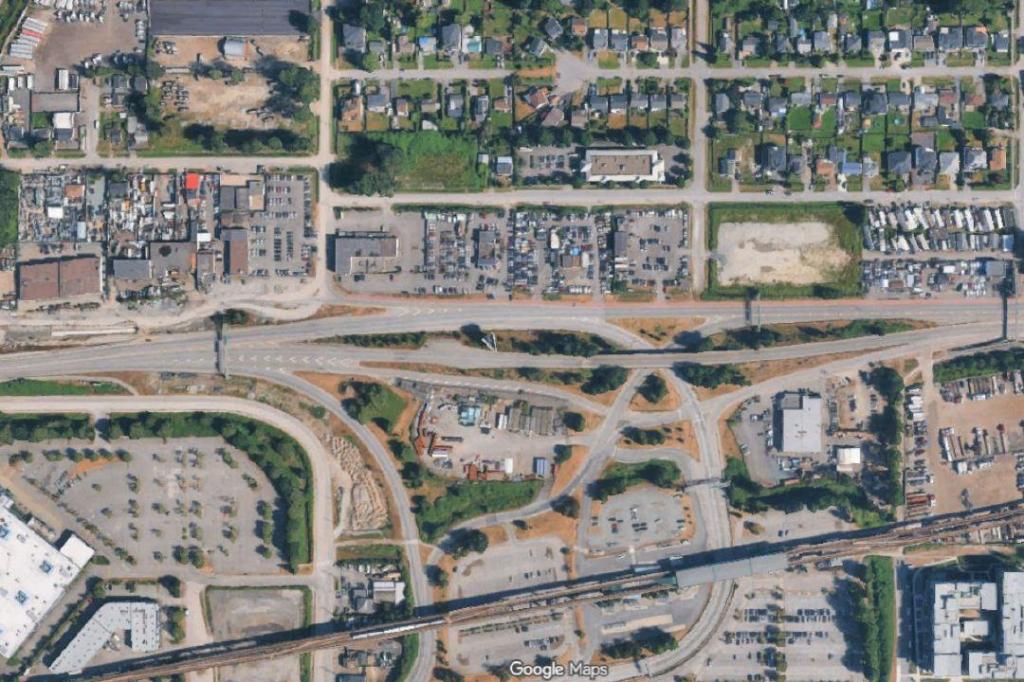
The crash occurred on June 20, 2024, as Akinola attempted to merge onto King George Boulevard from the Scott Road/120 Street on-ramp, and he was struck by a semi-truck and trailer. The decision names the driver as HB.
Traffic was heavy at the time of the crash, with vehicles in the merge lane and King George Boulevard travelling slowly before merging in a “zipper fashion.”
Akinola was driving a Tesla equipped with cameras that captured the crash.
“In the instant immediately before impact, the driver’s-side rear-facing camera showed the semi-truck bumper was behind Tesla’s rear tire. The semi slowed, with the Tesla almost entirely ahead of it. The Tesla slowed, nearly to a stop, but the semi continued forward and rubbed the Tesla’s back left corner with its front right bumper, at or just behind Tesla’s rear tire. The semi then stopped abruptly, the Tesla moved forward, and the drivers pulled over to exchange information,” reads the decision.
ICBC originally found Akinola 100 per cent at fault and cited “Motor Vehicle Act (MVA) section 151, which prohibits a driver from changing lanes unless they can do so in safety and in no way affecting the travel of another vehicle.”
ICBC also described Akinola as the “servient driver” as he was merging into the “dominant driver’s”/HB’s lane. So the onus was on Akinola to prove why the semi-truck was negligent.
Akinola claimed that ICBC had not properly investigated the crash and had made its decision before viewing the dashcam footage and collecting all the evidence.
The tribunal did not consider ICBC’s initial decision but reviewed ICBC’s CL722 form, which includes “a detailed responsibility assessment” issued by the Responsibility Review Team.
Rivers found that the review team had done a proper investigation but found ICBC’s decision “unreasonable.”
“The rules of the road, including the MVA’s provisions and the dominant/servient principle, are informative in determining responsibility. However, I must also consider the reasonableness of each driver’s actions,” Rivers said.
He found that ICBC did not address Akinola’s arguments regarding the semi-truck driver’s negligence.
“Akinola argues that HB rear-ended his Tesla, so I should presume HB was 100% liable. However, I agree with ICBC that while HB was largely behind Mr. Akinola, they were not fully behind him, such that the accident was a rear-end collision,” Rivers said. “I agree, generally, with Mr. Akinola that a commercial driver has an obligation to be aware of vehicles in any blind spots it may have. I find that is especially the case when a vehicle has travelled beside, and in front of, a truck for an extended period of time, as Mr. Akinola had.”
Akinola had expected that HB would let him merge into his lane, just as other drivers in front of him had done.
“While this does not give Mr. Akinola an undisputed right to the left lane, I find that pattern should have alerted HB to the possibility a vehicle would merge in the space ahead,” Rivers said. “As ICBC wrote in its CL722, after the crash, Mr. Akinola asked HB, ‘Didn’t you see me?’ HB said he told Mr. Akinola, ‘Your lane merges into my lane.’ I find HB’s response suggests HB was focused on their strict entitlement to the lane instead of on preventing an accident. Notably, HB never told ICBC they did not see Mr. Akinola.”
As a result, Rivers found Akinola 0 per cent responsible for the crash.