
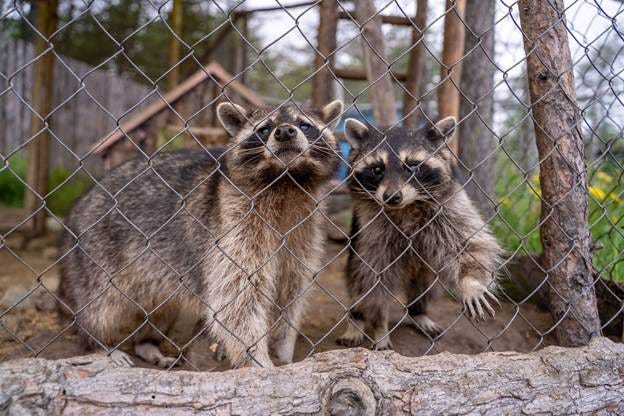
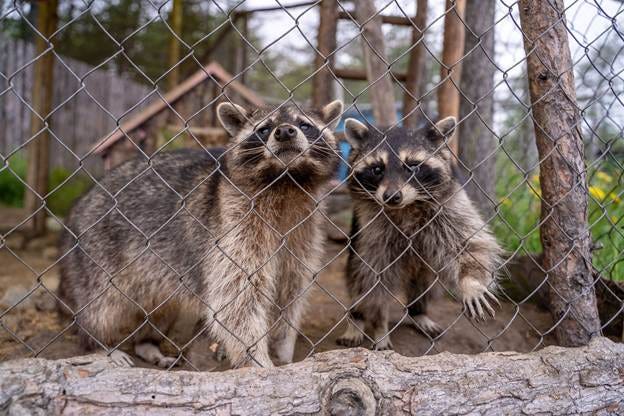
Two raccoons stand behind a wire fence. Quebec is offering financial assistance to eligible livestock producers for rabies vaccination as raccoon rabies continues to spread in southern Quebec. (Photo: Sejio402/Pexels)
Get local news like this every morning. Subscribe free below.
Eastern Townships livestock producers can receive financial assistance covering up to 100 per cent of eligible veterinary costs for rabies vaccination as Quebec responds to a continuing spread of raccoon rabies in southern parts of the province.
The latest provincial surveillance map, updated Aug. 6 by the Ministry of the Environment, the Fight Against Climate Change, Wildlife and Parks, showed 139 confirmed cases of raccoon rabies in Quebec since the beginning of 2026. A total of 1,320 specimens had been collected through the province’s surveillance program.
Meanwhile, the Ministry of Agriculture, Fisheries and Food, or MAPAQ, is offering a special vaccination measure through Quebec’s Integrated Animal Health Program, known as PISAQ.
According to MAPAQ, registered agricultural operations in every municipality in Estrie and Montérégie, along with designated municipalities in Centre-du-Québec, can qualify if they raise cattle, goats, sheep or pigs kept outdoors.
The assistance can cover up to 100 per cent of costs related to veterinary support and vaccination against raccoon rabies. The vaccination must be carried out by a veterinarian.
MAPAQ has classified rabies as a priority animal-health issue under PISAQ as the outbreak continues in southern Quebec.
In an Aug. 4 notice to veterinarians, MAPAQ said there had been a significant progression of raccoon rabies in two active outbreak areas, in Estrie and Montérégie. The ministry urged veterinarians to assess the exposure risks faced by livestock, including animals kept on pasture, and to discuss vaccination with producers.
The provincial response extends beyond farms.
Quebec has continued wildlife surveillance and vaccination operations intended to slow the spread of the virus. The Environment Ministry said in July that cases had progressed substantially in Montérégie toward the south shore of Montreal and Centre-du-Québec, while the outbreak centred around Stanstead in the Eastern Townships had expanded toward the Magog area.
Restrictions on moving certain live wild animals have also expanded.
Quebec’s current restriction list says raccoons, striped skunks, grey and red foxes, coyotes and their hybrids cannot be moved or relocated in municipalities surrounding known raccoon-rabies cases. Additional municipalities became subject to the restriction Aug. 7, and the prohibition is scheduled to remain in effect until Oct. 6, although the province says it could be extended.
Provincial officials have warned that relocating nuisance, injured or apparently orphaned wildlife can contribute to the spread of rabies. The government has said relocation may have contributed to the significant progression observed in parts of Estrie and Montérégie since spring 2026.
For farmers, MAPAQ is recommending vaccination alongside biosecurity measures intended to reduce contact between domestic and wild animals.
In a July 7 notice to producers, MAPAQ recommended blocking openings in farm buildings, securing garbage and compost containers and removing food sources that could attract wildlife near agricultural buildings and silos. The ministry also stressed the importance of preventive vaccination for both livestock and companion animals.
The government is asking residents in affected areas to report raccoons, skunks and foxes that are dead or appear disoriented, injured, unusually aggressive or paralysed. Reports can be made through Quebec’s online reporting form or by calling 1-877-346-6763.
Provincial health guidance also calls for precautions following possible human exposure.
According to the government, anyone bitten or scratched by an animal, or exposed to its saliva, should immediately wash the affected area with soap and water for 10 to 15 minutes and contact Info-Santé 811 for medical guidance.
MAPAQ is directing eligible livestock producers interested in the vaccination assistance to speak with their veterinarian, who can assess the farm’s situation and determine how the PISAQ measure applies.
Don’t miss the next story that affects your community.
Join thousands of readers getting The Pulse every morning—plus breaking news alerts when it matters most.
If you value this kind of local journalism, consider supporting it.
Subscribe, share and like!