
Navigating the salary cap is one of the most important tasks for a front office. Teams that can avoid total cap chaos by walking the tightrope of inking players to deals that match their value (or compensate for future value without breaking the bank) remain successful. Those who don’t often see struggles and front office changes.
As we do each year, PHR will look at every NHL team and give a thorough look at their cap situation for the 2026-27 season, though in a slightly different format than before. This will focus more on players who are regulars on the roster versus those who may find themselves shuttling between the AHL and NHL. All cap figures are courtesy of PuckPedia. We begin our series with a look at the Central Division, next up are the Jets.
2026-27
Upper Limit: $104MM
Current Cap Charge: $99,518,332
Cap Space: $4,481,668
Potential Bonuses: $1.43MM (most are unlikely to be reached)
Dead Cap: None
Expiring Contracts (RFA): F Brad Lambert ($886,666 + $375K in ‘A’ bonuses), D Elias Salomonsson ($865K + $55K in GP bonuses)
Lambert got an extended look with the Jets down the stretch and should have an inside track at a roster spot in training camp, albeit in a limited enough role to make his bonuses unlikely. He’s not a viable candidate to sign long-term; a one-or-two-year bridge deal in the $1.5MM range might make the most sense.
Salomonsson also got a look down the stretch and did well enough to garner full-time consideration this season which gives him a chance to reach at least some of his bonuses. Assuming he can lock down a regular role, a bridge deal for him should push past the $2MM mark.
Expiring Contracts (UFA): F Morgan Barron ($1.85MM), D Haydn Fleury ($950K), F Vladislav Namestnikov ($3MM), F Nino Niederreiter ($4MM), Jack St. Ivany ($850K)
Niederreiter is coming off a year to forget offensively although for now, it’s a one-off. If he goes back to being a 30-point player or so, he could still land something reasonably close to this, perhaps in the $2.75MM to $3MM range. If his struggles continue, however, he might be closer to PTO territory. Namestnikov fared even worse, although, like Niederreiter, it could just be a blip. If so, he could stay around his number. If not, he’ll be closer to the league minimum; his ability to play center in a pinch gives him a bit more utility. Barron, meanwhile, just had his best season while the market for bottom-six middlemen has taken off. It wouldn’t be shocking for his camp to point to Jack Drury’s five-year deal at $4.5MM per season as a possible comparable for his next contract.
Fleury has done well enough to stay on an NHL roster for nine years but he has typically been in the seventh role. While that’s enough to secure another one-way deal, it shouldn’t cost much more than the minimum salary. St. Ivany is less proven and was only able to secure a minimum-salary pact this summer. A small raise (beyond the increase in the minimum) could be doable but neither blueliner should come in above around $1.25MM barring a breakout.
2027-28
Projected Upper Limit: $113.5MM
Current Cap Charge: $86,266,666 (16 players signed)
Cap Space: $27,233,334
Potential Bonuses: $1MM (possible some of the ‘A’ bonuses are reached)
Dead Cap: None
With no real pricey contracts to contend with next summer, GM Kevin Cheveldayoff will have ample flexibility to add to his roster. That said, given their challenges enticing free agents to sign with them, there’s no guarantee he’ll necessarily be able to do so.
Expiring Contracts (RFA): F Isak Rosen ($925K)
Rosen came over from Buffalo at the trade deadline and played regularly down the stretch, albeit with limited ice time. It’s hard to see him pushing for top-six minutes over the next couple of seasons so he’s another player where a bridge deal likely makes sense. If he’s a full regular over that stretch, it could push past the $2MM mark.
Expiring Contracts (UFA): D Dylan DeMelo ($4.9MM), F Alex Iafallo ($3.666MM), F Cole Koepke ($1.45MM), D Josh Morrissey ($6.25MM), D Dylan Samberg ($5.75MM), G Stuart Skinner ($3.75MM)
Iafallo has ranged between 27 and 37 points over the last six seasons and could be on the fringe of either securing a small raise or being squeezed out if the 2028 summer operates like this one has. He operated with that mindset when he signed this deal, one that was actually a small pay cut to secure the three-year guarantee. Koepke is a bit of a late bloomer in terms of emerging as a regular fourth liner which didn’t help his market this summer. If he has two more years like his last two, however, he should push past the $2MM mark per season on another multi-year agreement.
 Morrissey is going to be the big one that the Jets have to contend with in the near future. From a contract perspective, doubling his current AAV feels like a lock. In reality, it’s how much more beyond $12.5MM they’re going to need to go for someone who is an all-situations number one defender for Winnipeg, and has been for several years now. A jump closer to the $15MM mark might be where he ultimately lands. He’ll be extension-eligible come July and it will be interesting to see if the two sides can work out an extension quickly. If not, it wouldn’t be surprising to see speculation pick up on the trade front.
Samberg has been a strong top-four defensive defender the last couple of years years although his offensive production has been rather limited. Still, that hasn’t hindered him much in contract talks thus far. Given that he’ll just be 29 when this deal is up, he should be able to cash in one more time with a longer-term pact that could trend toward the $7MM range. DeMelo has been a reliable second-pairing piece for several years now since joining the Jets although he’ll be 35 when his contract expires. Given the heavy game he plays, there could be some concern about injuries as he ages, but he should still be able to get a two- or three-year deal at this price tag.
Skinner has shown flashes of being a legitimate starter at times and others where he’s a fringe backup goalie. Accordingly, it wasn’t shocking that a true number one deal didn’t come his way but rather one for a higher-end second-stringer. If Skinner can become steadier and less inconsistent, there’s a pathway to a potential starting job and contract. Otherwise, this will be the price point he stays in.
2028-29
Forecasted Upper Limit: $123MM
Current Cap Charge: $63.425MM (9 players signed)
Cap Space: $59.575MM
Potential Bonuses: $1MM (possible some of the ‘A’ bonuses are reached)
Dead Cap: None
It’s going to cost considerably more for the Jets to keep their UFA group in the fold, more than covering the projected cap increase. While that shouldn’t stop Cheveldayoff from trying to add in the 2027 offseason, they may be more hard-pressed to add to the core in the 2028 summer if they can keep their blueliners, in particular, in Winnipeg.
Expiring Contracts (RFA): F Viggo Bjorck ($1.075MM + $1MM in ‘A’ bonuses)
Bjorck’s inclusion here could be premature if he doesn’t make the team out of training camp and ultimately defers the start of this deal. But all signs point to Bjorck getting a chance to play an impactful role early. If they ease him in, he may not hit his bonuses early in the contract but by 2029, it could be realistic if he’s in a top-six role. And if Bjorck’s in that role as a center, the sky is the limit on his second contract as we’re starting to see with quality young middlemen.
Expiring Contracts (UFA): D Mario Ferraro ($4MM)
Ferraro’s contract was one of the more reasonable ones signed in free agency as the long-term deal he was seeking never came to fruition. Barring a big role change with the Jets (if anything, he might play less now), his next contract should come in relatively close to this one.
2029-30
Forecasted Upper Limit: $133.5MM (8.5% increase)
Current Cap Charge: $54.5MM (7 players signed)
Cap Space: $68.5MM
Potential Bonuses: None
Dead Cap: None
If Bjorck pans out into the core piece the Jets think he can be, a big chunk of the forecasted increase to the cap could very well go to him. If they want to keep Ferraro as well, they may not be able to afford much more than that.
Expiring Contracts (RFA): None
Expiring Contracts (UFA): None
Signed For 2030-31 And Beyond
For that season, there will be a new CBA in place so trying to forecast the cap and cap space basically becomes a guessing game. Accordingly, we’ll go back to the old Deep Dive format for players signed beyond the 2030-31 campaign.
F Kyle Connor ($12MM through 2033-34)
G Connor Hellebuyck ($8.5MM through 2030-31)
F Adam Lowry ($5MM through 2030-31)
F Cole Perfetti ($6MM through 2030-31)
D Neal Pionk ($7MM through 2030-31)
F Mark Scheifele ($8.5MM through 2030-31)
F Gabriel Vilardi ($7.5MM through 2030-31)
Connor’s extension came last season, one that drastically reset Winnipeg’s salary structure. But top-line wingers who generally put up over a point per game are hard to come by and his deal falls in line with several recent comparable deals. He’ll be 37 when this deal is up so it’s unlikely he’ll be able to command more than this next time out. Scheifele has been a bargain through the first three years of his deal and that should continue for the foreseeable future. Even if he’s just a second liner at the end of the contract, that’s about where the market price should be.
Vilardi, when healthy, is a capable top-line threat but his injury history played a role in a non-max-term deal at a lower rate than some of Winnipeg’s other top players. Unlike Connor and Scheifele though, he’ll be young enough when this deal expires (entering his age-32 year) to still command a big raise if he continues on his current trajectory.
Perfetti signed his deal this summer coming off his bridge deal, one that left some questions after he struggled last season. This is reasonable money for a second-liner and there’s reason for optimism that he can get back to that level of production. He’ll be 29 when this deal is up, giving him a chance for a multi-million dollar increase if he can live up to his potential. Lowry’s deal will go okay if he can get back to 30-point form, not the 21-point performance from last season. He’s ideally a third liner and relative to some other recent contracts, it’s on the higher side, especially for someone who will be 38 when it’s done.
Pionk is coming off a tough year but his overall track record as a second or third option suggests he’ll rebound well. If that happens, they will get a solid return on his contract, one that will carry him through his age-36 season. If he’s still a 20-minute player, a small raise on a short-term deal could happen.
Hellebuyck’s future with Winnipeg has been a storyline all summer but no move has happened yet, at least. He’s coming off a down year (many Jets are, to be fair) but his reputation as an elite netminder is well-earned. From a value standpoint, this price tag for an elite starter is strong value, though there are concerns about how the final couple of years could go as he gets older. (Adding Skinner, capable of playing more than Eric Comrie, could help in that regard.) As long as he’s an above-average starter, they’ll be fine with this deal.
Outlook
In the short term, Cheveldayoff and the Jets should have some financial wiggle room to add to the core. But a bumper crop of 2028 UFAs will see either key pieces leaving or the team paying a lot more to keep them in the fold. In the latter scenario, Winnipeg could be tighter to the Upper Limit than they’ve been in recent years.
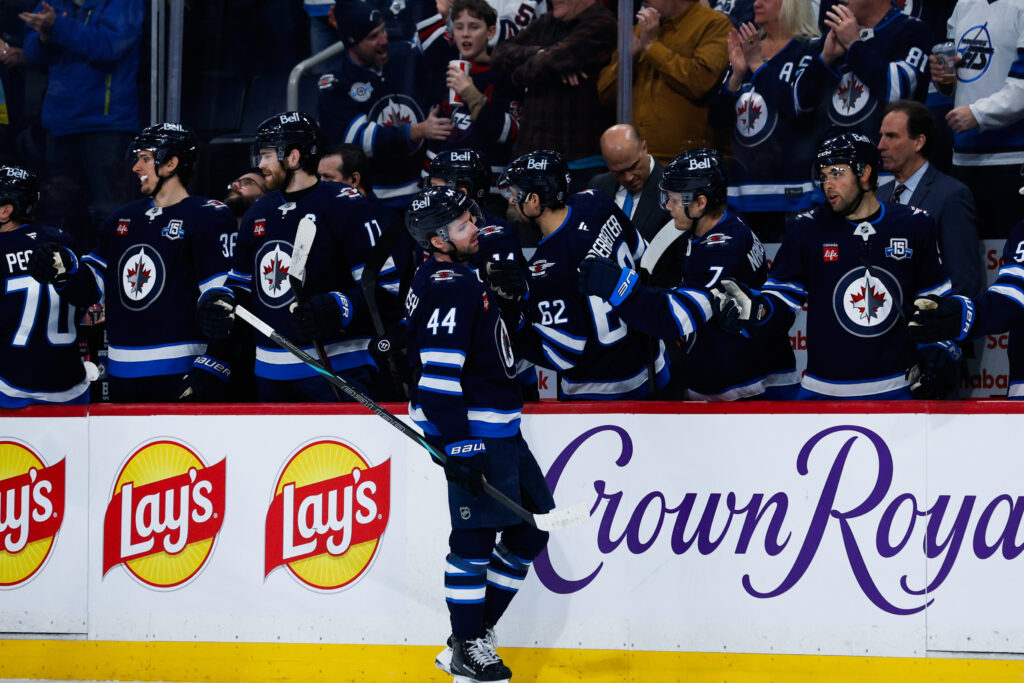
Photo courtesy of James Carey Lauder-Imagn Images via Reuters Connect.