
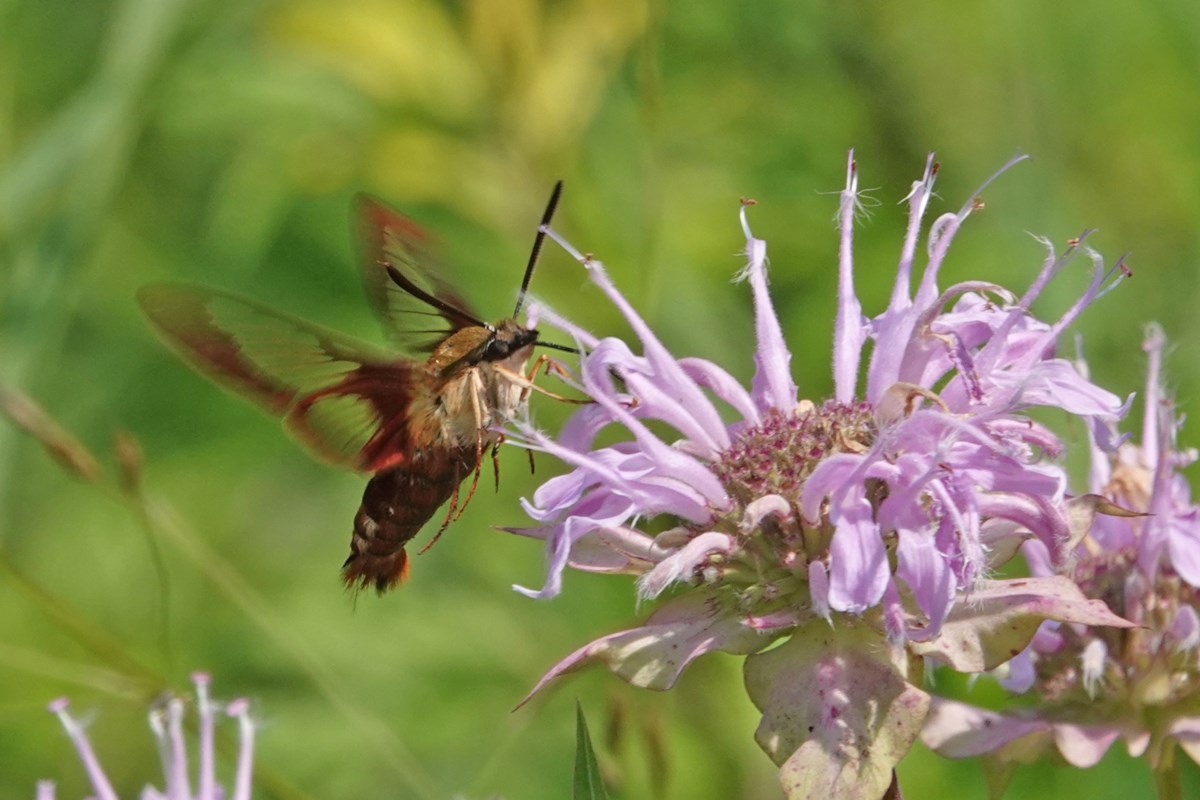
A brief visit from clear-wing moths shows how quickly summer changes, says columnist
Every week of every season has its highlights within the world of nature: the observation of animal tracks in the snow, spring wildflowers bursting forth, the return of migrating birds, summer wildflowers bursting into bloom, and autumn colours mark the passing of the year.
August is butterfly and dragonfly time. Yes, there are butterflies, moths, dragonflies and damselflies that can be found scattered throughout spring and early summer, but now is the time of peak populations. The warm air is filled with the fluttering of gossamer wings, whether over a wetland or within a meadow.
As I putter about our farm, making good use of the time to tend to the 10,000 trees we planted almost 20 years ago, the fluttering of insect wings is unavoidable. Monarchs fly up from milkweeds, white admirals swirl from puddles, fritillaries of two kinds drop in to visit Joe-pye-weed blossoms, and tiger swallowtails sail across the open areas.
While the sunlit hours are filled with butterflies, the moonlit part of the day is filled with moths: grey moths, brown moths, little grey and brown moths, slightly bigger brown and grey moths, tiny white moths, and sometimes rather big moths cloaked in shades of pewter with white accents.
If you are looking for a challenge, try identifying the myriad of moths that appear around the porch light!
The other evening, as I was parked in my home office, either creating a summary report of my observations that will someday re-shape the known world of natural history or, (more likely) was watching a re-run (yet again) of an old movie on Netflix — one or the other — Julie came bursting through the door and started pulling field guides from the shelf.
“I think I just saw one of those clear-wing moths!” she exclaimed. Hmm, that’s pretty interesting. I hit pause on my movie watching (I know what happens next because I saw this part before, at least a couple of times) and headed out of doors to confirm or deny her sighting.
All around the edge of the lawn are flower gardens, and just past these manicured gardens that seem to be filled with lilies of all sorts, can be found an assortment of wild flowers that occupy the remaining patches of what was once cow pasture. Bergamot, Queen Anne’s Lace, three species of goldenrod, a few aster stems, and a lot of milkweeds provide a great mix of viewing throughout the growing season.
As Julie searched the cluster of flowers that had been the site of her initial observation, I scanned the patch of adjacent wild blossoms. Just as she pouted, “Dang! It was right here but now it’s gone!” I exclaimed, “Whoa! What’s that?!”
Within the patch of bergamot blossoms were numerous flying insects, mainly bees (of which there appeared to be at least two species) but a couple individuals were big, tawny coloured, and hovering like a hummingbird. Not a bee. Something else.
Looking like a miniature hummingbird, these beautiful moths hovered in front of each tube-shaped flower part and extended a very long tongue into each to extract the sweet mint nectar.
This hovering separated them quickly from the bees that clamber full-body across the whole flower head. This unique flight pattern gave away the presence of four or five of these adult moths.
Our region is home to two species of clear-wing moths, the hummingbird clear-wing and the snowberry clear-wing. Both species have ‘windows’ in their wing patterns that are fully transparent. The snowberries tend to be found on the shrubby Canadian shield (look for them while picking blueberries) and the other prefers hardwood forest edges.
Over the next couple of evenings, I tried to get a good photo of these amazing moths. Clear-wings fly in the evening hours, after the butterflies have called it a day and before their night-flying cousins spread out across the landscape.
Like all moths, this adult form lasts only long enough to mate and lay eggs. By the third evening only one was noted, and the next day none. So cool to see this special part of the summer.
And now it’s back inside to process the photos and do some research on these unusual moths, but first, to see if Doc and Marty can solve their time-travelling predicament.
David J. Hawke is a freelance writer and naturalist who lives in rural North Simcoe County. He has been continuously creating weekly nature stories since 1989… and thinks that there are still many more topics to cover!