
Montreal police have confirmed the city’s 15th homicide of 2026: a 44-year-old woman who was found dead Saturday afternoon in an apartment in the Villeray—St-Michel—Parc-Extension borough with signs of violence on her body. They said a 51-year-old man found at the scene is considered a suspect in her death and confirmed that the two were in an intimate partner relationship.
Her death is the 12th suspected femicide so far this year in which a woman in Quebec has died at the hands of an intimate partner or a former partner, according to the Coalition féministe contre la violence envers les femmes. There were five in January alone.
The news on the femicide front, in other words, is grim.
In Quebec City, 61-year-old Martin Carrier faces charges of first-degree murder and indignity to a human body in connection with the death of his former partner, Sushmita Bhaskaran, 51. Her body was found half-buried in a wooded area in Lévis on June 22. Carrier’s case returns to court Aug. 31, when results of a psychiatric evaluation his lawyer requested are to be reviewed.
Police said 30-year-old Shannon Jean Hickey was allegedly killed by her partner, Tien Quan Vu, 34, on May 5 in an apparent murder-suicide in a Gatineau highrise. Court records showed that Vu had a documented history of violence, including a guilty plea for causing bodily harm to a woman and for sharing intimate images of a person without consent.
In Montreal on April 15, the bloodied body of 25-year-old Hiba Elrhazi was found inside a downtown apartment building: She had been shot at least once. Her partner, 27-year-old Alexandre Karim Amaury Restau, was arrested that day at Trudeau airport and charged with manslaughter the following day.
“She was trying to leave, the poor girl, but she was being controlled,” one neighbour told a reporter.
Editor’s Picks
Femicide is defined as the killing of women or girls because of their gender. The Coalition féministe includes in its tallies such deaths as the suspected murders of a sex worker and of a mother by her son, but women are more likely to be killed by a current or former intimate partner than by anyone else. Often they are murdered in their own home. In 2025, Statistics Canada reported a sharp increase in femicide by a former or current intimate partner: 81 in 2024, up from 53 in 2023.
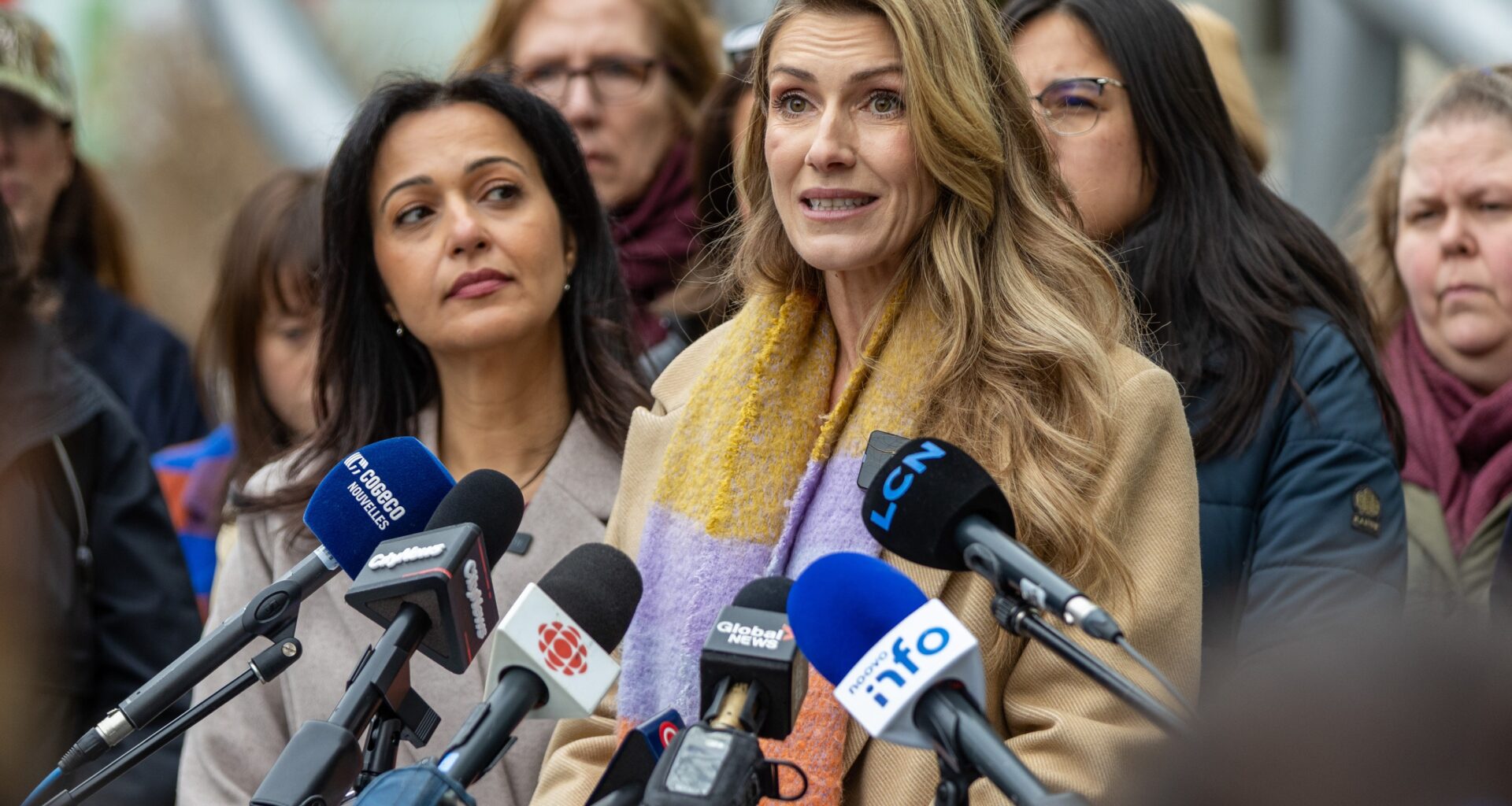
“How many deaths will it take before we act?” actor and activist Ingrid Falaise, a survivor of intimate partner violence, asked of Quebec Premier Christine Fréchette at a press conference in April. She and a coalition of others, led by Québec solidaire co-spokesperson Ruba Ghazal, called on the government to take concrete action to prevent future femicides.
Among their demands were for a violence disclosure law that would allow women who believe they are at risk of intimate partner violence to find out from police if their partner has a documented history of violent or abusive behaviour. Such a law was implemented in the United Kingdom in 2014 as Clare’s Law, named for a woman who was killed by an ex-boyfriend known by police to be dangerous; similar laws have since been adopted by several Canadian provinces.
Bill 4, called An Act Respecting the Communication of Information for the Purpose of Protecting Against Intimate Partner Violence, was tabled May 13 and passed into law unanimously by the National Assembly on June 11. It is unofficially named for Gabie Renaud, the victim of a suspected femicide found in her St-Jérôme apartment on Sept. 27, 2025; authorities believe the 43-year-old woman had been killed about three weeks earlier. Jonathan Blanchet, who had at least six convictions related to domestic violence and reportedly had violated probation conditions on 15 occasions, was arrested and charged with first-degree murder.
The new legislation represents one more tool in terms of prevention, but “cannot compensate for the glaring lack of shelter places and the absence of investment in specialized resources,” the shelter community said in its response to the tabling of the bill. “Today one woman in two is refused access to an emergency shelter because of a lack of space,” the Fédération des maisons d’hébergement pour femmes, the Regroupement des maisons pour femmes victimes de violence conjugale and the Alliance des maisons d’hébergement de deuxième étape said in a statement.
“The bill will lead to more requests for support and shelter by women who will learn that their safety could be at risk. We call upon the government to take action now with concrete and varied measures to ensure the safety of women — accompanied by sustainable funding.”
Experts say femicide is not usually an isolated incident but, rather, the extreme end of a continuum of intimate partner violence that can take many forms: emotional abuse, psychological abuse, economic abuse, physical abuse, sexual violence, and technology-facilitated violence such as using phone calls, texts and other means to track and monitor victims and to threaten, harass or coerce them.
This violence can occur at any time during a relationship or after it has ended. The danger to victims of intimate partner violence is often greatest when they leave or say they’re leaving: An abuser sensing that he is losing power will often act in dangerous ways to regain control, experts say.
Although anyone can be affected, women are much more likely than men to experience severe forms of violence in an intimate relationship. This includes unwanted sexual acts, confinement, suffocation, and violence or threats of violence against their pets used as a means of coercion, and the violence is most often perpetrated by men.
Forty per cent of Quebec women 18 and older have experienced some form of psychological, physical or sexual violence, according to results of the 2021-22 Quebec Survey on Intimate Partner Violence.
And despite an uptick in police operations related to intimate partner violence, a 2025 analysis by the Institut de la statistique du Québec found that roughly 74 per cent of women who experience intimate partner violence — and an even higher percentage of men — do not report it. Some believe it’s a private matter, or they fear shame or stigma. Others don’t trust the court system. And they don’t all understand what they are experiencing to be intimate partner violence.
The most common form of intimate partner violence is coercive control, a type of abuse involving a sustained pattern of controlling and abusive behaviour by a partner or spouse designed to dominate a partner by destroying her autonomy, limiting her freedom and introducing fear through manipulation, isolation and intimidation. The effects of this abuse can be profound and can result in anxiety, depression and low self-esteem.
“More than 90 per cent of our clients experience some form of coercive control and psychological abuse,” said Myriam Ariey-Jouglard, executive director of Auberge Shalom pour femmes in Montreal. “But the term is still not well known. Some survivors, when they come to us, doubt their own experience. Even friends and family mischaracterize coercive control as a couple conflict.
“Some women say, ‘I am not experiencing violence,’ but they really are.”
 “More than 90 per cent of our clients experience some form of coercive control and psychological abuse,” says Myriam Ariey-Jouglard, executive director of Auberge Shalom pour femmes. “But the term is still not well known.” Dave Sidaway / Montreal Gazette files
Bill C-16, known as the Protecting Victims Act, was tabled in the House of Commons in December 2025 and passed into law June 18, and came into force July 18. It classifies femicide as first-degree murder across Canada; creates a new offence of coercive control in intimate relationships; targets patterns of threats, isolation and manipulation; and makes it a crime to threaten to distribute intimate images without consent. Proponents say it will hold offenders accountable for psychological abuse and patterns of domination.
The Regroupement des maisons pour femmes victimes de violence conjugale, which has campaigned for several years for the criminalization of coercive control, said the bill’s passage marked “the start of a new era for women who are victims of intimate partner violence.”
“More of the assaults they experience will be criminalized — assaults with consequences as serious as physical violence or harassment,” said Regroupement president Annick Brazeau.
Even with an improved understanding of domestic violence by the judicial system and the courts, the risk is significant that a woman will have to repeat her story again and again, “effectively being re-victimized,” said Julie St-Pierre-Gaudreault, adviser on political issues with the Fédération des maisons d’hébergement pour femmes.
“This causes them to lose confidence in the system,” she said. “Many women decide not to report intimate partner violence.”
Some victims also contend with litigation abuse, in which their ex-partners use the court system as another tool to harass, intimidate or manipulate them. They file frivolous lawsuits or drag out legal proceedings to cause victims financial and emotional strain and make it harder for them to move on with their lives, said St-Pierre-Gaudreault. “Ex-partners using the system for post-separation abuse is real, and I feel like it is happening more and more.”
Still, significant strides are being made in broadening awareness of what constitutes intimate partner violence with a view to preventing it, and that is encouraging.
“I think there is a growing understanding that, to be in an abusive relationship, it doesn’t need to become physical,” said psychologist Mara Riff, co-founder and director of the Openspace Clinic in Westmount. “Violence can be social, it can be emotional, it can be psychological. It crosses all economic and socio-economic barriers and happens in all kinds of relationships.”
People sometimes come into therapy because they are unhappy and, “as part of the discovery, you recognize that violence is a factor,” she said. “I’m seeing it in younger and younger clients. Twenty years ago, a person talking about an unhealthy relationship was typically older: Now I have people in their 20s talking about it.”
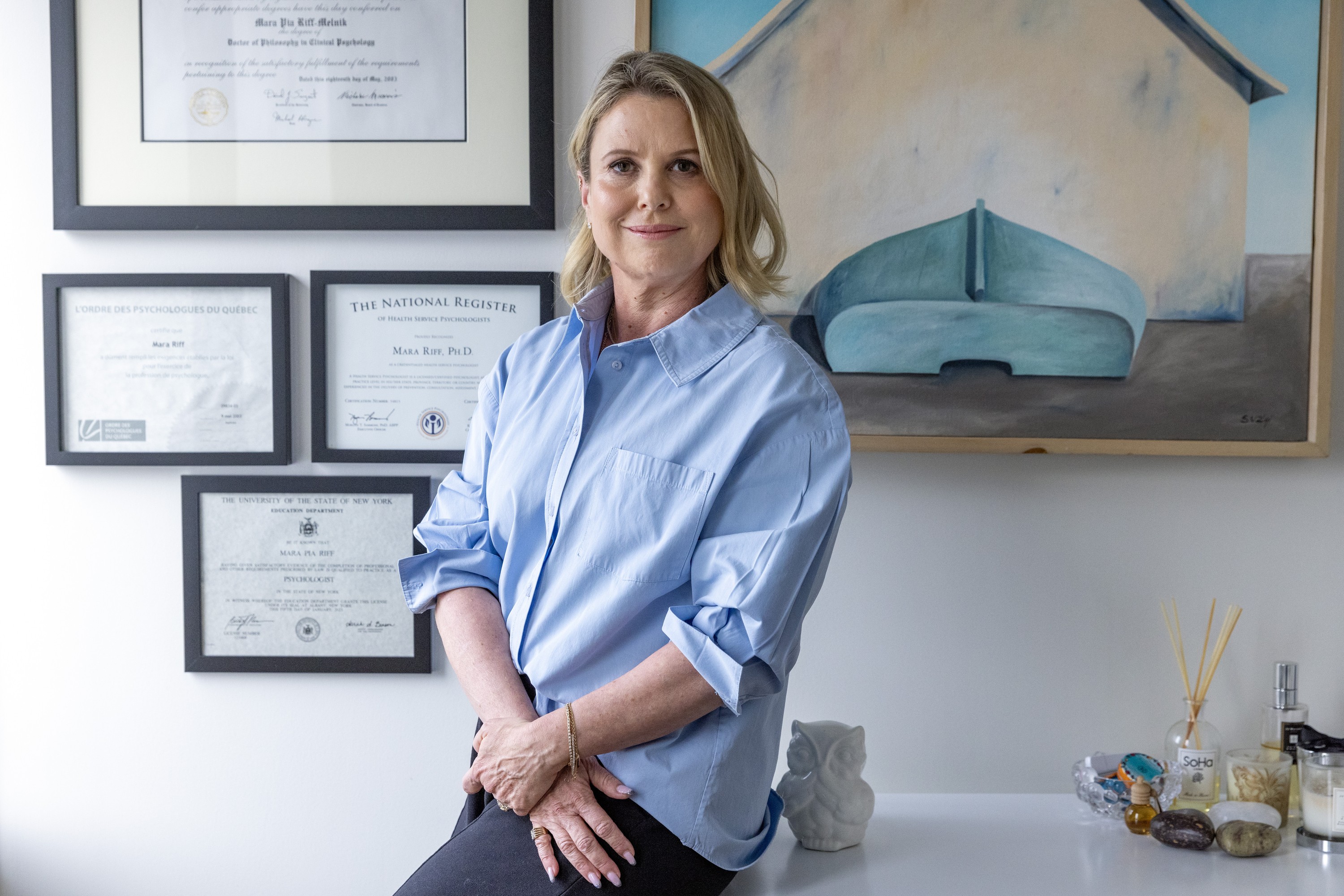 “I think there is a growing understanding that, to be in an abusive relationship, it doesn’t need to become physical,” says psychologist Mara Riff, co-founder and director of the Openspace Clinic in Westmount. John Mahoney / Montreal Gazette files
Outreach programs being introduced in schools and the community are raising awareness about what constitutes healthy and unhealthy relationships. During the 2025-26 academic year, for instance, Auberge Shalom pour femmes gave workshops on the subject to about 600 students.
And in a first for Quebec, a peer support group to empower mothers who have experienced intimate partner violence and to help their children, the Children’s Club and Empowerment for Mothers, was launched in 2025 by Logifem.
The mission of a new team at Santé Québec Centre-Sud-de-l’Île-de-Montréal — Universitaire, Équipe Violence conjugale et intrafamiliale, is to offer specialized psychosocial support to clients in its sector experiencing intimate partner violence or family violence.
And the profile of groups intended to help violent men has been raised. The Rebâtir la confiance report, tabled in the National Assembly in 2020 in a bid to improve the justice system’s handling of intimate partner violence and sexual assault cases, acknowledged that the root cause of the violence must be targeted if both types of violence are to be prevented. The strategy developed to implement the report’s 190 recommendations includes a focus on interventions for perpetrators.
The Montreal police department has had a specialized intimate partner violence unit since 2021. In 2024 and 2025, officers were trained in coercive control; as well, officers, investigators and prosecutors received training about strangulation in intimate partner violence. It’s not widely known that strangulation isn’t always fatal; half the time it leaves no visible injuries. But it is often a strong predictor of femicide and has been described as one of the most lethal forms of intimate partner violence.
Montreal police are also working more with partners in areas including health and social services, the judiciary and community organizations. “We recognize intimate partner violence as a pattern of coercive control, which goes beyond physical violence and includes components of psychological, sexual and economic aggression,” the department said in a statement.
“It’s a major societal challenge, which we take seriously.”
People facing intimate partner violence can contact SOS Violence Conjugale 24 hours a day at 1-800-363-9010.

We used typewriters when I started at The Gazette, and heavy black rotary phones. Today’s newsroom looks different but the work – reporting and informing my readers – remains constant and rewarding. I am grateful to my academic adviser at McGill, where I was a neurobiology major, for steering me to journalism. Evidently he realized I wasn’t cut out for neurobiology.
sschwartz@postmedia.com