
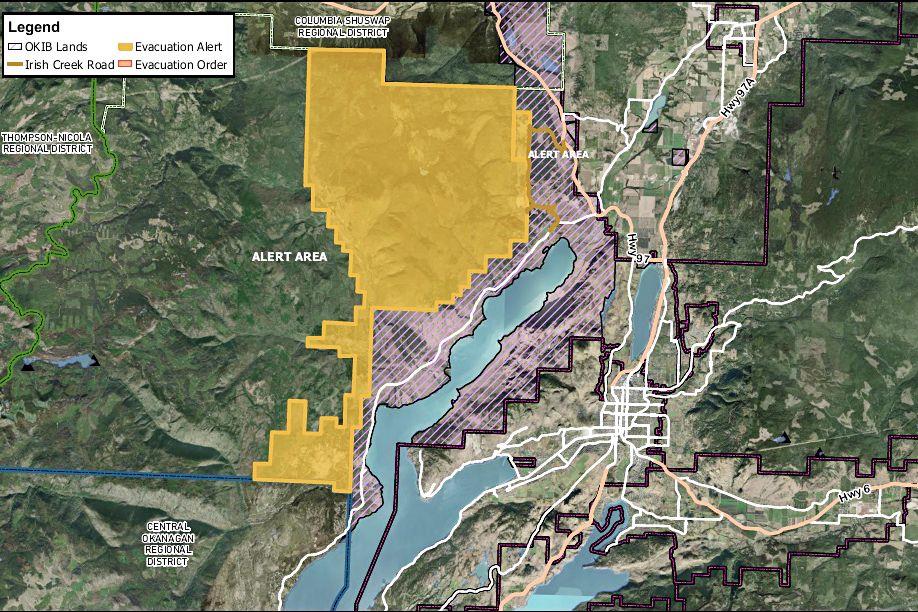
More evacuation orders downgraded to alerts for Bradley Creek wildfire
Published 7:22 pm Sunday, August 16, 2026
An evacuation order for several properties in Area “B” of the Regional District of North Okanagan (RDNO) has been downgraded to evacuation alert as of 6 p.m. Sunday (Aug. 16).
Residents who can now begin their return home include those at 570, 576, 590, 610, 614, 620, 640, 644, 664, 668, and 678 Irish Creek Road.
The following properties are still on evacuation alert:
17 and 65 Cain Road;
131, 252, 351, 425, 485, 631, and 635 Nashwito Road;
10, 15, 50, and 93 Banks Road;
79, 305, 311, 315, and 464 Beau Park Road;
278, 221, 236, and 267 Siwash Creek Road; and
442, 503, 545, 550, 560, 651, 655, 659, 661, 730, 735, 809, 878, 890, 901, 930, 1001, 1070, 1075, 1135, 1195, and 1470 Six Mile Creek Road.
Residents returning home from Six Mile Creek and Beau Park Road must travel around to West Kelowna and head north on Westside Road from West Kelowna.
As these properties are still on evacuation alert, residents must remain ready to leave at short notice if an evacuation order is reinstated.
In order to remain safe, returning residents should walk around their property and check for hazards, including downed power lines, the smell of gas, damaged trees, or hanging debris. When entering the house, do so cautiously and ensure that the main power breaker is turned off before inspecting for damage. Do not use the sewage disposal system until it is functioning properly and can safely handle waste.
Returning home after an evacuation can be overwhelming. The RDNO encourages residents to seek support for their mental and emotional well-being as they recover from this experience. The BC Mental Health Support Line is available 24 hours a day at 310-6789 (no area code required).
The RDNO is also asking residents to look out for one another as the community begins the recovery process. While some households may be celebrating a return home, others in the area may be facing significant loss or damage. People are asked to be respectful of private property, avoid entering or photographing damaged properties that are not their own, and give affected families the privacy, space, and compassion they need during this difficult time.
The Province of British Columbia offers resources for residents returning home after an evacuation, and returnees are encouraged to review the Recover After a Wildfire webpage.
Discard any refrigerated food that has spoiled or was stored in a refrigerator that lost power. Frozen food that has thawed should also be discarded. If a fridge or freezer was exposed to fire or was without power for more than three days, dispose of all contents.
Residents with refrigerators or freezers that remain undamaged and in good working condition may not need to replace them. However, appliances that have been damaged and are no longer safe to operate can be dropped off free of charge at the Greater Vernon Landfill, where a certified contractor will safely remove the refrigerants.
Before bringing appliances to an RDNO facility, residents must remove and separately dispose of all food, food waste, and residues, as facilities cannot accept appliances containing food or waste. The RDNO recognizes that recovery after a wildfire can be challenging and appreciates residents taking a few minutes to prepare appliances for recycling.
Canned goods are generally safe to keep unless the cans are bulging, rusted, or severely dented. Any cans exposed to smoke should be thoroughly washed and disinfected before use. Food stored in glass jars that has been exposed to heat should be thrown away. When in doubt about the safety of any food item, it is best to discard it.
Residents are also reminded that wildfire debris that is smouldering, could reignite, or has been on fire within the past seven days will not be accepted at the landfill. More information on appliance disposal, facility hours, accepted materials, and fees is available atwww.rdno.ca/wastefacilities.
Further information will be issued as updates are received from the BC Wildfire Service. RDNO residents are encouraged to visit www.rdno.ca/activeemergencies, and the RDNO Facebook page for more information.