
Human brain evolution may owe as much to the consumption of fruit and honey as to meat, according to a new Analytical Review.
Most people cut sugar first when they decide to improve their diet. The human brain, however, cannot do the same, because it runs on a sugar called glucose. Fruit and honey may be the reason it grew so big.
The brain is about 2 percent of an adult’s weight. It uses about a fifth of the body’s energy at rest. In a 5-year-old, that share is two-thirds.
Jennie Brand-Miller, an emeritus professor of human nutrition at the University of Sydney, worked out how much glucose our ancestors needed and where it came from.
One of her three colleagues is a prehistoric archaeologist at the University of Glasgow. In an interview with Earth.com, she was asked about the old idea that meat built the human brain.
“The meat story is still there and will always be there,” she said, “because it played an important role in giving us energy-dense sources of protein, fat and calories.”
Humans burn energy faster than other primates, she said, mostly because of the brain.
Glucose keeps a big brain running
After a few days without carbohydrate, the body starts making fuel out of fat. Those ketones cover up to half of what the brain needs. The other half still has to be glucose.
Red blood cells and part of the kidney cannot use fat at all. Add it up and an adult needs about a third of a pound (160 grams) of glucose a day.
The body can make some glucose from protein, but never enough. Even at its best, it produces 1 to 2 ounces (30 to 50 grams) a day less than the body needs.
Men who went a week without food lost three times as much lean tissue as fat. Their bodies were taking muscle apart to make glucose.
Pregnant women need even more
A fetus and a placenta together use about 2.5 ounces (70 grams) of glucose a day. At peak breastfeeding, a mother makes about that much again as lactose, the sugar in breast milk. Lactose alone covers 40 percent of a baby’s energy.
A pregnant or nursing woman needs close to half a pound (230 grams) of glucose a day. Every child too young to find food adds another 2 ounces (60 grams), and that assumes other adults feed the child the rest.
As pregnancy goes on, a woman’s muscles take up less glucose and more of it reaches the placenta. Her pancreas has to make extra insulin, the hormone that handles sugar. When it cannot make enough, she develops gestational diabetes, the most common hormonal disorder in the world.
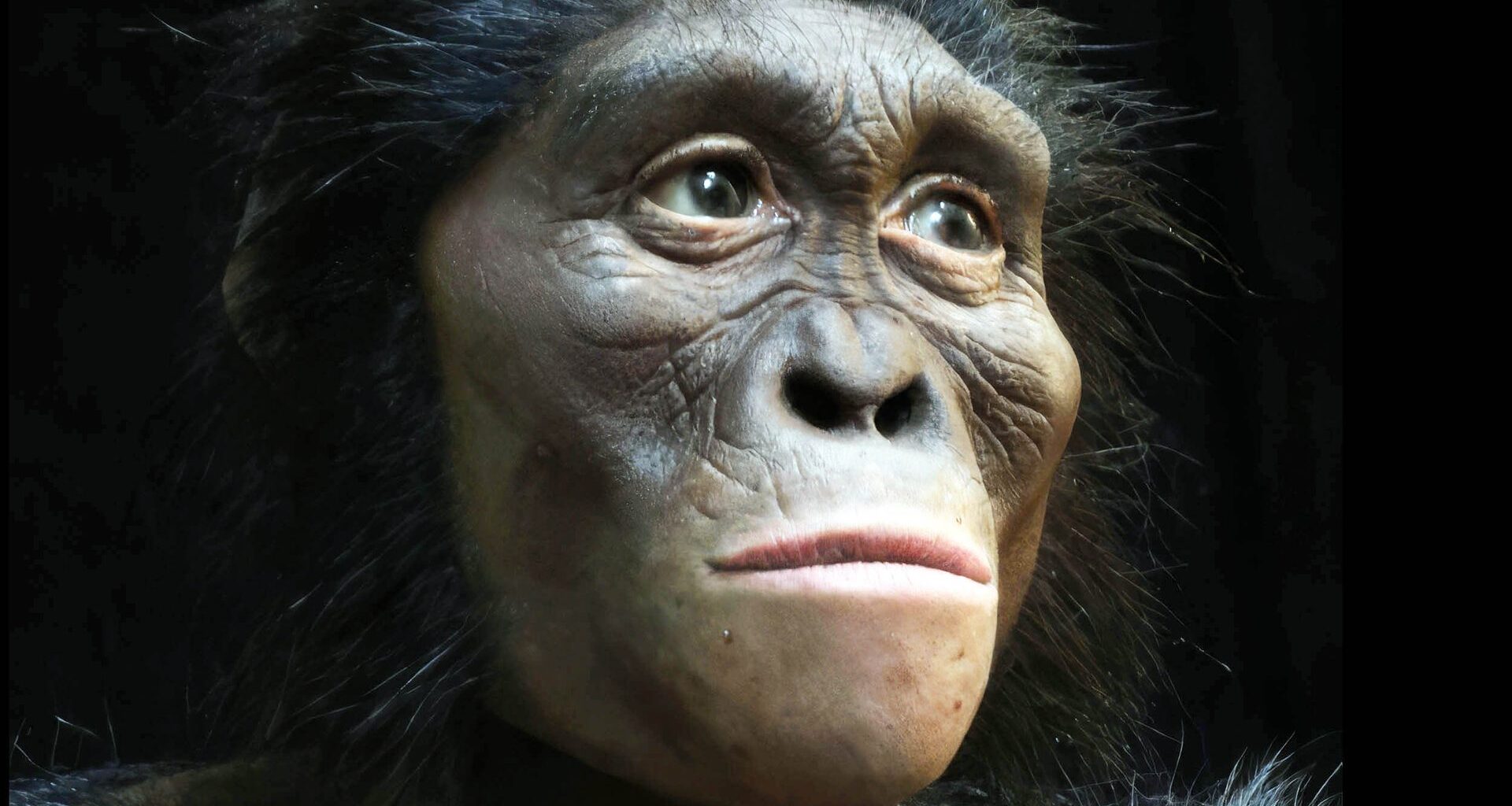
Females of Lucy’s species stood about 3 feet 3 inches (1 meter) tall and weighed around 66 pounds (30 kilograms). A pregnant one needed more carbohydrate than any male in her group.
Honey, fruit, then cooked starch
Her model runs in six steps, from chimpanzee to modern human. Most of a wild chimp’s energy comes from carbohydrate: the model estimates about 13 ounces (380 grams) of sugars a day, mostly ripe fruit.
A wild African fruit is about 17 percent sugar when fresh, 66 percent when dried. Honey runs 85 to 90 percent sugar, and both chimps and tropical foragers use tools to get it.
Fossil primate teeth 30 million and 12 million years old have cavities but almost no chipping, which is what soft, sweet food does to teeth. Across more than 140 primate species, fruit eaters have brains about 25 percent bigger than leaf eaters of the same weight.
Cooking is what made starch worth eating. The body barely digests the raw starch in seeds and tubers. The oldest controlled fire anyone has found is 1.5 million years old, at Koobi Fora in Kenya.
By the sixth step, a human with a 3-pound (1,500 gram) brain got about a quarter of their calories from sugars. Another quarter came from starch, and 19 percent from protein.
Empty calories, not the sugar itself
Brand-Miller is not making an argument for soda. She told Earth.com that none of this changes the standard advice on refined sugar: 10 percent of calories or less.
“What’s wrong with refined sugar and soft drinks is not the sugars but the empty calories.”
Eat more fruit if you enjoy it, she said, and drizzle honey on yogurt, oatmeal and salad dressings. Honey has plant compounds in it as well as sugar.
She said, “Honey is not a refined sugar, it comes straight from nature and is rich in phytonutrients, rather than vitamins and minerals.”
Trials have found no harm in eating a lot of fruit, and people who eat the most whole fruit have lower rates of diabetes and death. Sugary drinks are the one clear exception.
Brand-Miller has built a career on the glycemic index, which ranks foods by how fast they raise blood sugar. She takes royalties from books about it, runs a glycemic index testing center at her university, and advises Zoe Global, a nutrition company.
Low-carb diets, and who benefits
Earth.com asked her where other researchers will push back hardest.
“Some would still say low or very low carb diets are best for health and longevity,” she said. That is likely true, she said, for people with type 2 diabetes and for brain conditions such as epilepsy.
Her team ran no experiment and dug up no bones. They built the model out of numbers other scientists had published, some from the chemistry of old teeth and bones, some from what chimps and modern hunter-gatherers eat.
“Any discussion of diet in human evolution is necessarily speculative,” the four authors wrote.
Nobody knows which fruits grew where Lucy lived. The model assumes they were like the wild African fruits there now.
Brand-Miller focused on one more important factor in the mix, and it was fiber. Early humans ate more of it in a day than people are told to eat now.
“75 g or so, not the 30 g that are recommended,” she said.
No one has yet measured how much carbohydrate a woman needs to carry and feed a baby. Brand-Miller’s team published every equation in the model. Anyone who disputes the result can test it with new numbers.
The full study was published in the journal Science.
—–
Like what you read? Subscribe to our newsletter for engaging articles, exclusive content, and the latest updates.
Check us out on EarthSnap, a free app brought to you by Eric Ralls and Earth.com.
—–