
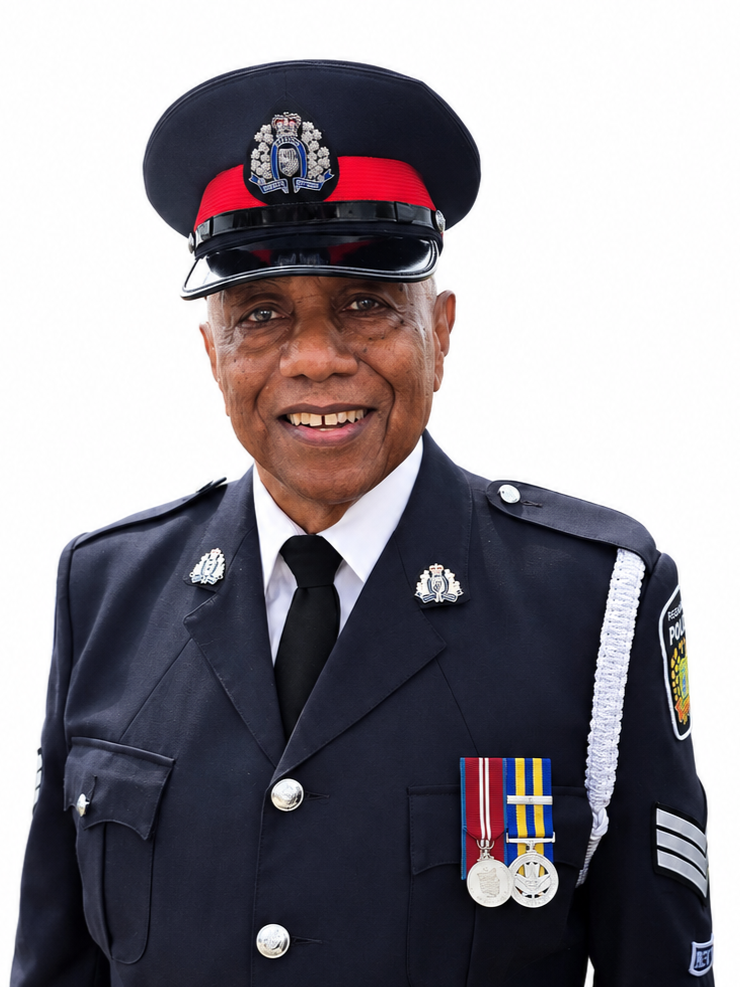
Retired Deputy Chief Ingrid Berkeley-Brown remembers Blackett as a trailblazer who created opportunities for Black candidates at a time when other police services were reluctant to hire them. During her recruitment, he visited her home, met her mother and conducted part of the interview there.
“At a time when other police agencies weren’t necessarily selecting us, Lonny was that guy who hired us,” she said.
Berkeley-Brown also recalls a hands-on sergeant who remained connected to frontline work and the community. While some supervisors preferred to stay behind, she said he regularly went on patrol and related easily to people.
“Lonny made friends everywhere he went because he is very personable,” she added. “He was never afraid to engage with people. He didn’t talk down to them. He spoke with them.”
Acting Inspector Paul Quashie met Blackett after joining the Service in 2003.
“Lonny paved the way for me and many other officers, particularly officers of colour,” he said. “His impact spans generations, and he epitomizes what a police officer should be.”
Blackett’s assignments included working as a hostage negotiator, lecturing at the Ontario Police College and serving at Pearson International Airport. His contributions were recognized with the Police Exemplary Service Medal and the Queen Elizabeth II Diamond Jubilee Medal.
One of the most dramatic tests of his career came on August 2, 2005, when Air France Flight 358 crashed while landing at Pearson during a violent thunderstorm.
Blackett was a patrol sergeant at the airport when the call came over the radio. He headed towards the crash site with officers behind him through rain and wind that struck sideways beneath a sky that had turned dark green.
The aircraft had left the runway and plunged into a ravine near Etobicoke Creek. Concerned that passengers might have been swept into the rising water, he requested marine units to search. Then, with the rear of the aircraft burning, he and another sergeant approached the plane.
Blackett wanted to enter.
“Don’t forget, we took an oath, man, to save lives,” he told him.
Despite having undergone knee surgery only days earlier, he climbed inside with assistance. The two sergeants moved along separate aisles with flashlights, calling for anyone who might be injured, unconscious or unable to escape. When thick black smoke began filling the cabin, they retreated.
Outside, Blackett noticed liquid pouring from a hole in one of the wings. At first, he thought it was rainwater, but then realized it was jet fuel and ordered officers surrounding the aircraft to move back. Minutes later, explosions began as the post-crash fire intensified.
All 309 people aboard survived.
Months later, Air France representatives returned to Toronto to thank emergency personnel, including the officers who entered the burning aircraft.
Blackett’s philosophy was characteristically direct.
“I did what I had to do,” he said. “I didn’t do it looking for anything.”
At the street-sign unveiling, Andrews said Blackett’s decision to put on the uniform more than 50 years ago represented far more than a historic first.
“It’s about courage, it’s about determination and it’s about stepping up and leading by example at a time when doing so required tremendous resilience and strength,” he said.
Andrews thanked Blackett for opening a door that had previously been closed in Peel and ensuring it remained open for those who followed.
“His achievement was not just a milestone of policing in Peel, but one for the Black community, minorities and people of colour,” he pointed out. “It sent a powerful message that talent, character and commitment should be measured by merit and not by the colour of one’s skin. But more than anything, we moved our Service closer to reflecting the diverse communities we are proud to serve today. Generations of officers have benefited from the path Lonny carved. Many may not fully appreciate the obstacles he faced or the barriers he overcame, but they continue to benefit from the example he set and the legacy he built.”
The legacy also continues within Blackett’s family.
His younger daughter, Melissa, has worked for Peel Regional Police for 27 years and is a records trainer for uniform and civilian members.
She said serving the community was always her father’s priority and that he instilled those same values in her and her older sister, Stefanie.
“This means the world to Dad,” Melissa said of the street naming. “For as long as I can remember, his priority has been serving the community. He has loved policing from the day he joined, and he instilled those same values in my sister and me. His example inspired me to join Peel Regional Police and serve the community as well.”